

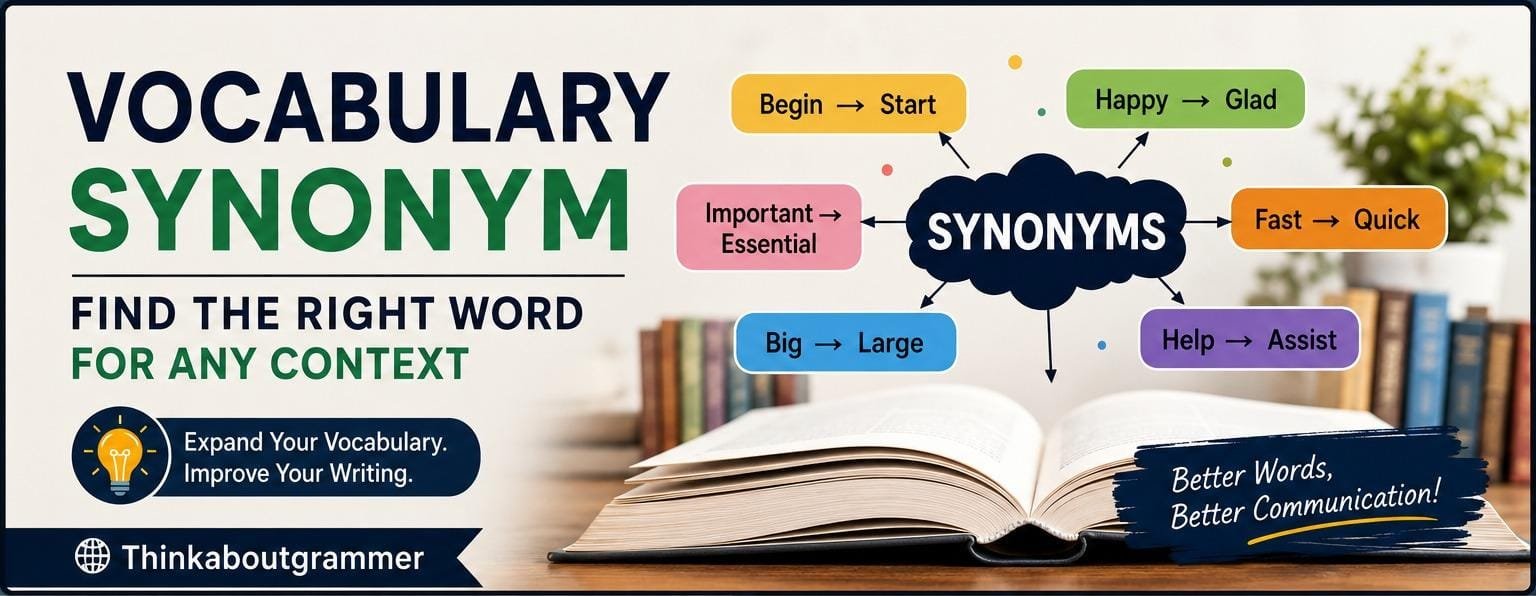
Finding the right vocabulary synonym can make your writing clearer, more precise, and more interesting. Whether you are a student writing an essay, a professional preparing an email, or someone trying to improve everyday English, knowing synonyms helps you express the same basic idea in different ways.
- What Is a Vocabulary Synonym?
- Why Are Synonyms Important in English Vocabulary?
- 1. Synonyms Reduce Repetition
- 2. Synonyms Improve Word Choice
- 3. Synonyms Make Writing More Precise
- 4. Synonyms Help You Adapt Your Tone
- Vocabulary Synonym vs. Antonym
- Common Types of Synonyms
- How to Choose the Right Vocabulary Synonym
- Step 1: Identify the Exact Meaning
- Step 2: Consider the Context
- Step 3: Check the Part of Speech
- Step 4: Think About Formality
- Step 5: Check the Strength of the Word
- Common Vocabulary Synonyms You Should Know
- Incorrect vs. Correct Synonym Usage
- How to Use a Thesaurus Effectively
- Vocabulary Synonyms for Academic Writing
- Vocabulary Synonyms for Professional Writing
- Vocabulary Synonyms for Creative Writing
- Common Mistakes When Using Synonyms
- Mistake 1: Assuming Every Synonym Is Interchangeable
- Mistake 2: Choosing Complicated Words
- Mistake 3: Ignoring Collocations
- Mistake 4: Changing the Meaning Accidentally
- How to Build a Stronger Vocabulary
- A Quick Synonym Selection Checklist
- Conclusion
But there is an important catch: synonyms are not always interchangeable. Two words may have similar dictionary meanings but differ in tone, strength, formality, or context. For example, happy, pleased, delighted, and thrilled all describe positive emotions, but they do not communicate exactly the same level of feeling.
This guide explains what a vocabulary synonym is, how synonyms work, when to use them, and how to choose the most accurate alternative without making your writing sound unnatural.
What Is a Vocabulary Synonym?
A vocabulary synonym is a word that has the same or a very similar meaning as another word.
For example:
| Original word | Possible synonyms |
|---|---|
| Happy | Glad, pleased, joyful, delighted |
| Big | Large, huge, enormous, massive |
| Begin | Start, commence, initiate |
| Fast | Quick, rapid, speedy |
| Important | Significant, essential, valuable |
| Help | Assist, support, aid |
| Difficult | Hard, challenging, demanding |
| Smart | Clever, intelligent, bright |
Synonyms give writers more choices. Instead of repeating one word several times, you can select another suitable word that communicates the idea more naturally.
However, the best synonym is not necessarily the one that looks most similar in a thesaurus. Meaning, context, tone, and grammar all matter.
Why Are Synonyms Important in English Vocabulary?
A strong vocabulary allows you to communicate ideas with greater accuracy. Synonyms are an important part of vocabulary development because they give you alternatives when one word does not quite express what you mean.
1. Synonyms Reduce Repetition
Repeatedly using the same word can make writing monotonous.
Repetitive:
The movie was interesting. The interesting characters made the story interesting.
Improved:
The movie was fascinating. Its memorable characters made the story even more engaging.
The second version provides more variety while also making the description more precise.
2. Synonyms Improve Word Choice
Sometimes a general word is not specific enough.
Consider the word good. It can describe almost anything positive, but it does not always tell the reader much.
Instead of:
She gave a good presentation.
You might write:
She gave an impressive presentation.
Or:
She gave a well-organized presentation.
Or:
She gave an informative presentation.
Each alternative communicates a slightly different idea.
3. Synonyms Make Writing More Precise
Choosing the correct synonym can change the strength of a statement.
For example:
- look → glance → stare
- walk → stroll → march
- angry → annoyed → furious
- small → tiny → minuscule
These words are related, but they do not have identical meanings.
4. Synonyms Help You Adapt Your Tone
Different situations require different vocabulary.
For example:
Casual:
Can you help me with this?
More formal:
Could you assist me with this?
Both sentences are understandable, but assist sounds more formal than help.
Vocabulary Synonym vs. Antonym
It is useful to understand the difference between a synonym and an antonym.
A synonym has the same or a closely related meaning.
Easy → Simple
An antonym expresses an opposite meaning.
Easy → Difficult
Here are more examples:
| Word | Synonym | Antonym |
| Early | Prompt | Late |
| Strong | Powerful | Weak |
| Easy | Simple | Difficult |
| Quiet | Silent | Noisy |
| Honest | Truthful | Dishonest |
| Modern | Contemporary | Ancient |
Knowing both synonyms and antonyms can help you build a broader English vocabulary.
Common Types of Synonyms
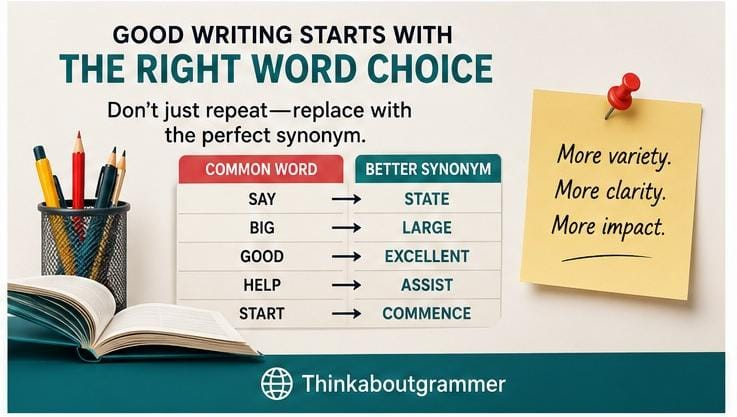
Not all synonyms are exactly alike. Understanding their differences can help you choose words more effectively.
Exact Synonyms
Exact synonyms have nearly identical meanings and can sometimes be substituted without changing the sentence significantly.
For example:
Purchase → Buy
Both can describe obtaining something in exchange for money.
However, even these words may differ in formality. Purchase is generally more formal than buy.
Near Synonyms
Near synonyms have similar meanings but are not completely interchangeable.
For example:
House → Home
A house usually refers to a physical building, while home can refer to the place where someone lives and feels a sense of belonging.
Compare:
They bought a new house.
with:
I finally feel at home here.
Replacing house with home in every situation would not work.
Contextual Synonyms
Some words become synonymous only in particular contexts.
For example, bright can mean intelligent when describing a person:
She is a bright student.
But bright can also refer to light:
The room is bright.
A synonym for the first meaning could be intelligent, while well-lit might work for the second.
This is why context is essential when selecting a vocabulary synonym.
How to Choose the Right Vocabulary Synonym
Finding a synonym is easy. Finding the right synonym requires more thought.
Use these steps when replacing a word.
Step 1: Identify the Exact Meaning
First, ask what you actually want to communicate.
Suppose you want an alternative to walk. Possible choices include:
- stroll
- wander
- march
- hurry
- roam
- pace
They all relate to movement on foot, but each expresses something different.
We walked through the park.
Could become:
We strolled through the park.
if the movement was relaxed.
But:
We marched through the park.
suggests a very different type of movement.
Step 2: Consider the Context
Think about the sentence, paragraph, and subject.
For example:
The scientist conducted a study.
Conducted works well in academic writing.
You would not normally replace it with:
The scientist did a study.
The second sentence is understandable, but conducted is more natural in this formal context.
Step 3: Check the Part of Speech
A synonym must fit the grammatical role of the original word.
Understanding parts of speech is especially important for students preparing for SAT grammar rules, where choosing the correct word form can affect sentence accuracy.
For example:
She made a quick decision.
Here, quick is an adjective.
You cannot simply replace it with quickly, because quickly is an adverb.
Correct:
She made a rapid decision.
Incorrect:
She made a rapidly decision.
The meaning may be related, but the grammar does not work.
Step 4: Think About Formality
Some synonyms are informal, while others are formal.
| Common word | More formal alternative |
| Buy | Purchase |
| Help | Assist |
| Start | Commence |
| Get | Obtain |
| Ask | Inquire |
| End | Conclude |
| Show | Demonstrate |
| Tell | Inform |
For a friendly conversation, simpler words are often better. For academic or professional writing, a more formal alternative may be appropriate.
Step 5: Check the Strength of the Word
Synonyms can have different levels of intensity.
Consider:
annoyed → angry → furious
These words are related, but furious expresses a much stronger emotion than annoyed.
Changing:
He was annoyed by the delay.
to:
He was furious about the delay.
may accidentally exaggerate the original meaning.
Common Vocabulary Synonyms You Should Know
Learning groups of related words can expand your vocabulary naturally.
Synonyms for “Important”
Depending on the context, you could use:
- significant
- essential
- crucial
- vital
- major
- meaningful
- influential
Examples:
Education plays an important role in society.
Possible alternatives include:
Education plays a significant role in society.
or:
Education plays a crucial role in society.
Crucial suggests greater importance than the more general important.
Synonyms for “Good”
Possible alternatives include:
- excellent
- effective
- positive
- impressive
- beneficial
- useful
- admirable
- successful
Choose according to meaning.
She is a good teacher.
could mean:
She is an effective teacher.
But if you mean she achieved excellent results, successful may be more appropriate.
Synonyms for “Bad”
Depending on the intended meaning:
- poor
- harmful
- negative
- unpleasant
- inadequate
- terrible
- damaging
- ineffective
For example:
The policy had a bad effect.
could become:
The policy had a negative effect.
If the effect caused actual harm, harmful or damaging might be more precise.
Synonyms for “Big”
Common alternatives include:
- large
- huge
- enormous
- massive
- substantial
- considerable
- vast
Again, context matters.
The company made a big investment.
A more professional alternative might be:
The company made a substantial investment.
Synonyms for “Small”
Depending on context:
- little
- tiny
- minor
- limited
- compact
- narrow
- slight
For example:
There was a small problem.
could become:
There was a minor problem.
But tiny problem emphasizes size or degree differently and may sound less appropriate in a formal context.
Incorrect vs. Correct Synonym Usage
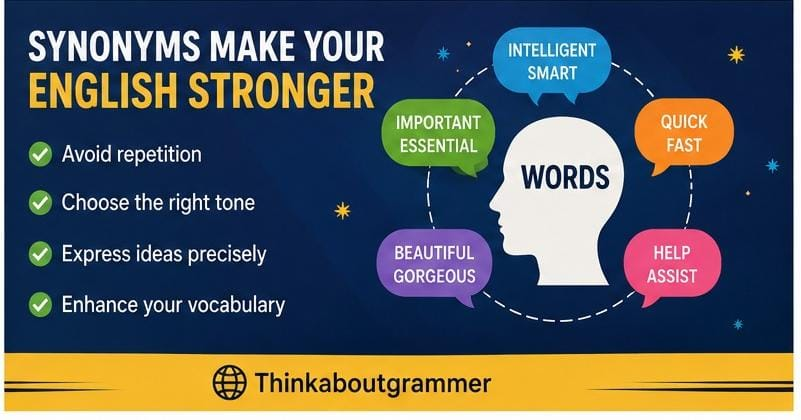
Choosing a synonym simply because a dictionary lists it can sometimes create awkward sentences.
Example 1
Incorrect or unnatural:
I purchased a sandwich from my friend.
If you mean you bought it from your friend, purchased is grammatically possible, but it may sound unnecessarily formal in this everyday context.
More natural:
I bought a sandwich from my friend.
Example 2
Awkward:
The child commenced crying.
Better:
The child started crying.
Commenced is formal and does not fit the natural tone of this sentence.
Example 3
Poor word choice:
The teacher was furious with the student’s excellent work.
If the student’s work was excellent, furious changes the intended meaning dramatically.
Better:
The teacher was impressed by the student’s excellent work.
The lesson is simple: a synonym should preserve the intended meaning, not merely resemble the original word.
How to Use a Thesaurus Effectively
A thesaurus can be extremely useful, but it should not be treated as a replacement for understanding vocabulary.
When you look up a word, you may find dozens of alternatives. Instead of choosing the most unusual one, ask:
- Does it have the same meaning in this sentence?
- Is it the same part of speech?
- Does it have the right level of intensity?
- Does it fit the tone?
- Is it commonly used in this context?
- Does the sentence still sound natural?
For example, if you need a synonym for beautiful, you might find:
- attractive
- lovely
- gorgeous
- stunning
- appealing
- elegant
- exquisite
These words overlap in meaning but create different impressions.
A formal description might use elegant. A casual conversation might use lovely. A stronger description might use stunning.
Vocabulary Synonyms for Academic Writing
Academic writing benefits from precise and appropriate vocabulary.
Here are some useful alternatives:
| Basic word | Academic alternatives |
| Show | Demonstrate, indicate, illustrate |
| Say | State, explain, argue |
| Think | Consider, believe, suggest |
| Help | Assist, facilitate, support |
| Use | Employ, utilize |
| Find | Discover, identify, determine |
| About | Approximately, regarding, concerning |
| Need | Require |
| Get | Obtain, receive, acquire |
| Start | Begin, initiate |
However, formal writing does not mean replacing every simple word with a complicated one.
For example, use is perfectly acceptable in academic writing. Replacing every occurrence with utilize can make your writing unnecessarily complicated.
Clarity should always come before complexity.
Vocabulary Synonyms for Professional Writing
Professional communication needs to be clear, respectful, and appropriate. Following professional email grammar rules can also help you choose vocabulary that matches a formal workplace setting.
Instead of:
We need to fix this problem quickly.
You could write:
We need to resolve this issue promptly.
Instead of:
Can you give me the information?
You could write:
Could you provide the information?
Instead of:
We need to look at the report.
You could write:
We need to review the report.
These alternatives can make workplace communication more polished without making it difficult to understand.
Vocabulary Synonyms for Creative Writing
Creative writing gives you more freedom to select vivid and descriptive words.
Instead of:
The wind was strong.
You might write:
The wind was fierce.
Or:
A powerful wind swept across the valley.
Instead of:
She walked into the room.
You could write:
She hurried into the room.
Or:
She quietly slipped into the room.
The best choice depends on what you want the reader to visualize.
Common Mistakes When Using Synonyms
Mistake 1: Assuming Every Synonym Is Interchangeable
A thesaurus may list words together because they are related, but that does not mean they can replace one another in every sentence.
Always check the specific meaning.
Mistake 2: Choosing Complicated Words
Using a rare word does not automatically make writing better.
Instead of:
We utilized an innovative methodology.
you might simply say:
We used a new method.
If the simpler version communicates the idea more clearly, it is often the better choice.
Mistake 3: Ignoring Collocations
Some words naturally appear together in English.
We say:
make a decision
rather than:
do a decision
Similarly:
strong argument
is natural, while powerful argument may work in some contexts but has a slightly different feel.
Learning synonyms alongside common word combinations helps you sound more natural.
Mistake 4: Changing the Meaning Accidentally
If you replace concerned with worried, the emotional meaning may become stronger.
If you replace large with enormous, you increase the implied size.
Always consider whether the new word preserves the original message.
How to Build a Stronger Vocabulary
You do not need to memorize hundreds of isolated synonym lists.
Instead, learn words in groups and contexts to improve your vocabulary.Professional communication needs to be clear, respectful, and appropriate.
Keep a Vocabulary Notebook
Create sections such as:
- Everyday vocabulary
- Academic vocabulary
- Professional vocabulary
- Descriptive vocabulary
- Useful verbs
- Common adjectives
For each new word, record its meaning, part of speech, one synonym, and an example sentence.
Learn Words in Context
Instead of memorizing:
Essential = necessary
learn:
Regular exercise is essential for maintaining good health.
The sentence shows how the word functions naturally.
Practice Rewriting Sentences
Take a simple sentence and rewrite it using a suitable synonym.
Original:
The test was difficult.
Possible rewrite:
The test was challenging.
Original:
The results were important.
Possible rewrite:
The results were significant.
This practice develops both vocabulary and writing flexibility.
A Quick Synonym Selection Checklist
Before replacing a word, ask yourself:
- Meaning: Does the new word express the same idea?
- Context: Does it fit the situation?
- Grammar: Is it the correct part of speech?
- Tone: Is it appropriately formal or informal?
- Intensity: Does it express the same strength?
- Naturalness: Would a fluent English speaker normally use it here?
- Clarity: Does it make the sentence easier to understand?
If the answer to all seven questions is yes, you have probably found a strong vocabulary synonym.
Frequently Asked Questions About Vocabulary Synonyms
What is a vocabulary synonym?
A vocabulary synonym is a word that has the same or a closely related meaning as another word. Examples include begin and start, or large and big.
Are synonyms exactly the same in meaning?
Not always. Many synonyms are only similar. They may differ in formality, intensity, emotional meaning, or context. That is why two words listed as synonyms cannot necessarily be exchanged in every sentence.
Why should I use synonyms in writing?
Synonyms can reduce unnecessary repetition, improve word choice, add variety, and help you communicate ideas more precisely.
How can I find the best synonym for a word?
Start with the sentence’s intended meaning and context. Then consider the word’s part of speech, tone, intensity, and common usage. A dictionary or thesaurus can provide options, but you should evaluate each option before using it.
Can synonyms improve academic writing?
Yes. Appropriate synonyms can make academic writing more precise and varied. However, academic writing should prioritize clarity rather than unnecessarily complicated vocabulary.
What is the difference between a synonym and an antonym?
A synonym has a similar meaning to another word, while an antonym has an opposite meaning. For example, rapid is a synonym of fast, while slow is its antonym.
Is using difficult vocabulary always better?
No. Effective writing is not about using the most complicated words possible. A simple word is often better when it communicates the idea clearly and naturally.
How can I learn synonyms faster?
Learn synonyms in context rather than memorizing isolated lists. Read regularly, record useful word groups, study example sentences, and practice rewriting sentences with appropriate alternatives.
Conclusion
A vocabulary synonym is more than a replacement word. The right synonym can change the tone, precision, strength, and clarity of a sentence.
The key is to avoid choosing words simply because they appear together in a thesaurus. Consider the meaning, context, grammar, formality, and intensity before making a substitution.
Whether you are improving everyday English, writing an academic essay, preparing professional communication, or developing creative writing skills, building a flexible vocabulary gives you more control over your language.
The practical takeaway is simple: learn synonyms in context, compare their subtle differences, and always choose the word that communicates your exact meaning most naturally.