

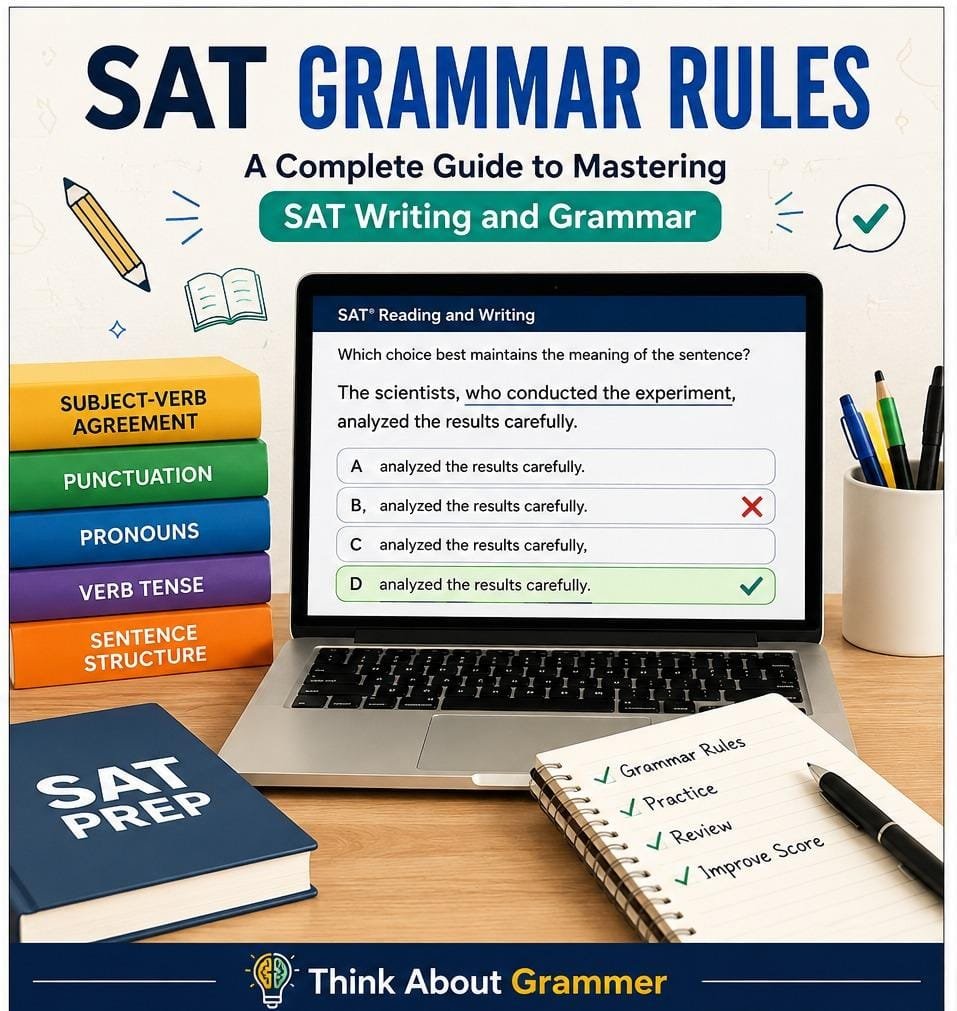
If SAT grammar questions feel confusing, you’re not alone. Many students know the basic rules of English but still lose points because SAT questions test those rules in specific sentence contexts.
- What Grammar Is Tested on the SAT?
- SAT Grammar Rules You Need to Know
- 1. Master Subject-Verb Agreement
- 2. Identify the Real Subject
- 3. Know the Difference Between Singular and Plural Nouns
- 4. Keep Verb Tenses Consistent
- 5. Understand Pronoun Agreement
- 6. Make Sure Pronouns Have Clear Referents
- 7. Learn the Rules for Commas
- 8. Know When to Use a Comma With Two Independent Clauses
- 9. Understand Semicolons
- 10. Understand Colons
- 11. Know How Dashes Work
- 12. Understand Essential and Nonessential Information
- 13. Watch for Modifier Problems
- 14. Use Parallel Structure
- 15. Watch for Comparisons
- 16. Use Apostrophes Correctly
- 17. Distinguish Its From It’s
- 18. Understand Sentence Fragments
- 19. Avoid Run-On Sentences
- 20. Understand Boundaries Between Sentences
- 21. Don’t Add Punctuation Just Because There Is a Pause
- 22. Learn Common Transition Relationships
- 23. Choose the Most Concise Grammatically Correct Option
- 24. Don’t Change the Meaning of the Sentence
- A Practical SAT Grammar Checklist
- Step 1: Read the Entire Sentence
- Step 2: Identify the Tested Skill
- Step 3: Find the Sentence Structure
- Step 4: Check Each Answer Choice
- Step 5: Eliminate Grammatically Incorrect Choices
- Step 6: Check Meaning
- Common SAT Grammar Mistakes to Avoid
- Mistake 1: Choosing the Longest Answer
- Mistake 2: Choosing What Sounds Natural
- Mistake 3: Ignoring the Words Around the Blank
- Mistake 4: Looking Only at the Nearest Noun
- Mistake 5: Using a Comma Whenever You Hear a Pause
- Mistake 6: Forgetting Context
- How to Study SAT Grammar Rules Effectively
- Practice One Rule at a Time
- Keep an Error Log
- Practice Under Time Limits
- Use Official Practice Questions
- SAT Grammar Rules: Quick Reference Table
- Conclusion
The good news is that you don’t need to memorize every grammar rule in the English language. The digital SAT Reading and Writing section focuses on a defined set of skills, including sentence structure, usage, punctuation, and how ideas are expressed. The Standard English Conventions domain specifically tests grammar, sentence structure, and punctuation.
This guide explains the most important SAT grammar rules, with simple explanations, examples, common traps, and practical strategies you can use while practicing.
What Grammar Is Tested on the SAT?
The digital SAT Reading and Writing section contains 54 questions across two 32-minute modules. About 26% of the section is devoted to Standard English Conventions, which covers Boundaries and Form, Structure, and Sense.
In practical terms, you should be comfortable with:
- Subject-verb agreement
- Verb tense and form
- Pronoun agreement
- Singular and plural nouns
- Sentence boundaries
- Commas
- Semicolons
- Colons
- Dashes
- Apostrophes
- Modifiers
- Parallel structure
- Sentence structure
- Logical grammar and usage
The SAT doesn’t simply ask you to recite grammar rules. Questions place grammar decisions inside short passages and ask you to choose the option that makes the text conform to Standard English conventions.
SAT Grammar Rules You Need to Know
Let’s break the most important rules into manageable categories.
1. Master Subject-Verb Agreement
A verb must agree with its subject in number.
A singular subject generally takes a singular verb, while a plural subject takes a plural verb.
Incorrect:
The collection of paintings are impressive.
Correct:
The collection of paintings is impressive.
The important word is collection, not paintings.
Watch Out for Extra Words
SAT questions often place phrases between the subject and verb to make agreement harder to identify.
Example:
The group of scientists studies the effects of climate change.
The subject is group, which is singular. The phrase “of scientists” doesn’t change the subject.
Quick Strategy
Remove the extra phrase mentally:
The group of scientists studies the effects.
If the sentence still makes sense, you’ve found the real subject.
2. Identify the Real Subject
Don’t automatically choose a verb based on the noun closest to it.
Incorrect:
The effects of the new policy is difficult to measure.
Correct:
The effects of the new policy are difficult to measure.
The subject is effects, which is plural.
Common SAT Trap
Words such as these can appear between the subject and verb:
- of
- with
- together with
- along with
- in addition to
- as well as
For example:
The results of the experiment suggest a different explanation.
The subject is results, not experiment.
3. Know the Difference Between Singular and Plural Nouns
The SAT can test whether you correctly recognize whether a noun is singular or plural.
Compare:
- student → singular
- students → plural
- analysis → singular
- analyses → plural
- criterion → singular
- criteria → plural
Example:
The researchers’ analyses of the data reveal several patterns.
Both analyses and reveal are plural.
4. Keep Verb Tenses Consistent
Verb tense should match the time being discussed.
Incorrect:
Yesterday, Maya visits the museum and examined several paintings.
Correct:
Yesterday, Maya visited the museum and examined several paintings.
However, don’t assume every verb in a sentence must use the same tense. The context determines the correct tense.
Example:
Scientists discovered the artifact in 2010, and researchers continue to study it today.
The discovery happened in the past, while the research continues now.
SAT Tip
Look for time clues such as:
- yesterday
- last year
- in 1995
- currently
- today
- since
- by the time
- before
- after
These can help you determine the appropriate verb tense.
5. Understand Pronoun Agreement
A pronoun should agree with the noun it refers to.
Incorrect:
Every student should bring their calculator to the exam.
For SAT-style Standard English questions, you need to pay attention to the intended antecedent and grammatical agreement.
A clearer singular construction is:
Correct:
Every student should bring his or her calculator to the exam.
Another option is to make the noun plural:
Correct:
All students should bring their calculators to the exam.
The key is to make the number and reference clear.
6. Make Sure Pronouns Have Clear Referents
A pronoun should clearly refer to a specific noun.
Unclear:
When Sarah spoke with Emma, she explained the results.
Who does “she” refer to?
Sarah or Emma?
A stronger sentence identifies the person:
When Sarah spoke with Emma, Sarah explained the results.
Ask Yourself
When you see a pronoun such as it, they, this, that, he, she, these, or those, ask:
What exact noun does this word refer to?
If the answer isn’t clear, the sentence may need revision.
7. Learn the Rules for Commas
Comma questions are among the most important SAT grammar topics.
One major rule is that a comma can separate an introductory element from the main part of a sentence.
Correct:
After completing the experiment, the researchers reviewed the results.
The comma separates the introductory phrase from the independent clause.
Don’t Put a Comma Between a Subject and Verb
Incorrect:
The researchers who conducted the experiment, analyzed the results.
Correct:
The researchers who conducted the experiment analyzed the results.
There shouldn’t normally be a comma separating the subject from its verb.
8. Know When to Use a Comma With Two Independent Clauses
Two independent clauses can be joined with a comma plus a coordinating conjunction.
The common coordinating conjunctions are:
FANBOYS
- For
- And
- Nor
- But
- Or
- Yet
- So
Correct:
The experiment was successful, but the researchers wanted additional evidence.
Each side can stand as a complete sentence:
The experiment was successful.
The researchers wanted additional evidence.
The Comma Alone Is Not Enough
Incorrect:
The experiment was successful, the researchers wanted additional evidence.
This is a comma splice.
You could correct it with:
The experiment was successful, but the researchers wanted additional evidence.
Or:
The experiment was successful; the researchers wanted additional evidence.
9. Understand Semicolons
A semicolon can join two closely related independent clauses.
Correct:
The results were unexpected; the researchers repeated the experiment.
Both sides are complete sentences.
A Simple Test
Replace the semicolon with a period.
If both resulting sentences are grammatically complete, a semicolon may work.
The results were unexpected.
The researchers repeated the experiment.
Semicolon With Transitional Words
Words such as however, therefore, nevertheless, and moreover often appear between independent clauses.
Correct:
The original experiment produced unusual results; however, the researchers did not abandon the project.
The semicolon separates the independent clauses, while the comma follows however.
10. Understand Colons
A colon can introduce an explanation, elaboration, or list after a complete clause.
Correct:
The researchers reached one conclusion: the results needed further investigation.
The words before the colon form a complete thought.
Colon Before a List
Correct:
The study examined three factors: temperature, pressure, and humidity.
Common Mistake
Don’t place a colon directly after a verb when the sentence doesn’t require one.
Incorrect:
The study examined: temperature, pressure, and humidity.
Correct:
The study examined three factors: temperature, pressure, and humidity.
The SAT assessment framework specifically identifies colon use for elaborations, including lists and phrases that rename or explain an earlier idea.
11. Know How Dashes Work
Dashes can set off additional information in a sentence.
Example:
The new telescope—one of the largest in the region—will begin operating next year.
The information between the dashes is supplementary.
You can think of paired dashes as functioning somewhat like paired commas or parentheses.
Don’t Mix Punctuation Randomly
Incorrect:
The new telescope—one of the largest in the region, will begin operating next year.
The opening and closing punctuation should form a consistent pair.
12. Understand Essential and Nonessential Information
Some information is necessary to identify a noun. Other information simply adds extra detail.
Nonessential Information
Correct:
Marie Curie, a pioneering scientist, conducted groundbreaking research.
The phrase a pioneering scientist adds information but isn’t necessary to identify Marie Curie.
Essential Information
Example:
Scientists who study volcanic activity often monitor seismic data.
The phrase who study volcanic activity identifies which scientists are being discussed.
Removing it changes the meaning.
SAT Tip
Ask:
If I remove this phrase, does the sentence still identify the intended noun clearly?
If yes, the information may be nonessential and may need punctuation.
13. Watch for Modifier Problems
A modifier should be positioned close to the word it describes.
Incorrect:
Walking through the museum, the paintings attracted Maya’s attention.
The sentence makes it sound as though the paintings were walking through the museum.
Correct:
Walking through the museum, Maya was attracted to the paintings.
Now walking through the museum clearly modifies Maya.
The Modifier Test
Ask:
Who or what is performing the action described by the opening phrase?
That noun should normally appear immediately after the introductory modifier.
14. Use Parallel Structure
Items in a list or comparison should generally follow the same grammatical pattern.
Incorrect:
The program teaches students to research, writing, and analyze.
Correct:
The program teaches students to research, write, and analyze.
The three verbs use the same form.
Another Example
Incorrect:
The researcher wanted to collect data, analyze the results, and writing a report.
Correct:
The researcher wanted to collect data, analyze the results, and write a report.
Parallel structure makes sentences clearer and easier to follow.
15. Watch for Comparisons
Comparisons should compare equivalent things.
Incorrect:
The population of City A is larger than City B.
This technically compares a population with a city.
Better:
The population of City A is larger than that of City B.
Now the comparison is between two populations.
SAT Strategy
When you see than, ask:
Are the two things being compared actually comparable?
If not, look for a better construction.
16. Use Apostrophes Correctly
Apostrophes can show possession.
Singular Possession
the student’s notebook
One student owns the notebook.
Plural Possession
the students’ notebooks
Multiple students own the notebooks.
Don’t Use Apostrophes to Make Ordinary Plurals
Incorrect:
The scientist’s conducted three experiments.
Correct:
The scientists conducted three experiments.
The apostrophe is unnecessary because scientists is simply plural.
17. Distinguish Its From It’s
This is a classic English grammar trap.
Its = possessive
The company changed its policy.
It’s = it is or it has
It’s important to review the rules.
A useful trick is to replace it’s with it is.
If the sentence still works, it’s may be correct.
18. Understand Sentence Fragments
A sentence fragment doesn’t express a complete thought.
Fragment:
Because the researchers needed more evidence.
The sentence begins with because, but the thought is incomplete.
Correct:
Because the researchers needed more evidence, they repeated the experiment.
Quick Test
Look for a complete:
- subject
- verb
- independent thought
If the sentence cannot stand on its own, check whether it is a fragment.
19. Avoid Run-On Sentences
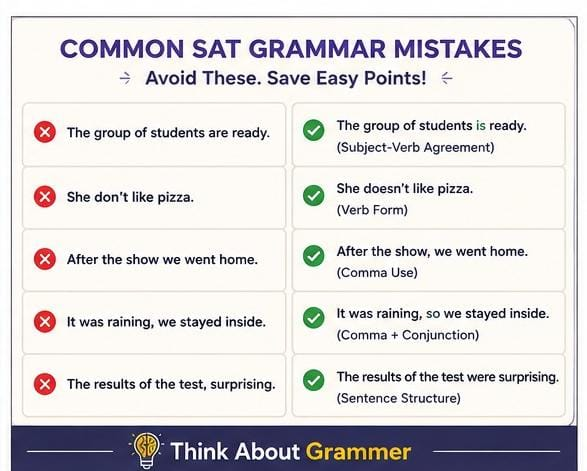
A run-on sentence occurs when independent clauses are incorrectly joined.
Incorrect:
The researchers completed the experiment they published the results.
Possible corrections include:
The researchers completed the experiment. They published the results.
Or:
The researchers completed the experiment, and they published the results.
Or:
The researchers completed the experiment; they published the results.
The correct choice depends on the relationship between the ideas.
20. Understand Boundaries Between Sentences
Sentence-boundary questions ask whether ideas should be separated or connected.
College Board describes Boundaries as part of Standard English Conventions and notes that these questions can involve periods, semicolons, colons, commas, dashes, and parentheses.
When you encounter different punctuation choices, first determine what is on each side of the punctuation.
If Both Sides Are Independent Clauses
Possible choices include:
- period
- semicolon
- comma + coordinating conjunction
Example:
The evidence was limited. The researchers continued their work.
The evidence was limited; the researchers continued their work.
The evidence was limited, but the researchers continued their work.
21. Don’t Add Punctuation Just Because There Is a Pause
One of the biggest grammar mistakes is choosing punctuation based on how a sentence sounds when spoken.
Instead, identify the grammatical structure.
Incorrect:
The results of the experiment, surprised the researchers.
Correct:
The results of the experiment surprised the researchers.
There is no grammatical reason to separate the subject from the verb.
Better Question
Instead of asking:
“Where would I pause?”
Ask:
“What grammatical relationship exists between these words?”
That approach is much more reliable on SAT questions.
22. Learn Common Transition Relationships
Not every SAT grammar question is purely about punctuation. The Reading and Writing section also includes Expression of Ideas, which tests transitions and rhetorical synthesis.
You should understand relationships such as:
| Relationship | Useful transitions |
|---|---|
| Contrast | however, nevertheless, in contrast |
| Cause and effect | therefore, consequently, thus |
| Addition | furthermore, moreover, additionally |
| Example | for example, for instance |
| Similarity | similarly, likewise |
| Sequence | first, next, finally |
Don’t choose a transition because it sounds sophisticated. Choose the one that matches the logical relationship between ideas.
Example:
The first experiment produced inconsistent results. Therefore, the researchers repeated the test.
The second sentence gives a consequence of the first.
23. Choose the Most Concise Grammatically Correct Option
Sometimes several choices appear grammatically possible, but one is unnecessarily wordy.
Wordy:
The researchers made the decision to repeat the experiment.
Concise:
The researchers decided to repeat the experiment.
The SAT can test effective expression as well as grammar. However, don’t automatically choose the shortest answer. The correct choice must preserve the intended meaning and fit the context.
24. Don’t Change the Meaning of the Sentence
A grammatically correct answer can still be wrong if it changes the intended meaning.
For example, if a sentence explains that an event happened before another event, don’t select an answer that makes the sequence unclear simply because it sounds smoother.
Always consider:
- Grammar
- Meaning
- Context
- Logical relationship
A Practical SAT Grammar Checklist
When you see a grammar question, use this quick process:
Step 1: Read the Entire Sentence
Don’t focus only on the underlined portion.
Step 2: Identify the Tested Skill
Ask whether the question involves:
- Subject-verb agreement
- Verb tense
- Pronouns
- Punctuation
- Sentence boundaries
- Modifiers
- Parallel structure
- Comparison
- Concision
Step 3: Find the Sentence Structure
Identify the subject, verb, clauses, and phrases.
Step 4: Check Each Answer Choice
Don’t automatically choose the first answer that sounds good.
Step 5: Eliminate Grammatically Incorrect Choices
Cross out choices that violate a clear rule.
Step 6: Check Meaning
Among the grammatically acceptable options, select the one that fits the passage’s meaning.
Common SAT Grammar Mistakes to Avoid
Mistake 1: Choosing the Longest Answer
Longer does not mean better.
Mistake 2: Choosing What Sounds Natural
Everyday speech doesn’t always follow Standard English conventions.
Mistake 3: Ignoring the Words Around the Blank
The surrounding sentence often determines the correct answer.
Mistake 4: Looking Only at the Nearest Noun
The nearest noun isn’t necessarily the subject.
Mistake 5: Using a Comma Whenever You Hear a Pause
Punctuation depends on grammar, not just pronunciation.
Mistake 6: Forgetting Context
A grammatically correct answer can still be wrong if it doesn’t logically fit the passage.
How to Study SAT Grammar Rules Effectively
Memorizing a long list of rules isn’t enough. You need to recognize those rules quickly in context.
Practice One Rule at a Time
For example, spend one study session focusing only on:
Subject-verb agreement
Then practice punctuation separately.
This makes mistakes easier to identify.
Keep an Error Log
After every practice session, record:
| Question | Mistake | Correct Rule |
| 1 | Wrong verb | Subject-verb agreement |
| 2 | Wrong comma | Independent clauses |
| 3 | Wrong pronoun | Pronoun agreement |
| 4 | Wrong tense | Verb tense |
After several practice sessions, patterns will appear.
Practice Under Time Limits
The Reading and Writing section gives you 64 minutes for 54 questions, divided into two 32-minute modules.
That means you need both accuracy and efficiency.
Use Official Practice Questions
The College Board provides a Student Question Bank containing Reading and Writing questions organized by skill, including Standard English Conventions.
Official SAT Student Question Bank
SAT Grammar Rules: Quick Reference Table
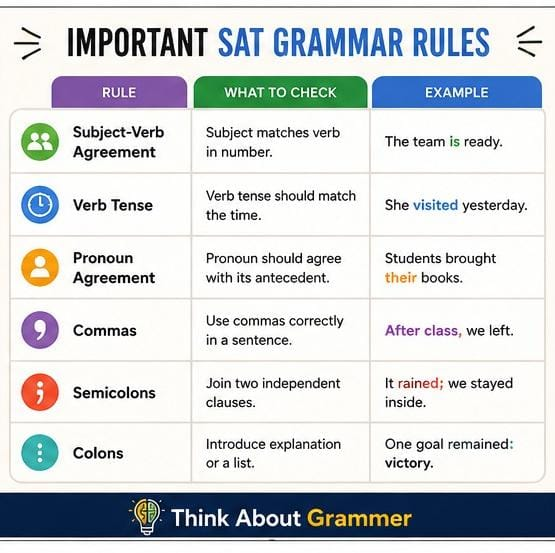
| Rule | What to Check | Example |
| Subject-verb agreement | Subject matches verb | The team is ready. |
| Verb tense | Time is consistent | She visited yesterday. |
| Pronouns | Clear agreement and reference | Students brought their books. |
| Commas | Correct sentence structure | After class, we left. |
| Semicolons | Two independent clauses | It rained; we stayed inside. |
| Colons | Complete clause before colon | One goal remained: victory. |
| Modifiers | Modifier clearly describes noun | Running quickly, Maya reached the bus. |
| Parallelism | Similar items use similar forms | Reading, writing, and editing |
| Apostrophes | Possession vs. plural | student’s / students |
| Sentence boundaries | Complete clauses joined correctly | Use a period, semicolon, or conjunction |
Frequently Asked Questions About SAT Grammar Rules
What are the most important SAT grammar rules?
Focus first on subject-verb agreement, verb tense, pronoun agreement, sentence boundaries, comma usage, semicolons, colons, modifiers, parallel structure, and apostrophes.
These topics fall within the broader Standard English Conventions skills tested on the Reading and Writing section.
Does the SAT test grammar?
Yes. The digital SAT Reading and Writing section includes a Standard English Conventions domain that tests sentence structure, usage, and punctuation.
How many grammar questions are on the SAT?
The College Board doesn’t present the section as a fixed number of “grammar questions.” Instead, Standard English Conventions is one of four Reading and Writing content domains and represents approximately 26% of the section.
Are commas important for the SAT?
Yes. Commas are part of the punctuation and sentence-boundary skills tested under Standard English Conventions. Questions can require you to determine whether commas should be used, omitted, or replaced by another punctuation mark.
How can I improve my SAT grammar score?
Learn the major rules, practice them in context, review every mistake, and keep an error log. Official practice questions are especially useful because they reflect the skills and question formats used by the SAT.
Should I memorize every English grammar rule?
No. Focus on the conventions and sentence structures that regularly appear in SAT-style questions. Understanding why a rule works is generally more useful than memorizing isolated examples.
What is the difference between SAT grammar and SAT Reading?
Grammar questions fall primarily under Standard English Conventions, while Reading and Writing also tests Information and Ideas, Craft and Structure, and Expression of Ideas.
Can I improve SAT grammar quickly?
You can make meaningful progress by concentrating on recurring errors. Start with sentence boundaries, subject-verb agreement, punctuation, verb forms, pronouns, and modifiers, then practice applying those rules to new passages.
Conclusion
Learning SAT grammar rules becomes much easier when you stop treating grammar as a huge collection of unrelated rules. Focus on the patterns the SAT actually tests: agreement, verb forms, pronouns, sentence boundaries, punctuation, modifiers, parallel structure, and clear expression.
The most effective approach is simple: learn the rule, see it in context, practice it, and review your mistakes.
Don’t just ask why an answer is correct. Ask why the other choices are wrong. That habit helps you recognize the same grammar patterns when they appear in a completely different SAT question.