

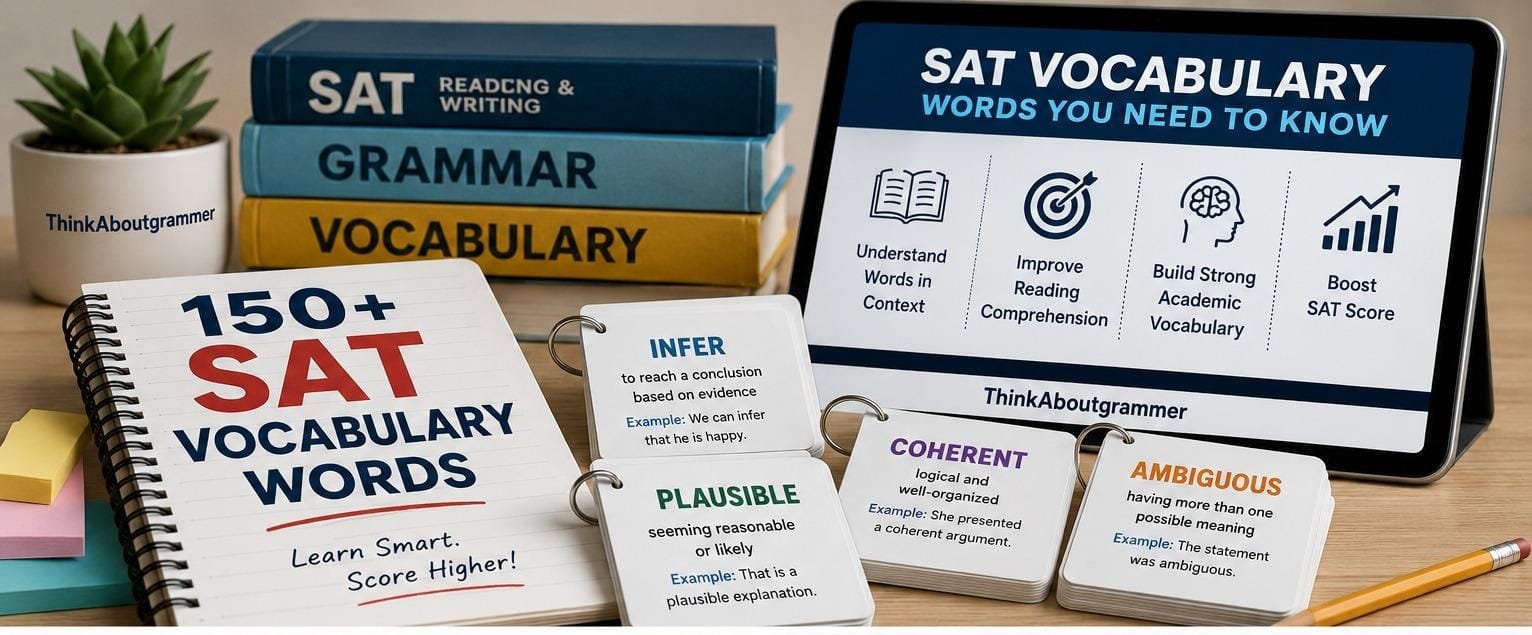
Preparing for the SAT can feel overwhelming, especially when you encounter unfamiliar words in Reading and Writing questions. The good news is that you do not need to memorize an enormous dictionary to improve your vocabulary.
- What Are SAT Vocabulary Words?
- How Does the SAT Test Vocabulary?
- 150+ Useful SAT Vocabulary Words
- 50 More High-Value SAT Vocabulary Words
- 50 Advanced SAT Vocabulary Words
- How to Learn SAT Vocabulary Words Effectively
- 1. Learn Words in Context
- 2. Learn Synonyms and Antonyms
- 3. Create Your Own Sentences
- 4. Use Spaced Review
- How to Use Context Clues on the SAT
- Common SAT Vocabulary Mistakes
- Mistake 1: Choosing the Most Familiar Word
- Mistake 2: Ignoring the Sentence Around the Word
- Mistake 3: Confusing Similar Words
- Mistake 4: Memorizing Without Understanding
- Incorrect vs. Correct Vocabulary Usage
- A Simple SAT Vocabulary Study Plan
- How Many SAT Vocabulary Words Should You Know?
- Conclusion
The most useful SAT vocabulary words are words that commonly appear in academic passages, arguments, science-related texts, history, and literature. More importantly, the SAT tests whether you can understand a word in context, not simply recite its definition.
This guide gives you a practical collection of high-value vocabulary, organized by meaning and difficulty. You’ll also learn how to study these words, use context clues, recognize common mistakes, and approach unfamiliar vocabulary on test day.
What Are SAT Vocabulary Words?
SAT vocabulary words are terms that students may encounter while completing the Reading and Writing portion of the SAT. These words often appear in academic or formal writing and can test your ability to understand meaning, tone, relationships between ideas, and precise word choice.
The modern digital SAT does not simply ask students to memorize long lists of obscure words. Instead, vocabulary is generally tested through words in context.
For example:
The scientist’s findings were tentative, so she avoided making a definitive claim.
Even if you don’t know tentative, the sentence gives you clues. The contrast with “definitive” suggests that the findings were uncertain or not final.
Why Vocabulary Matters on the SAT
A strong vocabulary can help you:
- Understand difficult passages more quickly
- Identify the author’s main point
- Recognize relationships between ideas
- Answer words-in-context questions
- Understand the tone of a passage
- Eliminate incorrect answer choices
- Read academic material with greater confidence
Vocabulary is therefore not an isolated skill. It supports your overall reading comprehension. Students preparing for the Reading and Writing section can also benefit from reviewing SAT Grammar Rules.
How Does the SAT Test Vocabulary?
The SAT generally emphasizes meaning in context rather than dictionary-style memorization.
You might see a sentence such as:
Although the initial results appeared promising, later experiments contradicted the researchers’ conclusions.
The question may ask what contradicted most nearly means in context.
Possible meanings could include:
- supported
- challenged
- repeated
- explained
The correct answer is challenged because the later experiments disagreed with the earlier conclusions.
Words in Context
The key question should always be:
“What does this word mean here?”
A word can have multiple meanings depending on how it is used.
For example, yield can mean:
- to produce something
- to give way
- to surrender
Consider:
The new farming technique yielded more crops.
Here, yielded means produced.
Precision in Word Choice
The SAT may also test whether you understand the precise relationship between words.
Consider:
- skeptical = doubtful
- cynical = distrustful of people’s motives
- indifferent = unconcerned
These words can seem similar, but they aren’t interchangeable.
150+ Useful SAT Vocabulary Words
The following list focuses on practical academic vocabulary that can help you read SAT passages more effectively.
SAT Vocabulary Words: 1–25
| Word | Meaning | Example |
|---|---|---|
| Abundant | Existing in large quantities | The region has abundant rainfall. |
| Ambiguous | Having more than one possible meaning | The statement was ambiguous. |
| Analyze | Examine carefully | Researchers analyzed the results. |
| Anticipate | Expect something to happen | Scientists anticipate further changes. |
| Apparent | Easy to notice or seeming to be true | The difference was apparent. |
| Arbitrary | Based on personal choice rather than reason | The decision seemed arbitrary. |
| Assert | State confidently | The author asserts that reform is necessary. |
| Coherent | Logical and well organized | Her argument was coherent. |
| Compelling | Convincing or persuasive | The study provides compelling evidence. |
| Comprehensive | Complete and covering many aspects | The report provides a comprehensive analysis. |
| Concede | Admit something is true | The author concedes that the plan has flaws. |
| Contradict | Show that something is wrong or untrue | The evidence contradicts the theory. |
| Conventional | Traditional or commonly accepted | They rejected conventional methods. |
| Crucial | Extremely important | Evidence is crucial to the argument. |
| Diminish | Make or become smaller or less important | The discovery diminished earlier concerns. |
| Discrepancy | A difference that should not exist | Researchers noticed a discrepancy in the data. |
| Emerge | Become known or visible | A new pattern began to emerge. |
| Empirical | Based on observation or experiment | The claim lacks empirical evidence. |
| Explicit | Clearly stated | The instructions were explicit. |
| Facilitate | Make something easier | Technology can facilitate communication. |
| Fundamental | Basic and essential | Trust is fundamental to cooperation. |
| Hypothesis | A proposed explanation that can be tested | The experiment tested the hypothesis. |
| Infer | Reach a conclusion from evidence | Readers can infer the author’s attitude. |
| Inevitable | Certain to happen | Some degree of change was inevitable. |
| Innovative | Introducing new ideas or methods | The researchers developed an innovative solution. |
SAT Vocabulary Words: 26–50
| Word | Meaning | Example |
|---|---|---|
| Integrate | Combine parts into a whole | The program integrates several technologies. |
| Interpret | Explain the meaning of something | Students interpreted the results differently. |
| Justify | Give reasons or evidence for something | The data justify the conclusion. |
| Legitimate | Valid or reasonable | The researchers raised a legitimate concern. |
| Maintain | Continue or argue that something is true | The author maintains that education matters. |
| Modify | Change slightly | Engineers modified the design. |
| Negligible | So small that it is unimportant | The difference was negligible. |
| Notion | An idea or belief | The article challenges the notion that success is automatic. |
| Objective | Unbiased or based on facts | The report attempts to remain objective. |
| Obscure | Not well known or difficult to understand | The reference was obscure. |
| Plausible | Seeming reasonable or possible | The explanation is plausible. |
| Prevalent | Common or widespread | The belief was prevalent at the time. |
| Prominent | Important, noticeable, or well known | She became a prominent researcher. |
| Refute | Prove that something is wrong | The evidence refuted the claim. |
| Relevant | Directly related to the topic | Only relevant evidence should be considered. |
| Resilient | Able to recover from difficulty | The ecosystem proved resilient. |
| Rigorous | Extremely thorough or careful | The researchers used rigorous methods. |
| Subsequent | Happening afterward | Subsequent studies confirmed the pattern. |
| Substantial | Large or important | The project requires substantial funding. |
| Sustain | Support or maintain | The evidence sustains the argument. |
| Tentative | Uncertain or not final | The researchers reached a tentative conclusion. |
| Undermine | Weaken something | The new evidence undermines the original theory. |
| Unique | One of a kind | The species has a unique adaptation. |
| Valid | Logical or well-founded | The researchers presented a valid argument. |
| Verify | Confirm that something is true | Scientists attempted to verify the results. |
50 More High-Value SAT Vocabulary Words
Academic and Analytical Words
| Word | Meaning |
|---|---|
| Advocate | Publicly support something |
| Contemporary | Existing or occurring at the same time; modern |
| Corroborate | Confirm with additional evidence |
| Deduce | Reach a conclusion through reasoning |
| Demonstrate | Show clearly |
| Distinguish | Recognize a difference |
| Elaborate | Explain in greater detail |
| Evaluate | Judge the value or quality |
| Exhibit | Show or display |
| Generate | Produce or create |
| Imply | Suggest without directly stating |
| Inherent | Naturally existing as part of something |
| Objective | Unbiased or factual |
| Paradox | A seemingly contradictory situation |
| Persistent | Continuing despite difficulty |
| Preliminary | Occurring before the main event or final stage |
| Proponent | A person who supports an idea |
| Retain | Continue to possess or keep |
| Scrutinize | Examine very carefully |
| Specify | State clearly and precisely |
Words for Arguments and Evidence
| Word | Meaning |
|---|---|
| Adequate | Sufficient for a purpose |
| Assertive | Confidently expressing an opinion |
| Bias | An unfair preference or tendency |
| Credible | Believable or trustworthy |
| Definitive | Conclusive or final |
| Dissent | Disagreement with an opinion |
| Evidence | Information supporting a conclusion |
| Flawed | Containing a weakness or mistake |
| Inference | A conclusion based on evidence |
| Objective | Free from personal bias |
| Premise | A statement supporting an argument |
| Rational | Based on reason |
| Rebut | Argue against a claim |
| Relevant | Connected to the issue |
| Substantiate | Support with evidence |
50 Advanced SAT Vocabulary Words
You don’t need to memorize every advanced word you encounter, but becoming familiar with these can make challenging passages easier.
| Word | Meaning | Example |
|---|---|---|
| Abolish | Officially end something | The law was eventually abolished. |
| Adept | Highly skilled | She is adept at solving complex problems. |
| Alleviate | Make something less severe | The new policy may alleviate the problem. |
| Astute | Clever and perceptive | The researcher made an astute observation. |
| Benevolent | Kind and generous | The organization had a benevolent purpose. |
| Candid | Honest and straightforward | The interview provided a candid discussion. |
| Conspicuous | Easily noticed | The error was conspicuous. |
| Cumulative | Increasing through successive additions | The cumulative effects were significant. |
| Deviate | Move away from an expected course | The results deviate from earlier findings. |
| Diligent | Careful and hardworking | The diligent student reviewed every result. |
| Disparity | A significant difference | Researchers found a disparity between the groups. |
| Eloquent | Persuasive or expressive | The speaker gave an eloquent explanation. |
| Feasible | Possible and practical | The proposal appears feasible. |
| Impartial | Fair and unbiased | Judges should remain impartial. |
| Inhibit | Prevent or slow something | Excessive heat can inhibit growth. |
| Meticulous | Extremely careful | The scientist kept meticulous records. |
| Nuance | A subtle difference | The passage contains an important nuance. |
| Obsolete | No longer useful or current | The technology became obsolete. |
| Precede | Come before | A short introduction precedes the main argument. |
| Proliferate | Increase or spread rapidly | The technology began to proliferate. |
| Pragmatic | Practical rather than idealistic | They adopted a pragmatic approach. |
| Scrupulous | Extremely careful and honest | The researcher was scrupulous about accuracy. |
| Skeptical | Doubtful | The scientist remained skeptical of the claim. |
| Subtle | Difficult to notice | The author makes a subtle distinction. |
| Vindicate | Show that someone was right or justified | Later evidence vindicated the researcher. |
How to Learn SAT Vocabulary Words Effectively
Simply reading a vocabulary list repeatedly isn’t always the best approach. You need to interact with the words.
1. Learn Words in Context
Instead of memorizing:
Mitigate = reduce
Create a sentence:
Planting trees can mitigate the effects of extreme heat.
Now the word has a meaning, situation, and mental association.
2. Learn Synonyms and Antonyms
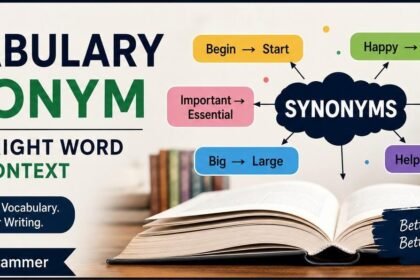
Grouping related words makes vocabulary easier to remember. Learning Vocabulary Synonyms can also help you recognize relationships between words and understand answer choices more quickly.
For example:
Support
- endorse
- advocate
- substantiate
- corroborate
Oppose
- contradict
- refute
- challenge
- undermine
Understanding these relationships is especially useful for Reading and Writing questions.
3. Create Your Own Sentences
After learning a word, write one original sentence.
For example:
Plausible:
“The scientist offered a plausible explanation for the unexpected result.”
Then ask yourself:
Could I replace plausible with impossible without changing the meaning?
No. That quick comparison strengthens your understanding.
4. Use Spaced Review
Don’t try to learn 100 words in one sitting.
A better approach is to review vocabulary repeatedly over several days.
For example:
- Learn 10–15 words.
- Review them later the same day.
- Review them again the next day.
- Test yourself after several days.
- Revisit words you keep forgetting.
How to Use Context Clues on the SAT
You will eventually encounter a word you don’t know. That’s normal.
Instead of immediately panicking, look at the surrounding sentence.
Look for Contrast
Words such as:
- although
- however
- yet
- despite
- nevertheless
- unlike
often signal a contrast.
Example:
Although the first theory was widely accepted, later evidence challenged it.
The word challenged probably has a meaning related to questioning or opposing.
Look for Cause and Effect
Words such as:
- because
- therefore
- consequently
- thus
- since
can reveal relationships.
Example:
The soil lacked essential nutrients; consequently, crop production declined.
The word declined means decreased.
Look for Examples
Sometimes an unfamiliar word is followed by an explanation.
The material is porous, meaning that it contains many tiny spaces through which water can pass.
Even if you don’t know porous, the explanation provides the meaning.
Common SAT Vocabulary Mistakes
Mistake 1: Choosing the Most Familiar Word
Students sometimes select an answer because they recognize it.
Recognition isn’t enough.
The answer must fit the specific context.
Mistake 2: Ignoring the Sentence Around the Word
Never analyze a vocabulary word completely by itself.
Read the entire sentence and, when necessary, the sentences before and after it.
Mistake 3: Confusing Similar Words
Some words have related meanings but different uses.
For example:
- Skeptical → doubtful about whether something is true
- Cynical → distrustful of people’s motives
- Indifferent → not particularly interested or concerned
Understanding these distinctions can prevent wrong answers.
Mistake 4: Memorizing Without Understanding
Knowing that mitigate means “reduce” is useful.
Knowing how to use it is better:
The policy was designed to mitigate the effects of pollution.
That’s the kind of understanding that transfers to an actual passage.
Incorrect vs. Correct Vocabulary Usage

Example 1
Incorrect:
“The evidence was abundant because there was only one example.”
Correct:
“The evidence was limited because there was only one example.”
Why?
Abundant means plentiful, so it contradicts the idea of having only one example.
Example 2
Incorrect:
“The scientist remained skeptical because the evidence strongly confirmed the theory.”
Better:
“The scientist became confident because the evidence strongly confirmed the theory.”
Why?
Skeptical means doubtful, while strong confirmation would normally reduce doubt.
Example 3
Incorrect:
“The explanation was ambiguous because it had only one clear meaning.”
Correct:
“The explanation was explicit because it had one clear meaning.”
Why?
Ambiguous suggests uncertainty or multiple possible interpretations.
A Simple SAT Vocabulary Study Plan
If you have several weeks before your exam, use a manageable routine rather than trying to memorize hundreds of words at once.
Week 1: Build Your Foundation
Learn 10–15 words per day.
Focus on:
- meaning
- synonyms
- antonyms
- example sentences
- context clues
Week 2: Practice in Context
Read short academic passages and identify unfamiliar words.
For each word, ask:
- What does it probably mean?
- What clues helped me?
- What words are related to it?
- Can I use it in a sentence?
Week 3: Review and Test
Stop adding large numbers of new words.
Instead, test yourself on previously learned vocabulary.
Separate words into:
- Know well
- Almost know
- Need to review
Spend most of your time on the last two groups.
How Many SAT Vocabulary Words Should You Know?
There is no magic number of vocabulary words that guarantees a particular SAT score.
Quality matters more than quantity.
Knowing 300 words deeply—understanding their meanings, relationships, and use in context—can be more useful than memorizing 1,000 words without understanding them.
Your broader goal should be to become comfortable reading academic English.
That means regularly encountering:
- science articles
- historical passages
- literary writing
- social science texts
- argumentative essays
- informational articles
Frequently Asked Questions About SAT Vocabulary Words
Are vocabulary words still important on the digital SAT?
Yes. Vocabulary remains important, particularly because students need to understand words and phrases in context while reading and answering questions.
Do I need to memorize thousands of SAT vocabulary words?
No. There is no official requirement to memorize a particular number of words. Focus on high-value academic vocabulary and, more importantly, learn how to determine meaning from context.
What are the most important SAT vocabulary words?
Words such as ambiguous, apparent, coherent, compelling, contradict, crucial, empirical, infer, plausible, relevant, rigorous, tentative, undermine, and verify are useful because they frequently occur in academic-style language.
How can I remember difficult vocabulary?
Use spaced repetition, example sentences, synonyms, antonyms, and context-based practice. Connecting a word to a meaningful sentence is usually more useful than repeatedly reading its dictionary definition.
What should I do if I don’t know a word on the SAT?
Don’t panic. Read the surrounding sentence, look for contrast or cause-and-effect clues, identify the author’s purpose, and eliminate answers that don’t fit the context.
Is it better to learn synonyms or definitions?
Learn both, but prioritize meaning in context. A synonym can help you remember a word, while a context-based example teaches you how the word actually functions.
Can reading improve SAT vocabulary?
Absolutely. Regular reading exposes you to vocabulary in context, which helps you understand not only what words mean but also how writers use them.
How often should I review SAT vocabulary?
Frequent short reviews are generally more practical than one long study session. Revisit difficult words over several days and test yourself without looking at the definitions.
Conclusion
Learning SAT vocabulary words is not about memorizing the most obscure words you can find. It’s about building a strong academic vocabulary and learning how to understand unfamiliar language from context.
Start with high-value words such as ambiguous, compelling, empirical, infer, plausible, rigorous, tentative, and undermine. Then practice them in real sentences and reading passages.
Most importantly, don’t depend entirely on memorization. On the SAT, the surrounding text is often your best clue. If you learn to combine vocabulary knowledge with context clues, you’ll be better prepared to understand challenging passages and choose precise answers.