


Division is one of the four basic operations in mathematics, but understanding the vocabulary used in division is just as important as knowing how to calculate an answer. Words such as dividend, divisor, quotient, remainder, factor, and multiple describe different parts of a division problem.
- What Is Division?
- The Main Division Vocabulary Terms
- What Is a Dividend?
- What Is a Divisor?
- What Is a Quotient?
- What Is a Remainder?
- Division Vocabulary in Long Division
- What Are Factors?
- What Are Multiples?
- What Does “Divisible” Mean?
- What Is an Exact Division?
- What Is an Inexact Division?
- Division Symbols and Their Names
- How Division and Multiplication Are Related
- Division Vocabulary for Word Problems
- Partitive and Quotative Division
- Division Vocabulary Cheat Sheet
- Common Division Vocabulary Mistakes
- Mistake 1: Confusing the Dividend and Divisor
- Mistake 2: Calling the Quotient the Remainder
- Mistake 3: Forgetting the Remainder
- Mistake 4: Assuming Every Division Has a Remainder
- How to Remember Division Terms Easily
- A Simple Method for Solving Division Problems
- Step 1: Identify the Dividend
- Step 2: Identify the Divisor
- Step 3: Find the Quotient
- Step 4: Check for a Remainder
- Step 5: Check Your Answer
- Division Vocabulary Practice
- Conclusion
If you are learning division, teaching a child, or reviewing math terminology, learning this vocabulary can make division problems much easier to understand. Learning new terms becomes easier when you use simple strategies to build your vocabulary.
For example, consider:
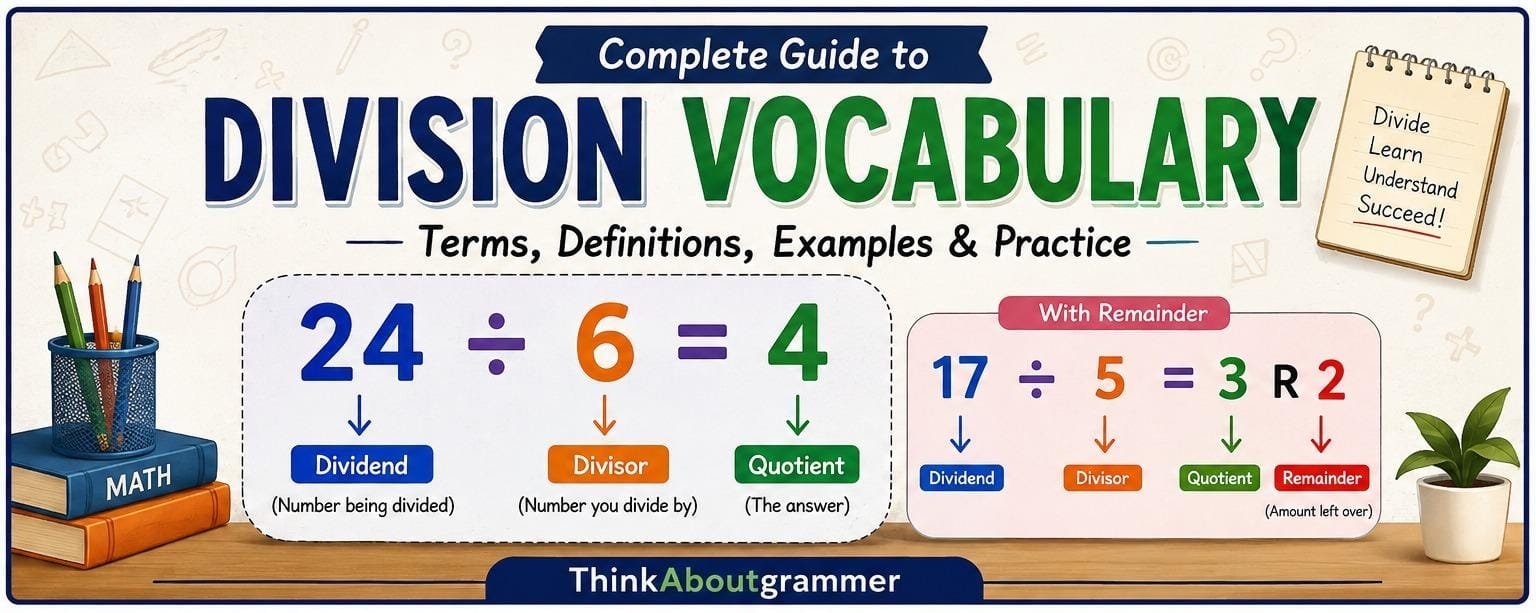
24 ÷ 6 = 4
In this problem, 24 is the dividend, 6 is the divisor, and 4 is the quotient. Once you know what each word means, mathematical instructions and word problems become much clearer.
This guide explains the most important division vocabulary in simple English, with examples, tables, common mistakes, and practical tips.
What Is Division?
Division is the process of splitting a number into equal groups or finding how many times one number fits into another.
For example:
20 ÷ 5 = 4
This can mean:
- Split 20 objects into 5 equal groups.
- Each group contains 4 objects.
- Or, 5 fits into 20 exactly 4 times.
Division is closely related to multiplication. Because:
5 × 4 = 20
we can also say:
20 ÷ 5 = 4
Understanding this relationship can help you check whether a division answer is correct.
The Main Division Vocabulary Terms
The most important division terms are dividend, divisor, quotient, and remainder.
Understanding related words and synonyms can also help you recognize different ways mathematical terms may be explained.
Here is a quick overview:
| Term | Meaning | Example in 20 ÷ 5 = 4 |
|---|---|---|
| Dividend | Number being divided | 20 |
| Divisor | Number doing the dividing | 5 |
| Quotient | Answer to a division problem | 4 |
| Remainder | Amount left over | 0 |
Let’s examine each term more closely.
What Is a Dividend?
The dividend is the number that is being divided.
For example:
36 ÷ 4 = 9
Here, 36 is the dividend.
You can think of the dividend as the total amount you start with before dividing it into groups.
Dividend Examples
48 ÷ 6 = 8
- Dividend = 48
- Divisor = 6
- Quotient = 8
Another example:
72 ÷ 9 = 8
- Dividend = 72
- Divisor = 9
- Quotient = 8
A useful question to ask is:
“What number am I dividing?”
That number is the dividend.
What Is a Divisor?
The divisor is the number by which the dividend is divided.
Consider:
35 ÷ 7 = 5
Here, 7 is the divisor.
The divisor tells you how many equal groups you are making when the problem is interpreted as sharing equally.
Divisor Examples
In:
40 ÷ 8 = 5
the divisor is 8.
In:
63 ÷ 7 = 9
the divisor is 7.
In:
100 ÷ 10 = 10
the divisor is 10.
A simple way to remember it is:
Dividend ÷ Divisor = Quotient
What Is a Quotient?
The quotient is the answer obtained from a division problem.
For example:
56 ÷ 7 = 8
The quotient is 8.
The quotient does not always have to be a whole number. Depending on the problem, it can be a decimal or fraction.
For example:
10 ÷ 4 = 2.5
Here, 2.5 is the quotient.
Quotient Examples
| Division Problem | Quotient |
|---|---|
| 12 ÷ 3 | 4 |
| 25 ÷ 5 | 5 |
| 81 ÷ 9 | 9 |
| 50 ÷ 10 | 5 |
| 10 ÷ 4 | 2.5 |
When a teacher asks for the quotient, they are asking for the result of the division.
What Is a Remainder?
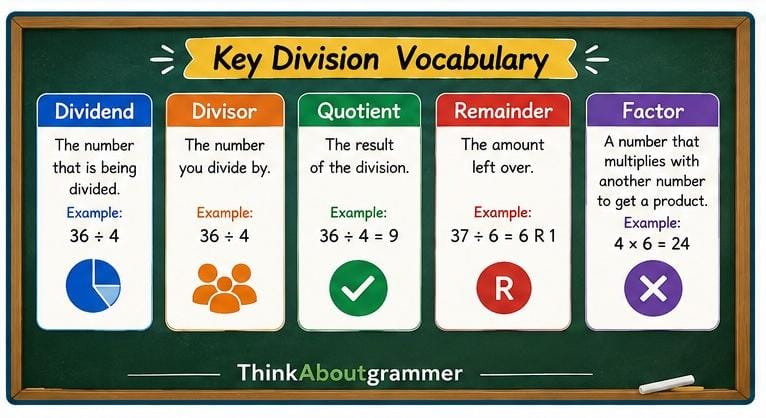
A remainder is the amount left over when a number cannot be divided equally.
For example:
17 ÷ 5 = 3 R2
Five goes into 17 three whole times, which uses 15:
5 × 3 = 15
There are 2 left over, so 2 is the remainder.
More Remainder Examples
22 ÷ 4 = 5 R2
Because:
4 × 5 = 20
and:
22 − 20 = 2
Therefore:
- Dividend = 22
- Divisor = 4
- Quotient = 5
- Remainder = 2
Division With No Remainder
Some division problems divide evenly.
For example:
24 ÷ 6 = 4
There is nothing left over, so the remainder is 0.
Division Vocabulary in Long Division
Long division uses the same basic vocabulary but presents the numbers in a specific format.
Consider:
156 ÷ 12 = 13
In a long-division setup:
- 156 is the dividend.
- 12 is the divisor.
- 13 is the quotient.
If the calculation does not divide evenly, the answer may also include a remainder.
For example:
157 ÷ 12 = 13 R1
Here:
- Dividend = 157
- Divisor = 12
- Quotient = 13
- Remainder = 1
What Are Factors?
A factor is a number that is multiplied by another number to produce a product.
Factors are closely connected to division.
For example:
6 × 4 = 24
Therefore, 6 and 4 are factors of 24.
This also means:
24 ÷ 6 = 4
and:
24 ÷ 4 = 6
So, factors can help you understand division relationships.
Factor Examples
The factors of 12 include:
1, 2, 3, 4, 6, and 12
This is because:
- 1 × 12 = 12
- 2 × 6 = 12
- 3 × 4 = 12
Each pair gives a product of 12.
What Are Multiples?
A multiple is the result of multiplying a number by a whole number.
For example, the multiples of 5 are:
5, 10, 15, 20, 25, 30…
Multiples are useful when solving division problems because they help you determine how many times a divisor fits into a dividend.
For example, to solve:
28 ÷ 7
you can think about multiples of 7:
7, 14, 21, 28
Because 28 is the fourth multiple of 7:
28 ÷ 7 = 4
What Does “Divisible” Mean?
A number is divisible by another number when it can be divided without leaving a remainder.
For example:
30 ÷ 5 = 6
So, 30 is divisible by 5.
But:
31 ÷ 5 = 6 R1
Therefore, 31 is not divisible by 5.
Examples of Divisibility
| Number | Divisor | Divisible? |
|---|---|---|
| 20 | 5 | Yes |
| 24 | 6 | Yes |
| 27 | 4 | No |
| 36 | 9 | Yes |
| 50 | 8 | No |
Divisibility rules can sometimes help you determine this quickly.
What Is an Exact Division?
An exact division occurs when the dividend can be divided by the divisor without a remainder.
For example:
45 ÷ 9 = 5
The remainder is 0, so this is an exact division.
Another example:
64 ÷ 8 = 8
Again, there is no remainder.
What Is an Inexact Division?
An inexact division occurs when a whole-number division leaves a remainder.
For example:
29 ÷ 6 = 4 R5
Because:
6 × 4 = 24
and:
29 − 24 = 5
The remainder is 5, so the division is not exact.
Division Symbols and Their Names
Division can be written using several different symbols or formats.
The ÷ Symbol
Example:
18 ÷ 3 = 6
The symbol ÷ is commonly called the division sign.
The Slash
Division can also be written using a slash:
18 / 3 = 6
This format is common in calculators, computer programs, and other digital contexts.
The Fraction Bar
Division can also be represented as a fraction:
18/3 = 6
The number on top is the numerator, and the number on the bottom is the denominator.
In many contexts, a fraction represents division.
How Division and Multiplication Are Related
Division and multiplication are inverse operations.
For example:
7 × 8 = 56
This gives us two related division equations:
56 ÷ 7 = 8
56 ÷ 8 = 7
These three equations form a related fact family.
Why This Relationship Helps
If you know your multiplication facts, you can often use them to solve division problems.
Suppose you need to solve:
42 ÷ 6 = ?
Ask:
“What number multiplied by 6 equals 42?”
Because:
6 × 7 = 42
the answer is:
42 ÷ 6 = 7
This strategy is especially useful when learning basic division facts.
Division Vocabulary for Word Problems
Division vocabulary becomes particularly important in mathematical word problems.
Look for phrases that suggest division, such as:
- shared equally
- divided equally
- each group
- per group
- each person gets
- split into equal groups
- how many groups
- how many in each group
- distributed equally
For example:
“A teacher has 30 pencils and wants to give them equally to 5 students. How many pencils does each student receive?”
The mathematical operation is:
30 ÷ 5 = 6
Each student receives 6 pencils.
Another Example
“There are 48 books. They are placed equally on 8 shelves. How many books go on each shelf?”
The equation is:
48 ÷ 8 = 6
The answer is 6 books per shelf.
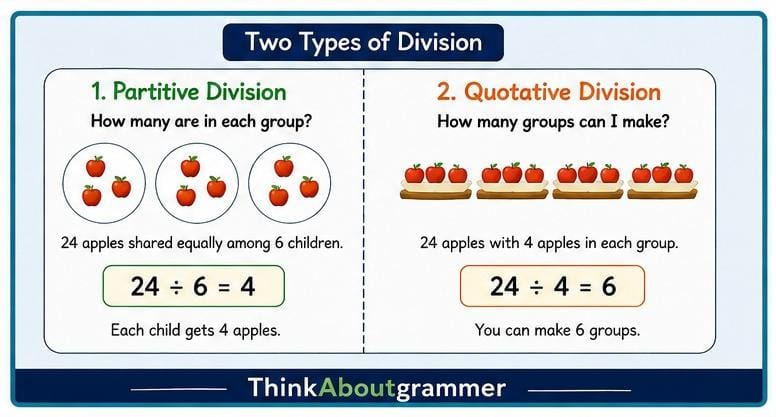
Partitive and Quotative Division
There are two common ways to think about division.
Partitive Division
Partitive division asks:
“How many are in each group?”
Example:
You have 24 candies and 6 children. If the candies are shared equally, how many does each child receive?
24 ÷ 6 = 4
Each child gets 4 candies.
Quotative Division
Quotative division asks:
“How many groups can I make?”
Example:
You have 24 candies and put 4 candies in each group. How many groups can you make?
24 ÷ 4 = 6
You can make 6 groups.
The calculation is similar, but the question being asked is different.
Division Vocabulary Cheat Sheet
Here is a quick reference for the most important terms:
| Vocabulary | Simple Definition | Example |
|---|---|---|
| Division | Splitting into equal groups or finding how many times one number fits into another | 20 ÷ 5 |
| Dividend | Number being divided | 20 |
| Divisor | Number you divide by | 5 |
| Quotient | Answer to division | 4 |
| Remainder | Amount left after whole-number division | 2 in 17 ÷ 5 |
| Factor | Number multiplied to produce a product | 4 in 4 × 6 |
| Multiple | Result of multiplying a number by a whole number | 24 is a multiple of 6 |
| Divisible | Can be divided evenly | 20 is divisible by 5 |
| Division sign | Symbol showing division | ÷ |
| Exact division | Division with no remainder | 24 ÷ 6 = 4 |
Common Division Vocabulary Mistakes
Learning the terms is easier when you know which mistakes to avoid.
Mistake 1: Confusing the Dividend and Divisor
Incorrect:
In 36 ÷ 6, saying 6 is the dividend.
Correct:
- 36 = dividend
- 6 = divisor
Remember:
Dividend ÷ Divisor = Quotient
Mistake 2: Calling the Quotient the Remainder
In:
19 ÷ 4 = 4 R3
the quotient is 4, while the remainder is 3.
They have different jobs.
Mistake 3: Forgetting the Remainder
If:
23 ÷ 5
you cannot simply say 4 without explaining the remainder when the problem expects a whole-number answer.
The complete answer is:
23 ÷ 5 = 4 R3
Mistake 4: Assuming Every Division Has a Remainder
Not every division problem has a remainder.
For example:
36 ÷ 6 = 6
The remainder is 0.
How to Remember Division Terms Easily
A simple sentence can help you remember the main vocabulary:
Dividend ÷ Divisor = Quotient
For example:
48 ÷ 8 = 6
So:
- 48 → dividend
- 8 → divisor
- 6 → quotient
If something remains, add the remainder:
50 ÷ 8 = 6 R2
Now:
- 50 → dividend
- 8 → divisor
- 6 → quotient
- 2 → remainder
Writing this structure repeatedly is one of the easiest ways to become familiar with division vocabulary. Regular practice is also useful when building a stronger vocabulary for academic subjects and tests.
A Simple Method for Solving Division Problems
When you encounter a division problem, follow these steps.
Step 1: Identify the Dividend
Find the number being divided.
Step 2: Identify the Divisor
Find the number you are dividing by.
Step 3: Find the Quotient
Determine how many times the divisor fits into the dividend.
Step 4: Check for a Remainder
If the numbers do not divide evenly, determine what is left.
Step 5: Check Your Answer
Multiply the divisor by the quotient and add the remainder.
For example:
29 ÷ 6 = 4 R5
Check:
6 × 4 + 5 = 29
Because the calculation returns to the original dividend, the answer is correct.
Division Vocabulary Practice
Try identifying the terms in these examples.
Example 1
42 ÷ 7 = 6
- Dividend: 42
- Divisor: 7
- Quotient: 6
- Remainder: 0
Example 2
35 ÷ 6 = 5 R5
- Dividend: 35
- Divisor: 6
- Quotient: 5
- Remainder: 5
Example 3
81 ÷ 9 = 9
- Dividend: 81
- Divisor: 9
- Quotient: 9
- Remainder: 0
Practice Questions
Identify the dividend, divisor, quotient, and remainder.
- 28 ÷ 4 = 7
- 31 ÷ 5 = 6 R1
- 50 ÷ 8 = 6 R2
- 72 ÷ 9 = 8
- 43 ÷ 7 = 6 R1
The most important thing is not simply finding the numerical answer. Make sure you can identify what each number represents.
Frequently Asked Questions About Division Vocabulary
What are the four main terms in division?
The four main terms are dividend, divisor, quotient, and remainder. The dividend is divided by the divisor. The quotient is the result, and the remainder is what is left over when the division is not exact.
What is the easiest way to remember dividend and divisor?
Remember the pattern:
Dividend ÷ Divisor = Quotient
The number before the division sign is usually the dividend, and the number after it is the divisor.
What is a quotient in simple terms?
A quotient is the answer to a division problem. For example, in 40 ÷ 8 = 5, the quotient is 5.
What is a remainder?
A remainder is the amount left after dividing as evenly as possible using whole numbers. For example, 18 ÷ 5 = 3 R3, so 3 is the remainder.
Are factors related to division?
Yes. Factors and division are closely related. If 4 × 6 = 24, then 4 and 6 are factors of 24, and 24 ÷ 4 = 6 and 24 ÷ 6 = 4.
What does divisible mean?
A number is divisible by another number when the division produces no remainder. For example, 36 is divisible by 6 because 36 ÷ 6 = 6.
Why is division vocabulary important?
Knowing division vocabulary helps you understand math instructions, word problems, long division, and explanations. It also makes it easier to communicate exactly which part of a division problem you are discussing.
How can students learn division vocabulary faster?
Start with the four core terms—dividend, divisor, quotient, and remainder. Practice identifying them in simple equations, then add related terms such as factors, multiples, and divisible. Connecting division to multiplication can also make the vocabulary easier to remember.
Conclusion
Understanding division vocabulary makes division much less confusing. The most important terms to remember are dividend, divisor, quotient, and remainder.
In the equation:
24 ÷ 6 = 4
24 is the dividend, 6 is the divisor, and 4 is the quotient. If something is left over, that amount is the remainder.
Once these basic terms become familiar, you can more easily understand long division, word problems, multiplication relationships, factors, multiples, and divisibility. The best approach is simple: practice identifying each term whenever you solve a division problem.