

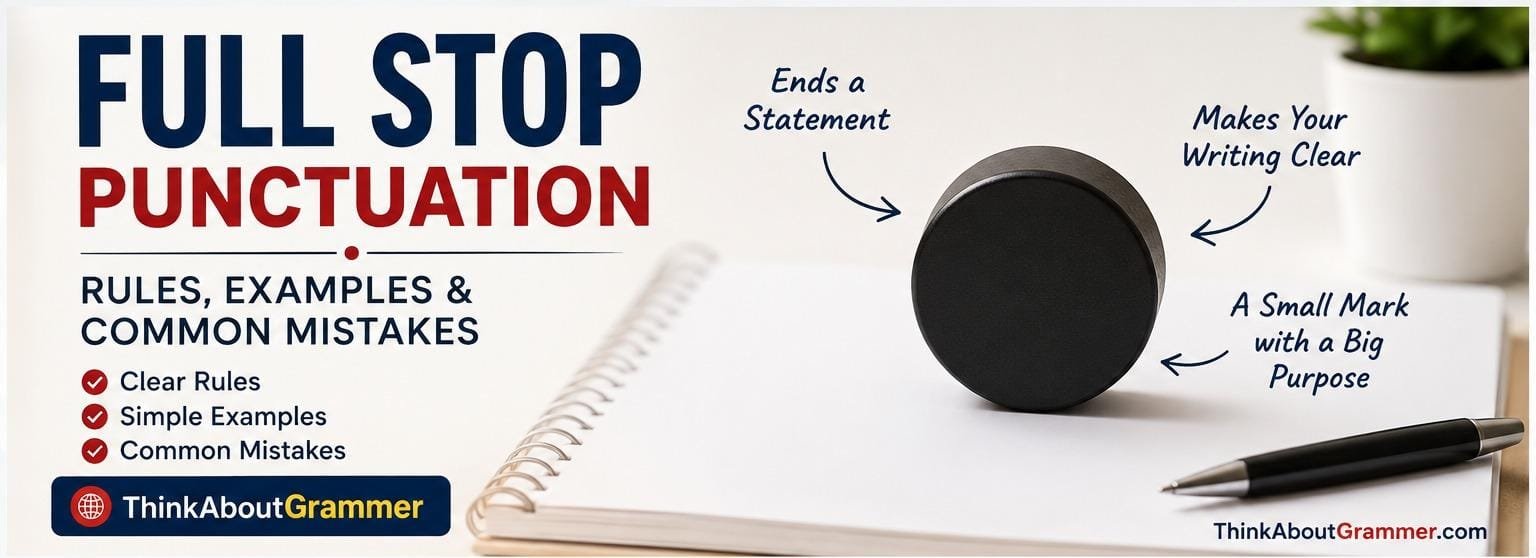
A full stop punctuation mark (.) is one of the most basic punctuation marks in English, but using it correctly is essential for clear writing. Also called a period in American English, the full stop tells readers that a statement or sentence has ended.
- What Is Full Stop Punctuation?
- When Should You Use a Full Stop?
- Full Stop Punctuation at the End of Declarative Sentences
- Full Stops in Imperative Sentences
- Full Stops in Abbreviations
- Full Stops With Initials
- Full Stops With Quotations
- Full Stops After Question Marks and Exclamation Marks
- Full Stops With Multiple Sentences
- Full Stop Punctuation and Sentence Fragments
- Full Stops in Lists
- Full Stops in Headings and Titles
- Full Stops in Captions
- Full Stops in Email Writing
- Full Stops in Academic Writing
- Full Stops in Business Writing
- Common Full Stop Mistakes
- 1. Forgetting the Full Stop
- 2. Adding a Full Stop After a Question Mark
- 3. Adding a Full Stop After an Exclamation Mark
- 4. Using Full Stops Between Words
- 5. Creating Sentence Fragments
- Full Stop vs. Comma
- How to Know Where a Full Stop Belongs
- Step 1: Find the Complete Thoughts
- Step 2: Check the Sentence Type
- Step 3: Check for Fragments
- Step 4: Check for Run-On Sentences
- Step 5: Read It Aloud
- Full Stop Punctuation: Quick Rules
- Does Every Sentence Need a Full Stop?
- Is a Full Stop the Same as a Period?
- Why Is Full Stop Punctuation Important?
- Tips for Using Full Stops Correctly
- Conclusion
You probably use full stops every day without thinking about them. But questions often arise: Should a full stop go after an abbreviation? Can you use one after a question mark? What happens with quotations? Should headings end with a full stop?
This guide explains full stop punctuation in simple terms, with practical examples, common mistakes, and easy rules you can apply to everyday writing.
What Is Full Stop Punctuation?
A full stop (.) is a punctuation mark used primarily at the end of a declarative or complete sentence.
For example:
- The library closes at six.
- Sarah finished her homework.
- We are planning a trip next month.
The full stop signals to the reader that the thought is complete.
In British English and many other varieties of English, the mark is commonly called a full stop. In American English, it is usually called a period.
Full Stop vs. Period
There is no difference between the two punctuation marks.
| Term | Common usage |
|---|---|
| Full stop | British English |
| Period | American English |
| Symbol | . |
So, if someone asks about a “period” in American grammar, they are generally referring to the same mark as the British English full stop.
When Should You Use a Full Stop?
The most important rule is straightforward:
Use a full stop at the end of a complete statement.
A complete statement usually expresses a fact, opinion, idea, or piece of information.
Examples of Correct Usage
- The weather is beautiful today.
- My brother studies engineering.
- We arrived before the meeting started.
- The company launched a new website.
- Please send the document tomorrow.
Each sentence expresses a complete thought, so each one ends with a full stop.
Full Stop Punctuation at the End of Declarative Sentences
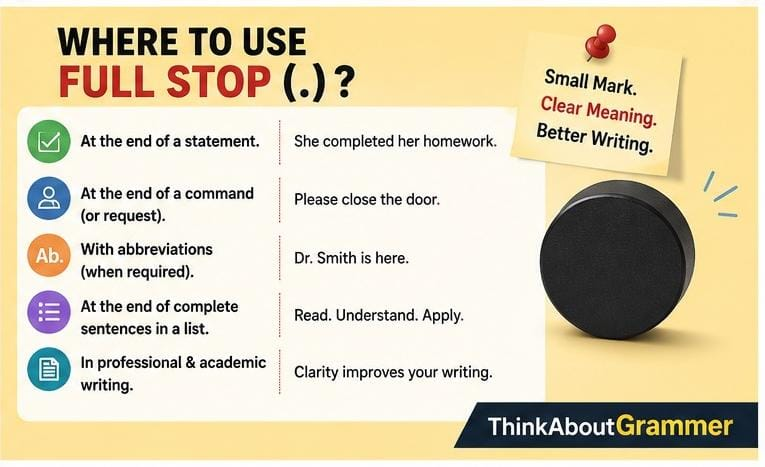
A declarative sentence makes a statement. These sentences normally end with a full stop.
Examples
Correct:
- The train leaves at 8:30.
- Maria enjoys reading novels.
- The students completed the assignment.
- Our office opens on Monday.
Incorrect:
- The train leaves at 8:30
- Maria enjoys reading novels
- The students completed the assignment
Without the punctuation, the sentences can still be understood, but the writing looks incomplete and may be harder to read.
Full Stops in Imperative Sentences
Imperative sentences give commands, instructions, requests, or advice. They can also end with a full stop when the tone is neutral.
Examples:
- Please close the door.
- Turn off the lights.
- Read the instructions carefully.
- Take your seat.
- Remember to bring your notebook.
An imperative sentence can sometimes end with an exclamation mark when the command is particularly forceful, but a full stop is appropriate for ordinary instructions.
Compare:
- Please wait here.
- Stop!
The first is a neutral instruction, while the second expresses strong urgency.
Full Stops in Abbreviations
One of the more confusing areas of full stop punctuation is abbreviations.
Some abbreviations traditionally take full stops:
- Mr.
- Dr.
- Prof.
- etc.
- e.g.
- i.e.
However, abbreviation conventions vary between style guides and varieties of English.
British and American Differences
For example, titles such as Mr and Dr are often written without full stops in modern British English:
- Dr Smith
- Mr Jones
American English commonly uses:
- Dr. Smith
- Mr. Jones
The important point is to follow the style required by your school, workplace, publication, or chosen style guide.
Full Stops With Initials
Initials can be written with full stops depending on the style being followed.
Examples include:
- J. K. Rowling
- T. S. Eliot
- George W. Bush
Some modern style systems omit the full stops:
- JK Rowling
- TS Eliot
Neither approach should be applied randomly. Choose the convention appropriate to your writing style and use it consistently.
Full Stops With Quotations
Quotation punctuation can become confusing because British and American conventions differ.
Consider:
She said, “The meeting starts at nine.”
In American English, a full stop is generally placed inside the closing quotation mark.
British English may use punctuation according to whether the punctuation belongs to the quoted material itself.
For example:
She described the proposal as “unrealistic”.
The key question is whether the punctuation belongs to the original quotation or to the surrounding sentence.
A Simple Approach
If you’re writing for a particular publication, academic institution, or professional audience, check its preferred quotation style.
Consistency matters more than switching between conventions.
Full Stops After Question Marks and Exclamation Marks
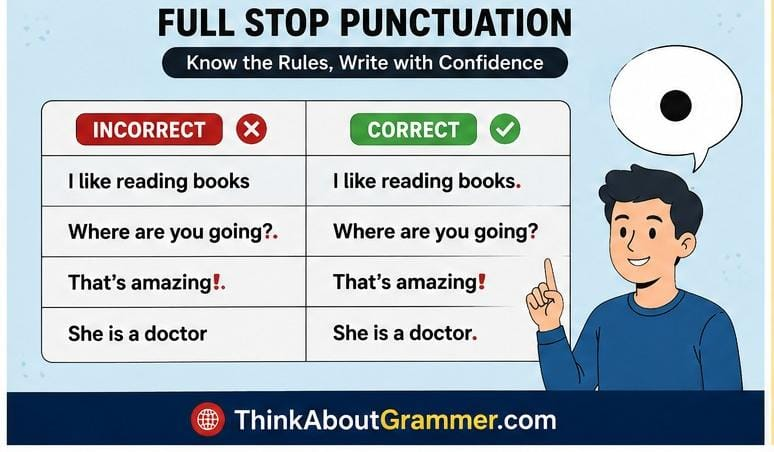
A question mark or exclamation mark already ends a sentence, so you do not normally add a full stop after it.
Incorrect
- Where are you going?.
- That was amazing!.
Correct
- Where are you going?
- That was amazing!
The question mark and exclamation mark perform the sentence-ending function themselves.
Full Stops With Multiple Sentences
When several complete sentences appear together, each sentence normally needs its own ending punctuation.
For example:
The exam begins at nine. Students should arrive at least fifteen minutes early. Bring a pencil and your identification.
Each sentence contains a separate complete thought, so each ends appropriately.
Avoid joining several independent sentences together without punctuation.
Incorrect
The exam begins at nine students should arrive early bring your identification.
Correct
The exam begins at nine. Students should arrive early. Bring your identification.
Full Stop Punctuation and Sentence Fragments
A full stop does not automatically turn a group of words into a complete sentence.
For example:
Because the weather was terrible.
This is a sentence fragment. It begins with “because” but does not provide the main clause needed to complete the thought.
Instead:
We stayed home because the weather was terrible.
The full stop correctly ends the complete sentence.
A Useful Check
Before putting a full stop at the end of a sentence, ask:
Does this sentence express a complete thought?
If the answer is no, you may have a sentence fragment.
Full Stops in Lists
Whether individual items in a list need full stops depends on the structure of the list.
Complete-Sentence List
If each item is a complete sentence, use full stops.
- Check your email.
- Review the document.
- Submit the form.
Short Phrase List
If the items are short phrases, full stops may not be necessary.
- Grammar rules
- Writing tips
- Punctuation examples
- Common mistakes
The important thing is to use a consistent format.
Full Stops in Headings and Titles
Headings generally do not require full stops when they are simply titles or labels.
For example:
How to Use a Full Stop
Not:
How to Use a Full Stop.
However, if a heading is written as a complete sentence in a particular publication style, punctuation may occasionally be used.
For most websites, articles, reports, and educational materials, leaving the full stop out of headings is the cleaner choice.
Full Stops in Captions
Captions can follow different conventions.
A short caption may not need a full stop:
Students studying in the library
A caption written as a complete sentence can take one:
Students are studying for their final examinations.
The decision depends on whether the caption is functioning as a label or as a sentence.
Full Stops in Email Writing
Professional emails often contain many sentences, so full stops are important for clarity. For more guidance on writing clearly and professionally, see our professional email grammar rules
Compare:
Without punctuation:
Thank you for your message I have reviewed the document and will send my feedback tomorrow
With punctuation:
Thank you for your message. I have reviewed the document and will send my feedback tomorrow.
The second version is much easier to read.
Avoid Overusing Full Stops
At the same time, don’t put a full stop after every fragment.
For example:
Hello. John.
Thank you. For your email.
This creates unnecessary sentence breaks.
A better version is:
Hello John,
Thank you for your email.
Full Stops in Academic Writing
Academic writing relies heavily on complete, clearly separated sentences.
For example:
Researchers collected data from three groups. The results were compared using the same criteria. The findings revealed several important differences.
Full stops help readers identify where one idea ends and another begins.
When academic sentences become very long, writers sometimes avoid punctuation entirely. Breaking long ideas into shorter sentences can improve clarity.
Full Stops in Business Writing
Clear punctuation is especially useful in professional communication.
Instead of:
We received your application we will review it and contact you next week
Write:
We received your application. We will review it and contact you next week.
This simple change makes the message more professional and readable.
Common Full Stop Mistakes
Even experienced writers occasionally make punctuation mistakes. Here are some of the most common ones.
1. Forgetting the Full Stop
Incorrect:
The project is complete
Correct:
The project is complete.
2. Adding a Full Stop After a Question Mark
Incorrect:
What time does the class start?.
Correct:
What time does the class start?
3. Adding a Full Stop After an Exclamation Mark
Incorrect:
Watch out!.
Correct:
Watch out!
4. Using Full Stops Between Words
A full stop should not be used where a comma or another punctuation mark is required.
Incorrect:
After dinner. We went for a walk.
Correct:
After dinner, we went for a walk.
Or:
We finished dinner. Then we went for a walk.
5. Creating Sentence Fragments
Incorrect:
When the lesson ended.
Correct:
We left when the lesson ended.
The first example is incomplete because “when” introduces a dependent clause that needs a main clause.
Full Stop vs. Comma
A full stop separates complete sentences, while a comma often separates parts within a sentence.
Compare:
I finished my homework, and I watched television.
The comma connects two clauses within one sentence.
Alternatively:
I finished my homework. I watched television.
The full stop separates them into two sentences. If you’re learning how to connect independent clauses correctly, our guide to FANBOYS grammar explains how coordinating conjunctions work with sentence structure.
Quick Comparison
| Punctuation | Main function | Example |
|---|---|---|
| Full stop (.) | Ends a statement | I finished my work. |
| Comma (,) | Separates parts of a sentence | After lunch, we left. |
| Question mark (?) | Ends a direct question | Are you ready? |
| Exclamation mark (!) | Shows strong emotion or emphasis | Be careful! |
| Colon (:) | Introduces information | Bring three things: paper, a pen, and a ruler. |
| Semicolon (;) | Links closely related independent clauses | I was tired; I continued working. |
How to Know Where a Full Stop Belongs
A simple editing process can help.
Step 1: Find the Complete Thoughts
Read your paragraph and identify where one complete idea ends.
Step 2: Check the Sentence Type
Ask whether the sentence is a statement, question, command, or exclamation.
- Statement → usually full stop
- Question → question mark
- Strong exclamation → exclamation mark
Step 3: Check for Fragments
Make sure the words before the punctuation form a complete sentence.
Step 4: Check for Run-On Sentences
If two complete sentences have been joined without appropriate punctuation, separate them or connect them correctly.
Step 5: Read It Aloud
Reading your writing aloud can help you notice places where a sentence naturally ends.
Full Stop Punctuation: Quick Rules
Here is a useful reference table:
| Rule | Example |
|---|---|
| End a declarative sentence with a full stop | She lives in London. |
| Use one after a neutral command | Please sit down. |
| Don’t add one after a question mark | Are you ready? |
| Don’t add one after an exclamation mark | That’s fantastic! |
| Use consistently with abbreviations | Dr. Smith |
| Don’t normally use one after a heading | Grammar Rules |
| Use one after a complete sentence in a list | Read the instructions. |
| Check for sentence fragments | Because I was tired. ❌ |
These punctuation principles are also useful when preparing for standardized tests. If you’re studying for the SAT, our guide to SAT grammar rules can help you review important sentence and punctuation concepts.
Does Every Sentence Need a Full Stop?
No.
A sentence can end with other punctuation marks, such as a question mark or exclamation mark.
For example:
- What are you doing?
- That’s incredible!
But a normal declarative sentence generally requires a full stop.
The children are playing outside.
Is a Full Stop the Same as a Period?
Yes. In punctuation, full stop and period refer to the same symbol: .
“Full stop” is especially common in British English, while “period” is the usual American English term.
Why Is Full Stop Punctuation Important?
Good punctuation makes writing easier to understand.
Without sentence-ending punctuation, readers may struggle to determine where one idea ends and another begins.
Compare:
The meeting ended everyone went home the manager stayed behind to finish the report
with:
The meeting ended. Everyone went home. The manager stayed behind to finish the report.
The second version is much clearer because each complete thought is properly separated.
Tips for Using Full Stops Correctly
Keep these practical tips in mind:
- End ordinary statements with a full stop.
- Don’t put a full stop after a question mark or exclamation mark.
- Make sure the sentence is complete before ending it.
- Don’t use full stops randomly inside a sentence.
- Follow the required style for abbreviations.
- Use consistent punctuation in lists.
- Avoid unnecessary full stops in headings.
- Break very long sentences into shorter, clearer ones.
- Check your writing for fragments and run-on sentences.
- Read your final text carefully before publishing or submitting it.
Frequently Asked Questions About Full Stop Punctuation
What is a full stop in punctuation?
A full stop is the punctuation mark (.) used mainly at the end of a complete statement. It indicates that the sentence has finished.
What is the difference between a full stop and a period?
There is no difference in the punctuation mark itself. Full stop is the common British English term, while period is commonly used in American English.
Should I put a full stop after a question mark?
No. A question mark already ends the sentence.
Correct:
Where are you going?
Incorrect:
Where are you going?.
Should headings have full stops?
Usually, no. Headings and titles generally don’t need ending punctuation unless a particular style guide requires it.
Can a command end with a full stop?
Yes. A neutral command or request can end with a full stop.
Please close the window.
A strong command may instead use an exclamation mark:
Stop!
Do abbreviations always need full stops?
No. Abbreviation conventions vary. Some abbreviations traditionally use full stops, while others don’t. Follow the style guide relevant to your audience.
Can a full stop be used after an abbreviation and at the end of a sentence?
Yes, although the formatting depends on the abbreviation. For example, if an abbreviation already ends with a full stop and the sentence also ends there, you generally don’t need to add another full stop.
Why is the full stop important in English writing?
It clearly marks the end of a sentence, helping readers separate complete thoughts and understand the structure of your writing.
Conclusion
Full stop punctuation may look simple, but it plays a fundamental role in clear English writing. Use a full stop primarily to end complete statements, while remembering that questions and exclamations normally use their own ending punctuation.
The most useful habit is to think about the structure of your sentence rather than simply adding punctuation automatically. Check whether your thought is complete, identify the type of sentence, and then choose the appropriate punctuation mark.
Once these basic rules become familiar, using full stops correctly becomes almost automatic—and your writing becomes clearer, more polished, and easier to read.