

Introduction
If you have ever wondered how to connect two complete sentences without making a grammatical mistake, FANBOYS grammar is one of the most useful rules to learn.
- Introduction
- What Does FANBOYS Mean in Grammar?
- What Are Coordinating Conjunctions?
- FANBOYS Grammar Rules
- When Do You NOT Need a Comma?
- FANBOYS Grammar: How Each Conjunction Works
- F — For
- A — And
- N — Nor
- B — But
- O — Or
- Y — Yet
- S — So
- A Simple Way to Remember FANBOYS
- FANBOYS Comma Rule
- What Is a Comma Splice?
- Common FANBOYS Grammar Mistakes
- Mistake 1: Forgetting the Comma
- Mistake 2: Adding a Comma Between Two Words
- Mistake 3: Using a Comma After FANBOYS
- Mistake 4: Treating Every “So” as a FANBOYS Conjunction
- Mistake 5: Using “Nor” Incorrectly
- FANBOYS vs. Subordinating Conjunctions
- FANBOYS vs. Semicolons
- Can FANBOYS Start a Sentence?
- How to Use FANBOYS in Academic Writing
- FANBOYS Examples for Students
- A Quick FANBOYS Test
- A Practical Editing Checklist
- Why FANBOYS Grammar Matters
- Conclusion
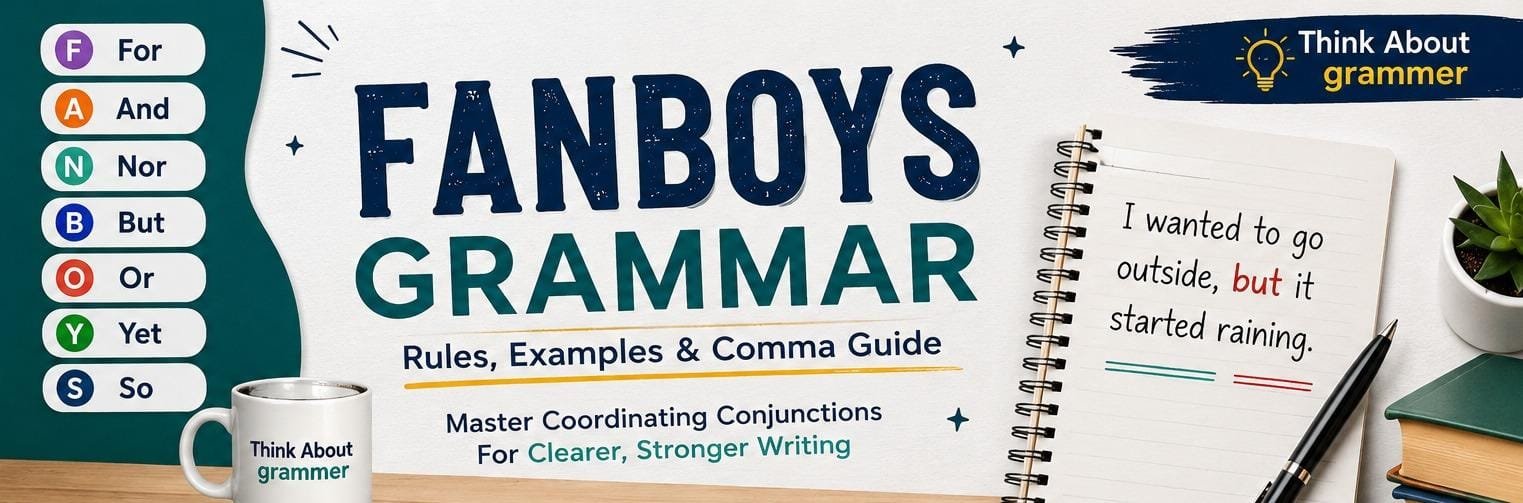
FANBOYS is an acronym for seven coordinating conjunctions:
For, And, Nor, But, Or, Yet, So
These small words connect words, phrases, and—most importantly—independent clauses. They help writers show relationships such as addition, contrast, choice, reason, and result.
For example:
I wanted to go outside, but it started raining.
The word but connects two complete thoughts: I wanted to go outside and it started raining.
In this guide, you will learn what FANBOYS means, when to use a comma, how each conjunction works, common mistakes, and how to use these words naturally in your own writing.
What Does FANBOYS Mean in Grammar?
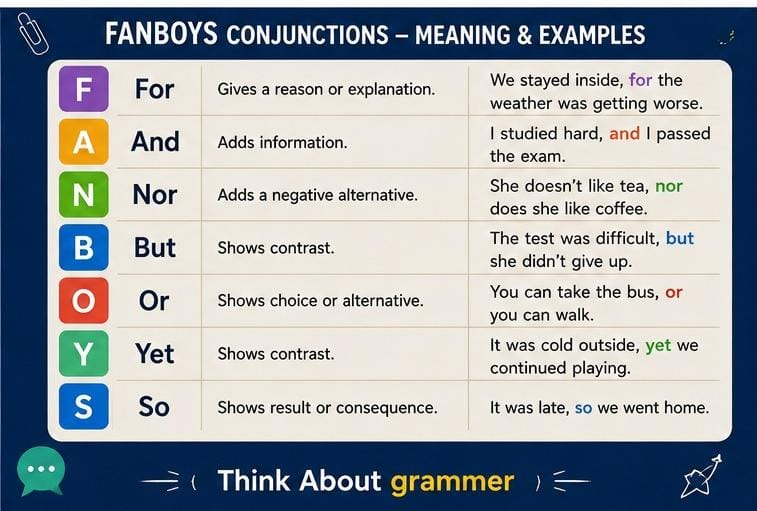
FANBOYS is a memory device for remembering the seven coordinating conjunctions:
| Letter | Conjunction | Common Function |
|---|---|---|
| F | For | Gives a reason |
| A | And | Adds information |
| N | Nor | Adds a negative alternative |
| B | But | Shows contrast |
| O | Or | Shows a choice or alternative |
| Y | Yet | Shows contrast |
| S | So | Shows a result |
These conjunctions are called coordinating conjunctions because they join grammatical elements of equal importance.
For example:
- Apples and oranges — two nouns
- Slowly but carefully — two adverbs
- She studied, and she passed — two independent clauses
What Are Coordinating Conjunctions?
A coordinating conjunction connects words, phrases, or clauses that have a similar grammatical role.
Consider this sentence:
Emma bought pencils and notebooks.
The conjunction and connects two nouns.
Now consider:
Emma studied hard, and she passed the exam.
Here, and connects two independent clauses.
An independent clause contains a subject and a verb and can stand alone as a complete sentence.
- Emma studied hard.
- She passed the exam.
Because both parts can function as complete sentences, they can be joined with a comma and a coordinating conjunction.
FANBOYS Grammar Rules
The most important FANBOYS rule concerns independent clauses.
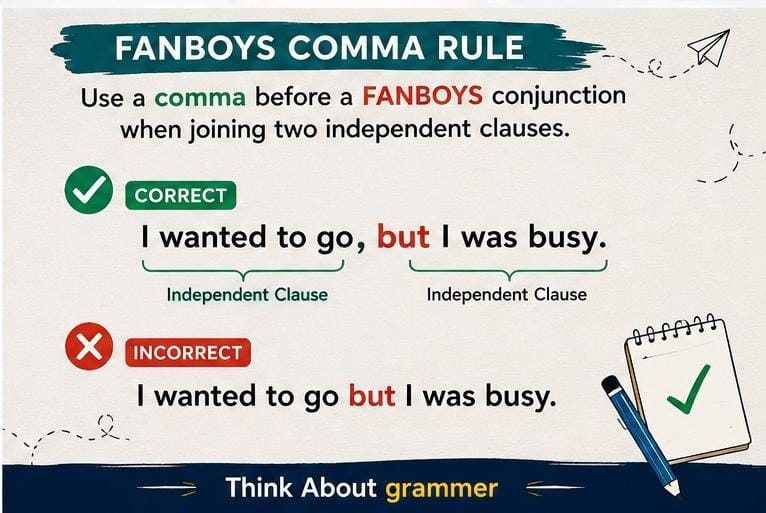
When a FANBOYS conjunction joins two independent clauses, normally place a comma before the conjunction.
Basic Pattern
Independent clause + comma + FANBOYS + independent clause
Example:
The restaurant was crowded, so we ordered takeout.
Both parts are complete:
- The restaurant was crowded.
- We ordered takeout.
Therefore, the comma before so is appropriate.
More Examples
I wanted to call you, but I was busy.
Sarah finished her homework, and she watched television.
You can take the bus, or you can walk.
The weather was cold, yet the children continued playing.
When Do You NOT Need a Comma?
You generally do not need a comma when a FANBOYS conjunction joins individual words or phrases rather than two independent clauses.
Joining Two Words
I bought bread and milk.
There is no comma because and joins two nouns.
Incorrect:
I bought bread, and milk.
Correct:
I bought bread and milk.
Joining Two Phrases
She worked quickly but carefully.
Here, but connects two adverbial elements rather than two independent clauses.
Joining Two Verbs
Daniel opened the door and walked inside.
The subject Daniel applies to both verbs, so a comma is usually unnecessary.
FANBOYS Grammar: How Each Conjunction Works
Each FANBOYS conjunction has a slightly different purpose. Understanding those differences will help you choose the right word.
F — For
For can introduce a reason or explanation. In this use, it is similar to because, although it often sounds more formal or literary.
Example:
We stayed inside, for the storm was getting worse.
The second clause explains why the first action happened.
Another example:
She left early, for she had an important appointment.
However, for is less common in everyday conversational English than because.
Important Note About “For”
The word for does not always function as a coordinating conjunction.
Compare:
I bought this gift for my sister.
Here, for is a preposition, not a coordinating conjunction.
A — And
And adds information or connects similar ideas.
Examples:
Tom likes reading, and Mia enjoys writing.
We visited the museum and the library.
She opened her laptop and started working.
When and joins two independent clauses, use a comma before it:
The lesson ended, and the students packed their bags.
When it joins words or phrases, a comma is generally unnecessary:
The lesson ended and the students packed their bags.
In the second sentence, the structure can be interpreted as one clause with a shared subject.
N — Nor
Nor introduces another negative alternative. It commonly follows neither or another negative construction.
Example:
She does not drink coffee, nor does she drink tea.
Another example:
He neither called me, nor did he send a message.
Notice that nor can involve an unusual word order after it:
Nor did she complain.
Instead of:
Nor she did complain.
The first version is grammatically correct.
Nor With Neither
A common structure is:
Neither the manager nor the employees were available.
Here, neither…nor connects two elements within the same sentence.
B — But
But introduces contrast or an unexpected difference.
Examples:
I wanted to go, but I was too tired.
The task was difficult, but she completed it.
He is young but experienced.
When but connects two independent clauses, a comma normally comes before it.
But vs. However
These words can both express contrast, but they behave differently grammatically.
I was tired, but I continued working.
I was tired. However, I continued working.
However is not one of the FANBOYS conjunctions, so you cannot simply substitute it for but with the same punctuation.
O — Or
Or presents a choice, possibility, or alternative.
Examples:
Would you like tea or coffee?
We can leave now, or we can wait.
You can study tonight or tomorrow morning.
When or connects two independent clauses, use a comma:
You can take the train, or you can drive.
When it connects individual words, no comma is normally needed:
Would you like tea or coffee?
Y — Yet
Yet can show contrast, much like but. It often emphasizes that something happened despite an expectation.
Examples:
The exam was difficult, yet she remained confident.
He was exhausted, yet he continued working.
It can also appear without a comma when it connects smaller grammatical elements:
The task was difficult yet rewarding.
Here, yet connects the adjectives difficult and rewarding.
S — So
So can show a result or consequence.
Examples:
It was raining, so we stayed inside.
I missed the bus, so I walked to school.
The first independent clause gives the situation, while the second gives the result.
Be Careful With “So”
So can have different grammatical functions.
In:
I was tired, so I went home.
So is a coordinating conjunction.
But in:
She was so tired that she went home.
Here, so is functioning differently as part of the so…that construction.
A Simple Way to Remember FANBOYS
If remembering all seven words is difficult, group them by meaning:
Addition
And
I studied and practiced.
Contrast
But, Yet
I was tired, but I continued.
It was difficult, yet we finished.
Choice
Or
You can stay or leave.
Negative Alternative
Nor
He didn’t call, nor did he text.
Reason
For
We left early, for the weather was changing.
Result
So
It was late, so we went home.
FANBOYS Comma Rule
One of the most important grammar lessons involving FANBOYS is the comma rule.
Use a comma before a FANBOYS conjunction when it joins two independent clauses.
Correct
The store was closed, so we went home.
Incorrect
The store was closed so, we went home.
The comma belongs before the conjunction, not after it.
Another Correct Example
Maria wanted to attend the meeting, but she was sick.
Both sides contain a subject and a verb:
- Maria wanted to attend.
- She was sick.
Therefore, the comma is appropriate.
What Is a Comma Splice?
A comma splice happens when two independent clauses are joined with only a comma.
Incorrect:
I finished my homework, I watched a movie.
The comma alone cannot properly connect the two complete sentences.
You could correct it in several ways:
I finished my homework, and I watched a movie.
Or:
I finished my homework. I watched a movie.
Or:
I finished my homework; I watched a movie.
The first option uses a FANBOYS conjunction correctly.
Common FANBOYS Grammar Mistakes
Mistake 1: Forgetting the Comma
Incorrect:
I wanted to help but I was busy.
When but joins two independent clauses, the comma is normally needed.
Correct:
I wanted to help, but I was busy.
Mistake 2: Adding a Comma Between Two Words
Incorrect:
She bought apples, and oranges.
Correct:
She bought apples and oranges.
The conjunction connects two nouns, not two independent clauses.
Mistake 3: Using a Comma After FANBOYS
Incorrect:
I was tired, but, I continued working.
Correct:
I was tired, but I continued working.
Mistake 4: Treating Every “So” as a FANBOYS Conjunction
The word so can serve different grammatical purposes.
It was raining, so we stayed home.
Here it connects independent clauses.
But:
I was so tired that I went to bed early.
Here it is part of a different construction.
Mistake 5: Using “Nor” Incorrectly
Incorrect:
He didn’t study, nor he completed the assignment.
Correct:
He didn’t study, nor did he complete the assignment.
When nor introduces an independent clause, auxiliary inversion is commonly used.
These punctuation rules are also useful when preparing for grammar-focused exams, so reviewing SAT grammar rules A Practical Editing Checklist can provide additional practice.
FANBOYS vs. Subordinating Conjunctions
FANBOYS words are coordinating conjunctions. They are different from subordinating conjunctions such as:
- because
- although
- while
- since
- unless
- although
- before
- after
Compare:
I stayed home because I was sick.
Here, because introduces a dependent clause.
Now compare:
I was sick, so I stayed home.
Here, so connects two independent clauses.
The relationship between the ideas is similar, but the grammatical structure is different.
FANBOYS vs. Semicolons
A semicolon can also connect two closely related independent clauses.
For example:
The store was closed; we went home.
You could instead use a FANBOYS conjunction:
The store was closed, so we went home.
The conjunction makes the relationship between the two ideas clearer. In this case, so tells the reader that the second event is a result of the first.
Can FANBOYS Start a Sentence?
Yes. A coordinating conjunction can sometimes begin a sentence, especially in modern, natural writing.
For example:
The weather looked terrible. But we decided to continue.
This is not automatically a grammar mistake.
However, writers should use sentence openings with conjunctions deliberately rather than adding them simply to create fragments.
Compare:
I wanted to go. But I was too tired.
This is grammatically acceptable because But I was too tired contains a subject and verb and can function as a complete sentence.
How to Use FANBOYS in Academic Writing
FANBOYS conjunctions are perfectly useful in academic writing, but variety and precision matter.
Instead of repeatedly writing:
The experiment failed, and the researchers repeated it, and they collected new data.
You could improve the structure:
The experiment failed, so the researchers repeated it and collected new data.
The goal is not to avoid FANBOYS. The goal is to use them where they make the relationship between ideas clear. If you’re applying these principles to workplace communication, learning professional email grammar rules Common FANBOYS Grammar Mistakes can help you write clearer and more polished messages.
FANBOYS Examples for Students
Here are several examples you can study:
| Conjunction | Example |
| For | We left early, for the weather was worsening. |
| And | She studied hard, and she passed the test. |
| Nor | He didn’t apologize, nor did he explain his decision. |
| But | I wanted to attend, but I had another appointment. |
| Or | We can take the bus, or we can walk. |
| Yet | The road was difficult, yet they continued. |
| So | The store was closed, so we returned home. |
A Quick FANBOYS Test
When you are unsure whether to place a comma before a FANBOYS conjunction, try this simple method:
- Find the conjunction.
- Look at the words before it.
- Look at the words after it.
- Ask whether both sides can stand alone as complete sentences.
- If both are independent clauses, a comma is generally appropriate.
Example
The movie ended, and everyone left.
Before and:
The movie ended.
After and:
Everyone left.
Both are complete sentences, so the comma works.
Now look at:
The movie ended and everyone left.
Here, the two parts can be understood as a single compound predicate with the same subject in the broader context, so a comma is not necessarily required.
A Practical Editing Checklist
Before submitting an essay, email, assignment, or article, check your FANBOYS usage.
- Check whether for, and, nor, but, or, yet, or so is being used as a conjunction.
- Look at what comes before and after the conjunction.
- Check whether both sides are independent clauses.
- Add a comma when appropriate.
- Do not automatically add a comma before every FANBOYS word.
- Check that nor is used with the correct sentence structure.
- Make sure the conjunction expresses the intended relationship.
- Read the sentence aloud to check whether the connection sounds natural.
Why FANBOYS Grammar Matters
Understanding FANBOYS grammar helps you build stronger sentences.
Instead of writing a series of short sentences:
I was hungry. I made dinner. I ate quickly.
You can combine ideas:
I was hungry, so I made dinner and ate quickly.
The result is more connected and can make your writing easier to follow. For a broader approach to improving sentence construction, The Writing Revolution is another useful resource to explore.
The key is balance. Good writing does not mean combining every sentence with a conjunction. Short sentences, compound sentences, and complex sentences can work together effectively.
Frequently Asked Questions About FANBOYS Grammar
What does FANBOYS stand for in grammar?
FANBOYS stands for For, And, Nor, But, Or, Yet, and So, the seven coordinating conjunctions.
What is the main FANBOYS comma rule?
When a FANBOYS conjunction joins two independent clauses, place a comma before the conjunction.
Do you always need a comma before FANBOYS?
No. A comma is generally unnecessary when the conjunction joins words, phrases, or elements that do not form two independent clauses.
Can FANBOYS connect two words?
Yes. For example: “She bought apples and oranges.” Here, and connects two nouns.
Can a sentence start with a FANBOYS conjunction?
Yes. Starting a sentence with words such as and or but can be grammatically acceptable when used appropriately.
Is “because” part of FANBOYS?
No. Because is a subordinating conjunction, while FANBOYS words are coordinating conjunctions.
What is the easiest way to remember FANBOYS?
Remember the seven words through the acronym F-A-N-B-O-Y-S: For, And, Nor, But, Or, Yet, So.
What is the difference between “but” and “yet”?
Both can show contrast, but yet often emphasizes a surprising contrast or result, while but is the more common general-purpose contrast conjunction.
Conclusion
Learning FANBOYS grammar gives you a simple framework for connecting ideas clearly. The seven coordinating conjunctions—for, and, nor, but, or, yet, and so—can join words, phrases, and independent clauses.
The most important rule to remember is straightforward: when a FANBOYS conjunction connects two independent clauses, a comma generally comes before the conjunction. When it connects smaller grammatical elements, a comma is usually unnecessary.
Once you can identify independent clauses, choosing the correct punctuation becomes much easier. Practice by looking at real sentences, checking what each conjunction connects, and asking whether both sides can stand alone.