

If you have ever seen a small decorative mark used in old books, manuscripts, inscriptions, or historical documents, you may have encountered hedera punctuation. Although it is rarely taught in modern grammar classes, this distinctive symbol has an interesting history and a practical purpose in the development of written punctuation.
- What Is Hedera Punctuation?
- Why Is It Called a Hedera?
- The Historical Origins of Hedera Punctuation
- How Hedera Punctuation Differs From Modern Punctuation
- Is Hedera Punctuation Still Used Today?
- How the Hedera Looks
- Hedera Punctuation and Typography
- Hedera Punctuation in Manuscripts
- Is Hedera a Grammar Mark?
- Common Mistakes About Hedera Punctuation
- Mistake 1: Treating It Like a Modern Comma
- Mistake 2: Assuming It Ends Every Sentence
- Mistake 3: Using It in Formal Writing Without a Reason
- Mistake 4: Assuming Every Leaf Symbol Has the Same Meaning
- How to Use Hedera Punctuation in Modern Writing
- Hedera Punctuation vs. Other Historical Marks
- Why Learning About Hedera Punctuation Matters
- Hedera Punctuation in Digital Text
- Practical Examples of Hedera Punctuation
- A Quick Guide to Using the Hedera Correctly
- Conclusion
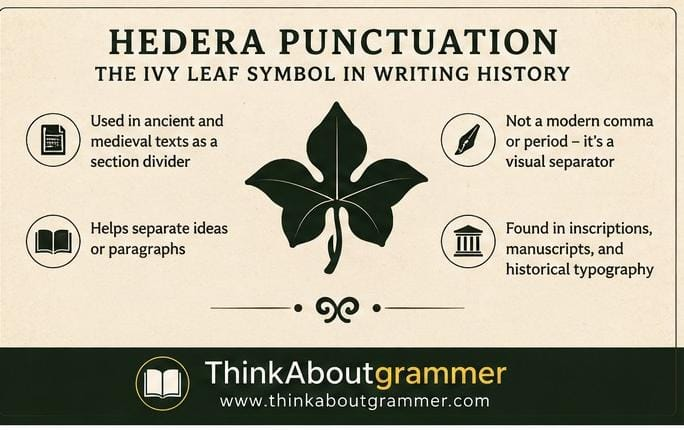
The hedera is usually represented by a leaf-shaped symbol, often resembling an ivy leaf. It was used by ancient and medieval writers as a visual separator between sections of text. Unlike a modern period, comma, or semicolon, its main purpose was not to show a particular grammatical relationship between words. Instead, it helped organize written material and make longer passages easier to read.
Understanding hedera punctuation is useful for students of language, typography, history, manuscripts, and writing systems. It also helps explain an important fact about punctuation: the symbols we use today developed gradually, and many older marks have disappeared from everyday writing.
This guide explains what hedera punctuation means, where it came from, how it was used, how it differs from modern punctuation, and where you might still encounter it today.
What Is Hedera Punctuation?
Hedera punctuation refers to the use of a decorative leaf-shaped mark as a punctuation or text-separation symbol.
The word hedera is Latin for ivy, so the term essentially refers to an ivy-leaf symbol. It is sometimes called the hedera, hedera punctum, or ivy leaf punctuation.
The symbol is commonly represented as:
❧
Another related character is:
☙
However, historical examples can look quite different depending on the period, manuscript, typeface, or writing tradition.
Rather than functioning like a modern comma or question mark, the hedera was generally used to create a visual break in text.
What Did the Hedera Do?
The hedera could be used to:
- Separate paragraphs or sections
- Mark a break between ideas
- Divide passages in manuscripts
- Create a visual distinction between blocks of text
- Decorate inscriptions and written pages
- Indicate divisions where modern paragraph formatting might be used
Its decorative appearance was therefore closely connected with its organizational function.
Why Is It Called a Hedera?
The name comes from the Latin word hedera, meaning ivy.
The symbol resembles an ivy leaf, which explains why scribes and scholars associated the mark with the plant. Its leaf-like appearance also made it visually attractive compared with simple dots or lines.
This is an interesting example of how the names of writing symbols often come from their physical appearance.
For comparison:
| Symbol or term | Basic idea behind the name |
|---|---|
| Hedera | Ivy or ivy leaf |
| Asterisk | Star-like symbol |
| Obelus | Historical term associated with a pointed mark |
| Pilcrow | Historical name for the paragraph mark |
| Ampersand | Developed from a phrase associated with “and” |
The names of punctuation marks can therefore preserve pieces of writing history.
The Historical Origins of Hedera Punctuation
The hedera has roots in classical writing traditions, particularly in the world of ancient Greek and Roman texts.
Ancient writing did not always use punctuation in the systematic way modern English does. Spaces, paragraph breaks, capitalization, commas, periods, and other familiar conventions developed at different times and for different purposes.
Decorative separators such as the hedera provided one way to divide written material.
Hedera in Ancient and Classical Texts
The hedera appears in historical inscriptions and manuscripts associated with the ancient Mediterranean world.
It could be placed between sections of text or used to make an inscription more visually organized. In some cases, the symbol served both a practical and decorative role.
This combination is important. Historical punctuation was not always purely grammatical.
A mark could simultaneously:
- Separate text.
- Improve visual readability.
- Fill empty space.
- Add decoration.
- Signal a transition.
That makes hedera punctuation different from the highly standardized punctuation system used in modern English.
How Hedera Punctuation Differs From Modern Punctuation
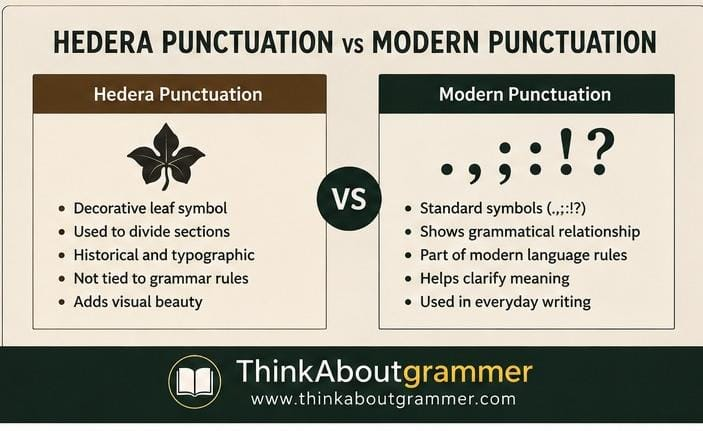
Modern punctuation usually has a specific relationship with grammar, sentence structure, or meaning.
For example:
- A period usually ends a statement.
- A question mark identifies a direct question.
- A comma can separate elements within a sentence.
- A semicolon can connect closely related independent clauses.
- A colon can introduce an explanation or list.
The hedera generally does not work this way.
Instead, it is primarily a visual separator.
Hedera vs. a Period
Consider a modern sentence:
The journey ended. Everyone returned home.
The period marks the end of the first sentence.
If you want to learn more about how periods work in English, see our guide to Full Stop Punctuation.
A hedera, by contrast, might historically be used as a decorative division between larger sections rather than simply indicating that one grammatical sentence has ended.
Hedera vs. a Paragraph Break
The hedera can sometimes perform a function that feels similar to a paragraph break.
For example:
The first section discusses the journey. ❧ The next section describes what happened afterward.
In a modern document, you would normally create a new paragraph instead of inserting a hedera.
Is Hedera Punctuation Still Used Today?
Yes, but it is uncommon in ordinary English writing.
You are much more likely to encounter the hedera in:
- Historical texts
- Typography
- Book design
- Manuscript studies
- Decorative publishing
- Academic discussions of punctuation
- Digital character collections
- Reproductions of historical documents
It is not normally part of everyday school, business, or professional writing.
If you are writing an email, essay, report, or standard blog post, there is usually no reason to replace a normal paragraph break or punctuation mark with a hedera.
How the Hedera Looks
The classic hedera is recognizable because of its leaf-like shape.
The character ❧ is one of the most recognizable modern representations.
However, historical forms were not necessarily identical. Scribes, printers, and typographers could draw the symbol in different ways.
This variation is common with historical punctuation. Before digital typography standardized character shapes, symbols could change significantly between:
- Manuscripts
- Printing houses
- Time periods
- Regions
- Typefaces
- Individual scribes
Therefore, not every leaf-shaped mark in an old text should automatically be identified as exactly the same punctuation symbol.
Hedera Punctuation and Typography
One of the most interesting aspects of the hedera is its relationship with typography.
Typography is not only about making words readable. It also concerns the visual organization of a page.
A decorative symbol can help guide the reader’s eye by creating a visible boundary between sections.
Why Visual Separators Matter
Imagine a page containing several large blocks of uninterrupted text.
Without headings, spacing, or paragraph breaks, the page can become difficult to navigate.
Modern documents solve this problem with tools such as:
- Paragraph spacing
- Headings
- Horizontal rules
- Bulleted lists
- Indentation
- White space
Historical texts had fewer standardized options, so decorative marks could play an important organizational role.
Hedera Punctuation in Manuscripts
Manuscripts provide some of the most fascinating examples of historical punctuation.
Before modern printing and word-processing software, text was copied by hand. Scribes used visual conventions to organize information and distinguish important sections.
A hedera could contribute to that structure.
However, interpretation requires caution. A decorative leaf does not automatically mean exactly the same thing in every manuscript.
Researchers consider factors such as:
- Where the symbol appears
- What surrounds it
- The manuscript’s date
- The writing tradition
- The language
- The scribe’s conventions
- Whether similar symbols appear elsewhere in the document
This context helps determine the symbol’s likely function.
Is Hedera a Grammar Mark?
Not in the same sense as a comma, period, or semicolon.
It is better understood as a historical punctuation or text-division symbol. To better understand the difference between grammar and punctuation, start with our guide on What Is Grammar.
Calling it simply a grammar mark can be misleading because its main purpose was often visual organization rather than expressing a specific grammatical relationship.
For example, a comma can change how a sentence is parsed:
After dinner, we went outside.
The comma helps separate an introductory phrase from the main clause.
A hedera does not normally provide this type of grammatical information.
Common Mistakes About Hedera Punctuation
Because the hedera is unfamiliar to many modern readers, several misunderstandings are common.
Mistake 1: Treating It Like a Modern Comma
The hedera should not automatically be inserted wherever a comma would appear.
Incorrect approach:
I went home ❧ because it was late.
The symbol does not function as a normal comma.
Mistake 2: Assuming It Ends Every Sentence
A hedera is not simply an alternative period.
Its historical uses were broader and often related to section division.
Mistake 3: Using It in Formal Writing Without a Reason
Modern readers may find unexplained decorative punctuation confusing.
If you are writing a school assignment, report, article, or professional document, standard punctuation is normally the better choice.
Mistake 4: Assuming Every Leaf Symbol Has the Same Meaning
A leaf-shaped decorative mark can have different functions depending on the historical source.
Context matters.
How to Use Hedera Punctuation in Modern Writing
If you are studying historical typography or creating a design inspired by older texts, the hedera can be used deliberately.
For example:
Chapter One
The story begins in the old city.
❧
Chapter Two
The journey continues beyond the city walls.
Here, the hedera functions as a visual divider.
It is not being used as a replacement for a comma or period.
When It Makes Sense to Use It
You might consider using a hedera for:
- Decorative section breaks
- Historical design projects
- Typography experiments
- Book or manuscript-inspired layouts
- Creative publishing
- Digital recreations of historical documents
For normal informational writing, however, headings and spacing are usually clearer.
Hedera Punctuation vs. Other Historical Marks
The hedera belongs to a much larger story about punctuation.
Many symbols that were once common have become rare, changed shape, or disappeared from everyday writing.
| Mark | General historical role |
|---|---|
| Hedera | Decorative or sectional division |
| Pilcrow (¶) | Paragraph or section indication |
| Diple | Textual marking and emphasis |
| Obelus (÷) | Historical textual criticism and marking |
| Asterisk (*) | Reference, omission, emphasis, and other uses |
| Interpunct (·) | Word or phrase separation in some writing systems |
This history shows that punctuation is not fixed forever. Writing conventions change as technology, reading habits, and publishing practices change. For another example of how punctuation can affect written expression, explore our guide to Ellipses in Grammar.
Why Learning About Hedera Punctuation Matters
At first glance, the hedera might seem like an obscure symbol with little relevance to modern readers.
But it offers a useful lesson about language.
Punctuation Is Historical
The punctuation system taught in modern English classrooms is the result of centuries of development.
Symbols were introduced, modified, repurposed, and eventually abandoned.
The hedera is a reminder that today’s punctuation conventions are not the only possible way to organize written language.
Punctuation Is Also Visual
Good writing is not only about grammar.
The appearance of a page affects how easily readers can understand and navigate information.
The hedera demonstrates how visual design and written language have historically worked together.
Hedera Punctuation in Digital Text
Modern computers can represent certain historical and decorative characters using Unicode.
The symbol ❧ is commonly available as a Unicode character known as a ROTATED FLORAL HEART BULLET, while other related symbols have their own Unicode identities.
This distinction matters because a character’s digital name does not always perfectly describe its historical use.
When using unusual Unicode symbols, you should also consider whether the reader’s device and font support them correctly.
Why Font Support Matters
A historical symbol may appear differently across devices.
Possible problems include:
- The character may use a different font.
- The symbol may appear as a missing-character box.
- Its shape may vary slightly.
- Screen readers may interpret it differently.
- Some publishing systems may remove or alter unusual characters.
For ordinary web content, accessibility and readability should therefore take priority over decorative punctuation.
Practical Examples of Hedera Punctuation
Here are several examples showing how the mark might be understood in different contexts.
Example 1: Section Divider
The First Journey
The travelers left before sunrise.
❧
The Second Journey
They returned several weeks later.
The hedera visually separates two sections.
Example 2: Decorative Book Design
A Collection of Historical Notes
Ancient writers used many different methods to organize text.
❧
Later traditions developed more standardized punctuation.
Again, the symbol acts as a visual break.
Example 3: Modern Sentence Punctuation
Not recommended:
The sun was setting ❧ we decided to leave.
Better:
The sun was setting, so we decided to leave.
Or:
The sun was setting. We decided to leave.
The modern punctuation communicates the grammatical relationship much more clearly.
A Quick Guide to Using the Hedera Correctly
If you want to use the symbol in a modern project, follow these guidelines:
- Treat it primarily as a decorative or sectional mark.
- Do not automatically substitute it for commas or periods.
- Use it when a historical or typographical effect is intended.
- Check how the symbol renders in your chosen font.
- Consider accessibility before using unusual characters.
- Use standard punctuation for ordinary grammatical relationships.
- Look at the historical context when interpreting an old hedera.
Frequently Asked Questions About Hedera Punctuation
What does hedera punctuation mean?
Hedera punctuation refers to the historical use of a leaf-shaped symbol, associated with the Latin word for ivy, to divide or decorate written sections.
What does the hedera symbol look like?
A common modern representation is ❧. Historical versions can vary in shape and design.
Is hedera punctuation still used?
It is rarely used in everyday writing today, but it can appear in historical texts, typography, decorative publishing, and manuscript-related work.
Is the hedera the same as a comma?
No. A comma is a modern grammatical punctuation mark with specific syntactic functions. The hedera was generally used as a decorative or sectional separator.
Can I use a hedera in an essay?
You can, but it usually is not necessary. Standard punctuation and paragraph formatting are more appropriate for most academic writing unless the assignment specifically concerns historical typography or punctuation.
Why was the hedera shaped like a leaf?
The name hedera comes from Latin for ivy, and the symbol resembles an ivy leaf. Its attractive shape also made it suitable for decorative text.
What is the difference between hedera punctuation and a paragraph mark?
A hedera could visually separate sections, while the paragraph mark, or pilcrow (¶), has a more direct historical association with identifying paragraphs. Their exact functions varied across periods and texts.
Why is historical punctuation important?
Historical punctuation shows how writing systems developed. Studying older symbols helps us understand that modern punctuation conventions evolved over time rather than appearing as a complete system all at once.
Conclusion
Hedera punctuation is a fascinating example of how writing, typography, and visual design have evolved together. Represented by a distinctive leaf-like symbol, the hedera was used historically to divide, organize, and decorate written material rather than functioning like a modern comma or period.
Today, it is mostly encountered in historical documents, typography, manuscript studies, and decorative design. For everyday English writing, conventional punctuation remains the clearer choice.
The key takeaway is simple: the hedera is best understood as a historical text-separation and decorative mark, not as a direct replacement for modern grammatical punctuation. Learning about it provides a small but valuable window into the long history of written communication.