

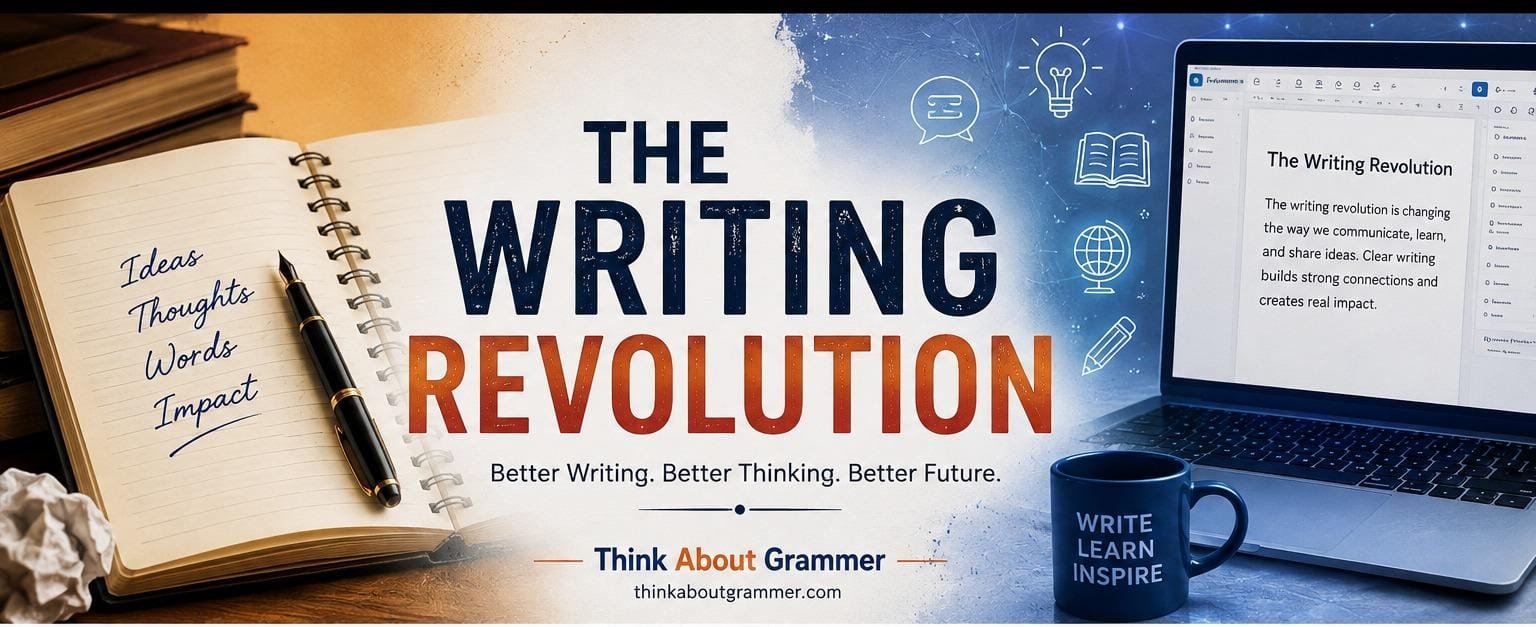
Writing has always been more than putting words on a page. It is a way to organize thoughts, explain complicated ideas, persuade an audience, record knowledge, and make ourselves understood. Today, however, writing is changing faster than ever.
- What Is the Writing Revolution?
- The Connection Between Writing and Thinking
- The Writing Revolution in Education
- Grammar Is Part of the Writing Revolution
- Why Clear Writing Beats Complicated Writing
- The Role of Technology in the Writing Revolution
- Human Judgment Still Matters
- Writing for Different Audiences
- The Importance of Structure
- Paragraphs Should Have a Purpose
- Common Writing Mistakes to Avoid
- 1. Writing Without a Clear Purpose
- 2. Using Too Many Words
- 3. Overusing Passive Voice
- 4. Repeating the Same Point
- 5. Ignoring the Reader
- A Practical Writing Process
- Step 1: Define the Purpose
- Step 2: Create a Simple Outline
- Step 3: Write the First Draft
- Step 4: Revise for Meaning
- Step 5: Proofread
- Revision vs. Proofreading
- How to Make Your Writing More Powerful
- How Students Can Benefit From the Writing Revolution
- How Professionals Can Benefit
- Writing in the Digital Age
- Is the Writing Revolution About Technology or Education?
- What the Future of Writing May Look Like
- Conclusion: Why The Writing Revolution Matters
From classrooms and workplaces to blogs, social media, digital publishing, and AI-assisted tools, people are being asked to communicate clearly in more formats than previous generations. This shift is often described as the writing revolution.
But what does the phrase really mean? Is it about technology, better writing education, or simply the growing importance of written communication?
The answer is broader than any one trend. The writing revolution represents a movement toward making writing more deliberate, accessible, practical, and effective. It encourages people to focus not only on grammar and spelling but also on thinking, structure, clarity, audience, and purpose.
Whether you are a student trying to improve an essay, a professional writing emails, or a content creator developing articles, understanding this shift can help you become a more confident writer.
What Is the Writing Revolution?
The writing revolution can be understood as a broad change in how people learn, practice, teach, and use writing.
Traditional writing instruction often focused heavily on rules, worksheets, sentence correction, and long assignments. Modern approaches increasingly emphasize the connection between writing and thinking.
Good writing requires a writer to make decisions:
- What am I trying to say?
- Who is going to read this?
- What information matters most?
- How should I organize my ideas?
- Which words communicate my meaning most clearly?
- Does each sentence contribute something useful?
These questions turn writing from a mechanical exercise into a thinking process.
Why Is Writing Becoming More Important?
Written communication is everywhere.
A person may write messages, applications, school assignments, reports, product descriptions, social media posts, instructions, presentations, and professional emails in the same week.
Because so much communication happens through text, the ability to express an idea clearly has practical value.
A strong writer does not necessarily use complicated vocabulary. Instead, a strong writer knows how to make an idea understandable.
The Connection Between Writing and Thinking
One of the most important ideas behind modern writing instruction is that writing can strengthen thinking.
When an idea exists only in your head, it may seem clear. Once you put it on paper, gaps in your reasoning become easier to notice.
For example:
Unclear idea:
Social media is bad because it has many negative effects.
This sentence introduces a position but does not explain it.
Clearer idea:
Excessive social media use can make it harder for students to concentrate when notifications repeatedly interrupt their study time.
The second example makes a specific claim and identifies a reason.
Writing forces the writer to answer questions that vague thinking can avoid.
Writing Helps Organize Ideas
Suppose you are asked whether students should have less homework.
Before writing, you might have several thoughts:
- Homework takes time.
- Practice can help students learn.
- Some assignments are unnecessary.
- Students need time for sleep and activities.
- Teachers need ways to reinforce lessons.
Writing these ideas down allows you to group related points, remove repetition, and build an argument.
That is why effective writing is closely connected to critical thinking.
The Writing Revolution in Education
Education is one of the areas where the writing revolution has significant potential.
Writing should not be treated as something students practice only in language classes. Students can use writing to demonstrate understanding in history, science, mathematics, social studies, and other subjects.
A student who explains a scientific process in their own words is doing more than practicing grammar. They are demonstrating whether they actually understand the concept.
From Long Essays to Short, Focused Writing
Writing instruction does not always need to begin with a five-page essay.
Short exercises can be extremely useful.
For example, a teacher might ask:
Explain the main cause of the event in three sentences.
Or:
State the argument and provide one piece of evidence.
These smaller tasks help students practice individual skills before combining them into longer assignments.
Sentence-Level Writing Matters
Large essays are built from sentences.
If students struggle to construct a clear sentence, asking them to write several pages will not necessarily solve the problem.
Consider this example:
Incorrect or unclear:
The character was angry because the situation was unfair which made him react badly.
Improved:
The character believed the situation was unfair, so he reacted angrily.
The second version makes the relationship between the ideas easier to understand.
Small improvements at the sentence level can eventually produce stronger paragraphs and essays.
Grammar Is Part of the Writing Revolution
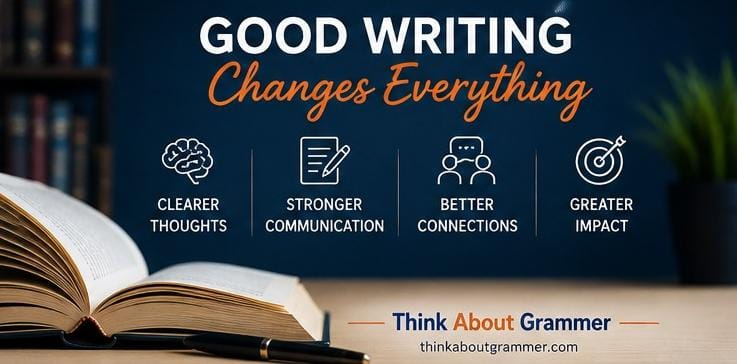
Grammar still matters, but grammar is most useful when it helps writers communicate meaning.
Instead of memorizing rules without context, writers benefit from seeing how grammar affects clarity.
Students preparing for standardized tests can also strengthen these skills by reviewing practical SAT Grammar Rules before tackling writing and language questions.
Example: Subject-Verb Agreement
Incorrect:
The group of students are preparing a presentation.
Correct:
The group of students is preparing a presentation.
The subject is “group,” which is singular.
Example: Sentence Fragments
Fragment:
Because the meeting ended early.
The reader expects more information.
Complete sentence:
Because the meeting ended early, the students had time to review their notes.
Example: Confusing Pronouns
Unclear:
When Sara spoke to Emma, she seemed nervous.
Who seemed nervous—Sara or Emma?
Clearer:
Sara seemed nervous when she spoke to Emma.
Good grammar is not simply about avoiding mistakes. It helps readers understand exactly what the writer means.
Why Clear Writing Beats Complicated Writing
Many people assume that sophisticated writing must contain sophisticated vocabulary.
That is not necessarily true.
Compare these sentences:
The implementation of an efficacious methodology facilitated the optimization of the learning process.
With:
The new method made learning more effective.
The second sentence is easier to understand while communicating the central idea directly.
Strong writing is not about trying to sound intelligent. It is about making the reader understand the idea with as little unnecessary effort as possible.
When Complex Words Are Useful
Complex terminology has a place when the audience understands it and the term communicates something precise.
For example, a medical article may need technical vocabulary that would be unnecessary in a general-interest article.
The goal is not to eliminate difficult words.
The goal is to choose the right words.
The Role of Technology in the Writing Revolution
Technology has transformed writing.
Word processors made editing easier. Digital publishing made distribution faster. Search engines changed how people research topics. Smartphones made writing possible almost anywhere.
More recently, AI-assisted writing tools have introduced another major change.
These technologies can help with tasks such as brainstorming, organization, proofreading, and generating alternatives. However, they do not remove the need for human judgment.
A writer still needs to decide:
- What is true?
- What is relevant?
- What should be included?
- What should be removed?
- Who is the audience?
- Does the final text actually communicate the intended message?
Technology can assist the writing process, but effective communication still depends on thoughtful decisions.
Human Judgment Still Matters
Imagine a tool produces this sentence:
The innovative initiative represents a transformative approach to enhancing communication outcomes.
It sounds polished, but what does it actually mean?
A human writer might replace it with:
The program gives students more opportunities to practice clear communication.
The second sentence is more specific.
This illustrates an important principle of the writing revolution: better writing is not necessarily more elaborate writing.
It is more purposeful writing.
Writing for Different Audiences
A major writing skill is learning to adapt your language to the reader.
The same idea can require different wording depending on the audience.
For example, a teacher might explain a topic to students differently than a researcher would explain it to specialists.
Formal Writing
A formal report might say:
The findings indicate that regular practice can improve students’ ability to organize written arguments.
Everyday Writing
A casual explanation might say:
Regular practice can help students organize their ideas better.
Neither sentence is automatically better.
The appropriate choice depends on the situation.
The Importance of Structure
Even strong ideas can become difficult to follow when they are poorly organized.
A useful structure for many informational articles is:
- Introduce the topic.
- Explain the central idea.
- Present supporting information.
- Give examples.
- Address possible problems or limitations.
- Offer practical advice.
- Summarize the key takeaway.
Structure gives readers a path through the information.
The Power of Headings
Headings allow readers to scan an article before deciding which sections deserve closer attention.
For online writing, this is especially useful because many readers do not consume an article from beginning to end.
Descriptive headings can make long content easier to navigate.
Paragraphs Should Have a Purpose
A paragraph should generally develop one main idea.
For example, a paragraph about proofreading should not suddenly move into a discussion about social media trends halfway through.
A focused paragraph might follow this pattern:
Main idea → explanation → example → connection to the topic
This simple structure helps readers understand why each paragraph exists.
Common Writing Mistakes to Avoid
Even experienced writers make mistakes. Some problems, however, appear repeatedly.
1. Writing Without a Clear Purpose
Before beginning, identify what you want the reader to understand.
If you cannot explain the purpose in one or two sentences, the draft may need a clearer direction.
2. Using Too Many Words
Longer does not automatically mean better.
Wordy:
Due to the fact that the student was unable to complete the assignment within the required period of time, the teacher decided to provide an extension.
Concise:
Because the student could not finish the assignment on time, the teacher granted an extension.
3. Overusing Passive Voice
Passive voice is sometimes appropriate, but excessive use can make writing feel distant.
Passive:
The report was completed by the research team.
Active:
The research team completed the report.
The active version is usually more direct.
4. Repeating the Same Point
Repeating an idea does not necessarily strengthen it.
After making an important point, develop it with evidence, explanation, or an example rather than simply restating it.
5. Ignoring the Reader
Writers sometimes focus so much on what they want to say that they forget what the reader needs to know.
Good writing answers the reader’s likely questions.
A Practical Writing Process
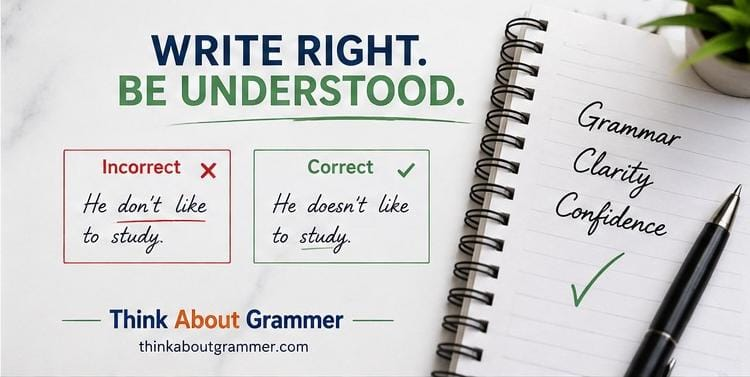
You do not need a complicated system to improve your writing.
Try this five-step process.
Step 1: Define the Purpose
Ask:
What should the reader know, understand, or do after reading this?
Step 2: Create a Simple Outline
Write down the main points before drafting.
For a short article, even three to five bullet points can provide useful direction.
Step 3: Write the First Draft
Do not try to make every sentence perfect immediately.
Focus on getting the ideas onto the page.
Step 4: Revise for Meaning
Read the draft and ask:
- Is the main idea obvious?
- Are the examples relevant?
- Does every section contribute?
- Are any ideas missing?
- Is anything unnecessary?
Step 5: Proofread
Only after improving the ideas and structure should you focus closely on grammar, spelling, punctuation, and word choice.
This separates revision from proofreading, two processes that writers often confuse.
Revision vs. Proofreading
Revision means improving the writing itself.
Proofreading means checking the finished text for surface-level errors.
| Revision | Proofreading |
|---|---|
| Improves organization | Checks spelling |
| Removes unnecessary ideas | Checks punctuation |
| Adds missing explanations | Checks grammar |
| Strengthens arguments | Finds typographical errors |
| Improves clarity | Checks formatting |
A sentence can be grammatically perfect and still be poorly written if its idea is unclear.
How to Make Your Writing More Powerful
Small habits can produce noticeable improvements.
Use Specific Examples
Instead of:
Exercise is good for students.
Try:
A short walk between study sessions can give students a simple opportunity to move and take a mental break.
The second statement gives the reader something concrete to imagine.
Prefer Strong Verbs
Instead of:
She made a decision to leave the project.
Write:
She decided to leave the project.
Instead of:
The team conducted an investigation into the problem.
Write:
The team investigated the problem.
Strong verbs often make sentences shorter and clearer.
Read Your Writing Aloud
Reading aloud can reveal problems that are easy to miss when reading silently.
You may notice:
- awkward wording,
- repeated phrases,
- excessively long sentences,
- missing words,
- unnatural transitions.
If a sentence is difficult to say, it may also be difficult to read.
How Students Can Benefit From the Writing Revolution
Students can apply these principles to almost any subject.
Instead of waiting until an essay is assigned, they can practice explaining concepts in short paragraphs.
For example:
Question: Why does recycling matter?
A weak response might simply say:
Recycling is important because it helps the environment.
A stronger response could explain a specific mechanism:
Recycling can reduce the amount of material sent to landfills and allow some resources to be processed and used again.
The second response demonstrates explanation rather than simply stating an opinion.
How Professionals Can Benefit
Writing skills are equally useful outside education.
A professional who can write a clear email can communicate a request without unnecessary back-and-forth. A manager who writes precise instructions can reduce confusion. A business that explains its services clearly can make information easier for customers to understand.
In many situations, good writing saves time.
Consider the difference:
Please send me the information as soon as possible.
And:
Please send the updated sales figures by Friday afternoon.
The second message gives the reader a clear action and deadline.
Writing in the Digital Age
Online writing has its own challenges.
Readers often encounter text on small screens, while notifications and other distractions compete for their attention.
That makes clarity, formatting, and organization especially important.
Useful practices include:
- Keep paragraphs reasonably short.
- Use descriptive headings.
- Put important information near the beginning.
- Use bullet points when listing several items.
- Avoid unnecessary introductions.
- Use examples to clarify abstract ideas.
- Make the next step obvious when appropriate.
Digital writing does not mean lowering standards. It means presenting information in a format that works for the way people read today.
For practical guidance on applying these principles to workplace communication, see our guide to Professional Email Grammar Rules.
Is the Writing Revolution About Technology or Education?
It is both—and more.
Technology has changed how writing is created and distributed, while education is changing how writing is taught and practiced.
But the deeper transformation is cultural.
Writing is increasingly viewed as a practical skill connected to thinking, learning, work, and everyday communication.
The most valuable writers will not necessarily be those who write the longest texts. They will be people who can understand a purpose, organize information, adapt to an audience, and communicate an idea clearly.
What the Future of Writing May Look Like
Writing will continue to evolve.
New tools will make drafting, editing, translating, formatting, and publishing easier. At the same time, readers will continue to value information that is accurate, understandable, relevant, and genuinely useful.
This creates an interesting challenge.
As technology makes it easier to produce text, the quality of human judgment becomes even more important.
A future where everyone can generate paragraphs instantly does not make writing irrelevant. It makes the ability to recognize a good paragraph more valuable.
Writers will need to ask better questions, verify information, make thoughtful choices, and add genuine value rather than simply producing more words.
Frequently Asked Questions About The Writing Revolution
What is the writing revolution?
The writing revolution describes the broader shift toward clearer, more purposeful, practical, and accessible writing in education, technology, work, and everyday communication.
Why is writing important today?
Writing is important because people use it constantly to communicate ideas, learn, work, solve problems, share information, and connect with others.
Does the writing revolution focus only on grammar?
No. Grammar matters, but the broader focus includes thinking, organization, clarity, audience, purpose, revision, and effective communication.
How can students improve their writing?
Students can improve by practicing regularly, writing short explanations, organizing ideas before drafting, revising their work, and learning from specific examples.
Does technology make writing skills less important?
No. Technology can make writing easier to produce and edit, but people still need judgment to determine whether information is accurate, relevant, clear, and appropriate.
What is the difference between revision and proofreading?
Revision improves ideas, organization, and clarity, while proofreading focuses mainly on grammar, spelling, punctuation, and other surface errors.
How can I make my writing clearer?
Use specific language, strong verbs, focused paragraphs, logical organization, and examples that help readers understand your main point.
Is complicated vocabulary necessary for good writing?
No. Good writing prioritizes precise and appropriate language rather than unnecessarily complicated vocabulary.
Conclusion: Why The Writing Revolution Matters
The writing revolution is not simply about new software, digital publishing, or changes in the classroom. At its heart, it is about recognizing writing as a powerful tool for thinking and communication.
Good writing helps people turn complicated thoughts into understandable ideas. It helps students demonstrate what they know, professionals communicate efficiently, and readers find useful information without unnecessary effort.
The practical takeaway is simple: write with a purpose, organize your ideas, choose clear language, revise thoughtfully, and always consider your reader.
As writing continues to evolve, those fundamentals will remain valuable—even as the tools used to write keep changing.