

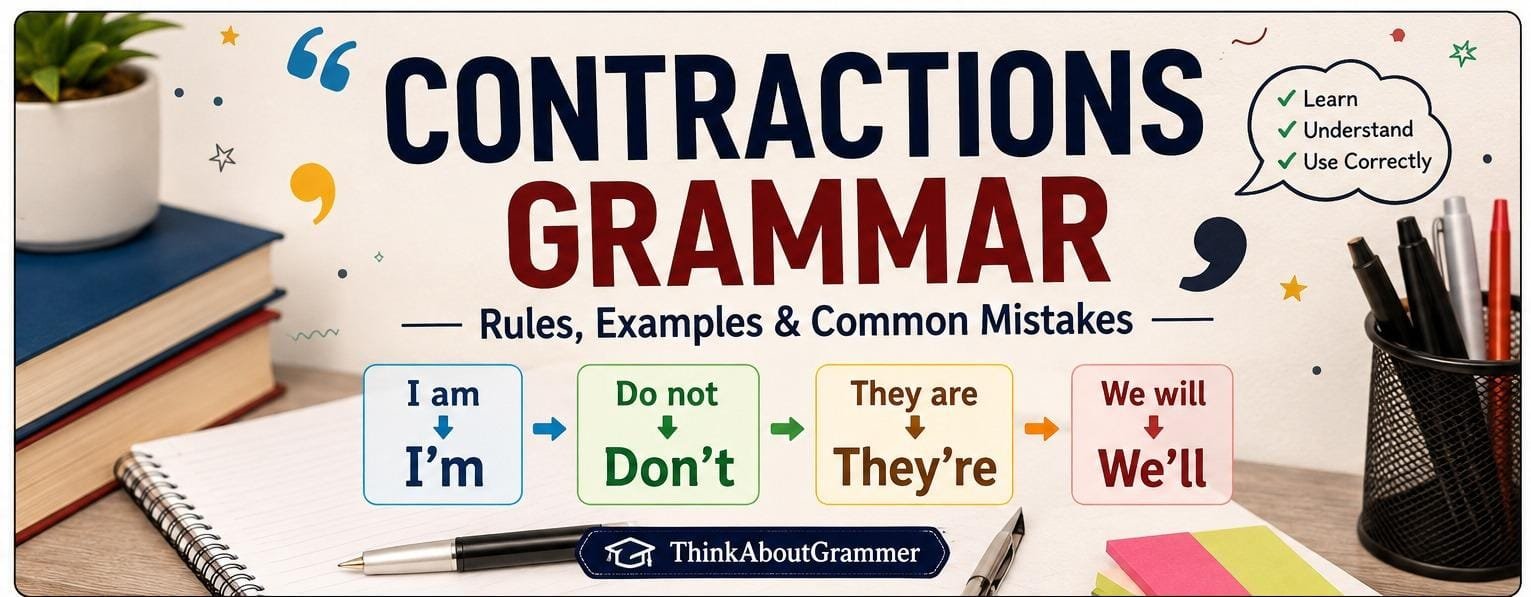
If you have ever wondered whether you should write “I am” or “I’m,” “do not” or “don’t,” or “they are” or “they’re,” you are dealing with contractions grammar.
- What Are Contractions in Grammar?
- Why Do We Use Contractions?
- Common English Contractions
- How Are Contractions Formed?
- Contractions With Pronouns
- Contractions With Auxiliary Verbs
- Negative Contractions
- The Special Case of “Won’t”
- The Special Case of “Can’t”
- When Should You Use Contractions?
- When Should You Avoid Contractions?
- Formal vs. Informal Contractions
- Common Contractions Grammar Mistakes
- Apostrophes in Contractions
- Contractions in Questions
- Contractions in Negative Questions
- Contractions in Academic Writing
- Contractions in Professional Writing
- Contractions in Dialogue
- Double Contractions
- Contractions With Names and Nouns
- Contractions and Meaning
- Common Mistakes to Avoid
- Mistake 1: Using an Apostrophe for a Plural
- Mistake 2: Confusing Possessives With Contractions
- Mistake 3: Writing “Could Of”
- Mistake 4: Confusing “You’re” and “Your”
- Mistake 5: Overusing Contractions
- How to Choose Between a Contraction and the Full Form
- A Quick Guide to Contractions
- Contractions Grammar Practice
- Conclusion: Mastering Contractions Grammar
Contractions are shortened forms of words or groups of words. They are extremely common in everyday English and help writing sound natural, conversational, and fluent. However, they are not appropriate in every situation. Knowing when to use contractions, when to avoid them, and how to punctuate them correctly can make your writing much clearer.
In this guide, you will learn what contractions are, how they are formed, the different types of contractions, common mistakes, formal and informal usage, and practical examples you can use in your own writing.
What Are Contractions in Grammar?
A contraction is a shortened version of one or more words. An apostrophe (') usually shows where letters have been removed.
For example:
- I am → I’m
- you are → you’re
- cannot → can’t
- we will → we’ll
- they have → they’ve
- she would → she’d
The apostrophe is important because it indicates that part of the original word or words has been omitted.
Contractions Grammar Definition
In simple terms, contractions grammar refers to the rules for forming and using shortened words in English.
Consider this example:
She is ready.
This can become:
She’s ready.
The meaning remains the same, but the contracted version sounds more conversational.
Why Do We Use Contractions?
Contractions are an important part of natural English because they make speech and writing more efficient.
They can:
- Make sentences shorter.
- Create a conversational tone.
- Reflect natural spoken English.
- Make dialogue sound realistic.
- Help writing feel less stiff.
- Improve the flow of informal communication.
Compare these sentences:
Without a contraction:
I am going to call you when I have finished.
With contractions:
I’m going to call you when I’ve finished.
Both are grammatically correct. The second version generally sounds more natural in everyday conversation.
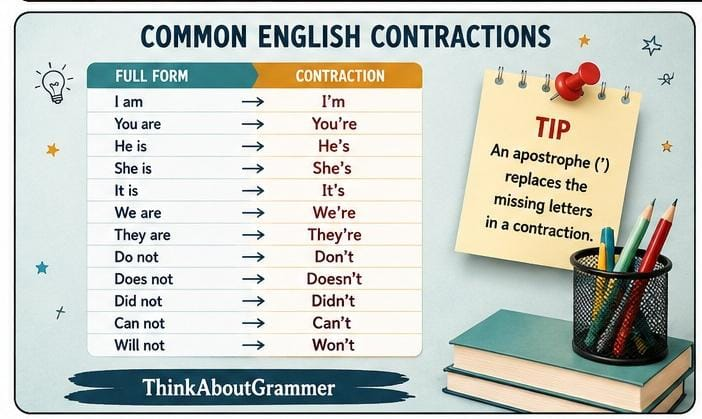
Common English Contractions
There are many contractions in English, but some appear much more frequently than others.
| Full Form | Contraction | Example |
|---|---|---|
| I am | I’m | I’m ready. |
| You are | You’re | You’re right. |
| He is | He’s | He’s busy. |
| She is | She’s | She’s here. |
| It is | It’s | It’s cold. |
| We are | We’re | We’re late. |
| They are | They’re | They’re outside. |
| I have | I’ve | I’ve finished. |
| You have | You’ve | You’ve done well. |
| We have | We’ve | We’ve seen it. |
| They have | They’ve | They’ve arrived. |
| I will | I’ll | I’ll help you. |
| You will | You’ll | You’ll understand. |
| He will | He’ll | He’ll call later. |
| We will | We’ll | We’ll wait. |
| They will | They’ll | They’ll come soon. |
| I would | I’d | I’d like some tea. |
| You would | You’d | You’d enjoy it. |
| We would | We’d | We’d agree. |
| They would | They’d | They’d help. |
| Do not | Don’t | Don’t worry. |
| Does not | Doesn’t | She doesn’t know. |
| Did not | Didn’t | He didn’t call. |
| Cannot | Can’t | I can’t swim. |
| Could not | Couldn’t | We couldn’t stay. |
| Should not | Shouldn’t | You shouldn’t worry. |
| Would not | Wouldn’t | I wouldn’t do that. |
| Will not | Won’t | They won’t agree. |
| Is not | Isn’t | It isn’t ready. |
| Are not | Aren’t | They aren’t here. |
| Was not | Wasn’t | She wasn’t there. |
| Were not | Weren’t | We weren’t late. |
How Are Contractions Formed?
Most contractions combine words and replace missing letters with an apostrophe.
For example:
She is → she’s
The apostrophe represents the omitted part of the original expression.
Another example is:
They are → they’re
The apostrophe indicates that letters have been removed.
The important point is that the apostrophe does not mean the words are plural or possessive. It signals a contraction.
Contractions With Pronouns
Pronoun contractions are among the most common forms in English.
I’m, You’re, He’s, She’s, and It’s
These contractions combine pronouns with forms of be.
- I am → I’m
- you are → you’re
- he is → he’s
- she is → she’s
- it is → it’s
Examples:
I’m tired.
You’re very helpful.
He’s at school.
She’s preparing dinner.
It’s getting late.
We’re and They’re
These combine pronouns with are:
- we are → we’re
- they are → they’re
Examples:
We’re ready to leave.
They’re waiting outside.
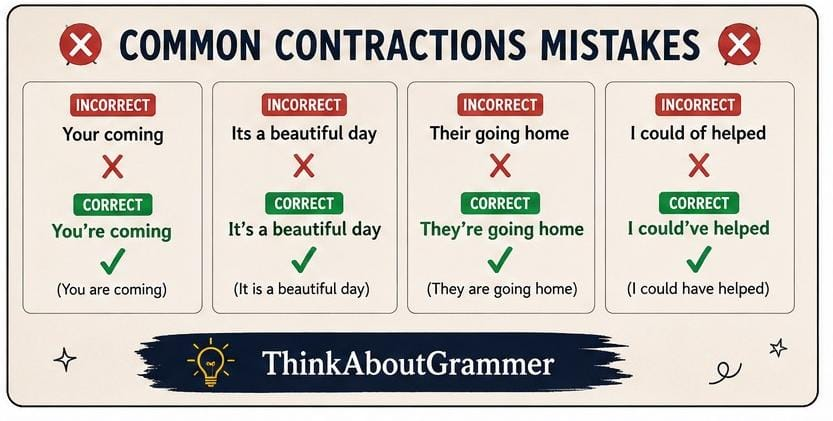
A common mistake is confusing they’re with their and there.
Incorrect:
Their going to the store.
Correct:
They’re going to the store.
Here, they’re means they are.
Contractions With Auxiliary Verbs
Contractions are also frequently created with auxiliary verbs such as have, will, and would.
Have Contractions
Examples include:
- I have → I’ve
- you have → you’ve
- we have → we’ve
- they have → they’ve
For example:
I’ve completed my homework.
Instead of:
I have completed my homework.
Both are grammatically correct.
Will Contractions
The word will can contract with pronouns:
- I will → I’ll
- you will → you’ll
- he will → he’ll
- she will → she’ll
- we will → we’ll
- they will → they’ll
Examples:
I’ll call you tomorrow.
We’ll finish the project soon.
They’ll arrive at noon.
Would Contractions
Would can also be shortened:
- I would → I’d
- you would → you’d
- he would → he’d
- she would → she’d
- we would → we’d
- they would → they’d
For example:
I’d like to ask a question.
However, I’d can sometimes mean I had, so context matters.
Compare:
I’d like some water.
(I would like)
I’d already eaten.
(I had already eaten)
Negative Contractions
Negative contractions are formed by combining a verb with not.
Some of the most common examples are:
- do not → don’t
- does not → doesn’t
- did not → didn’t
- is not → isn’t
- are not → aren’t
- was not → wasn’t
- were not → weren’t
- cannot → can’t
- could not → couldn’t
- should not → shouldn’t
- would not → wouldn’t
Examples:
I don’t understand.
She doesn’t like coffee.
They didn’t arrive on time.
You shouldn’t worry.
We couldn’t find the address.
The Special Case of “Won’t”
One contraction deserves special attention: won’t.
Unlike many contractions, its spelling does not look like a simple shortening of will not.
will not → won’t
Examples:
I won’t be late.
She won’t agree.
They won’t change their minds.
Because won’t is irregular, learners sometimes incorrectly write willn’t. That form is not standard English.
The Special Case of “Can’t”
Cannot is normally contracted as can’t.
Examples:
I can’t come today.
She can’t drive.
We can’t find the key.
The standard written form is cannot as one word when it is used in this sense.
When Should You Use Contractions?
Whether contractions are appropriate depends largely on the context.
They are especially common in:
- Everyday conversations
- Text messages
- Emails to friends
- Personal blogs
- Informal articles
- Social media posts
- Dialogue in stories
- Casual workplace communication
For example:
I’m sorry, but I can’t attend the meeting.
This sounds natural in a casual email.
When Should You Avoid Contractions?
Contractions are not necessarily grammatically wrong in formal writing, but some contexts traditionally favor full forms.
You may choose to avoid contractions in:
- Highly formal academic writing
- Legal documents
- Formal reports
- Official statements
- Certain professional documents
- Situations where a deliberately formal tone is required
For example:
More conversational:
We’re unable to approve your request.
More formal:
We are unable to approve your request.
The choice depends on the expected style and audience.
Formal vs. Informal Contractions
It is useful to think of contractions as a tone choice, rather than simply a right-or-wrong grammar rule.
| Context | Typical Choice |
| Text message | Contractions are common |
| Casual email | Contractions are common |
| Conversation | Contractions are extremely common |
| Blog post | Usually acceptable |
| Personal essay | Often acceptable |
| Academic paper | Depends on style and institution |
| Formal report | Full forms may be preferable |
| Legal document | Full forms are often preferred |
The key is consistency. If you choose a formal style, avoid switching randomly between highly formal and highly conversational language.
Common Contractions Grammar Mistakes
Understanding contractions also means knowing which similar-looking words are not contractions.
It’s vs. Its
It’s means it is or it has.
It’s raining.
Its is a possessive form.
The dog wagged its tail.
A simple test is to replace it’s with it is or it has.
If the sentence still makes sense, it’s may be correct.
You’re vs. Your
You’re means you are.
You’re very kind.
Your shows possession.
Is this your book?
Incorrect:
Your going to enjoy the movie.
Correct:
You’re going to enjoy the movie.
They’re vs. Their vs. There
These three words are frequently confused.
They’re = they are
They’re coming soon.
Their = belonging to them
Their house is large.
There = refers to a place or introduces something
The keys are over there.
Who’s vs. Whose
Who’s means who is or who has.
Who’s coming with us?
Whose indicates possession.
Whose jacket is this?
Do not assume that every word containing an apostrophe is possessive. In who’s, the apostrophe marks a contraction.
Apostrophes in Contractions
The apostrophe is an essential part of standard contractions. Apostrophes are only one part of punctuation, so reviewing full stop punctuation can help you build a stronger foundation in English writing mechanics.
It replaces letters that have been removed.
Examples:
- I am → I’m
- they are → they’re
- do not → don’t
- we have → we’ve
A common mistake is placing the apostrophe in the wrong location.
Incorrect:
Do’nt worry.
Correct:
Don’t worry.
The apostrophe belongs where the omitted letters would have been represented in the contraction.
Contractions in Questions
Contractions are perfectly natural in many questions.
Examples:
What’s your name?
Where’re they going?
Haven’t you finished?
Isn’t this your book?
Can’t we try again?
Some contractions, such as where’re, are less common in everyday writing because they can sound awkward. Writers often use the full form instead:
Where are they going?
Natural usage matters just as much as grammatical possibility.
Contractions in Negative Questions
Negative questions often use contractions.
For example:
Isn’t it beautiful?
Didn’t you see the message?
Haven’t they arrived yet?
Shouldn’t we leave now?
These forms are especially common in conversation.
Without contractions, the sentences sound more formal:
Is it not beautiful?
Did you not see the message?
The second versions can be grammatical but may sound unusually formal in ordinary conversation.
Contractions in Academic Writing
One common misconception is that contractions are always grammatically incorrect in academic writing.
Students preparing for standardized tests can also review essential SAT grammar rules to strengthen their understanding of formal grammar and punctuation.
That is too broad.
The acceptability of contractions depends on the required style guide, instructor, publication, and type of academic work.
For a formal academic assignment, using full forms can be a safe stylistic choice:
The results do not support the hypothesis.
Instead of:
The results don’t support the hypothesis.
However, a quoted statement or informal example may naturally contain contractions.
The most important rule is to follow the specific style requirements for your assignment or publication.
Contractions in Professional Writing
Professional writing requires judgment rather than a blanket ban on contractions.
If you’re writing a professional message, understanding professional email grammar rules can help you choose the right level of formality and use contractions appropriately.
Compare:
We’re pleased to announce the update.
with:
We are pleased to announce the update.
Both can be appropriate. The first feels warmer and more conversational, while the second sounds more formal.
For customer-facing communication, contractions can sometimes make writing feel more approachable:
We’re happy to help.
For highly formal notices, the full form may be more suitable:
We are writing to inform you of the change.
Contractions in Dialogue
Contractions are particularly useful when writing dialogue because real conversations commonly use shortened forms.
For example:
“I’m not sure what happened.”
sounds more natural than:
“I am not sure what happened.”
Using contractions can therefore help distinguish spoken dialogue from formal written narration.
Double Contractions
English also contains some informal double contractions, where two words are shortened together.
Examples include:
- I’d’ve = I would have
- could’ve = could have
- should’ve = should have
- would’ve = would have
Forms such as I’d’ve are highly informal and are generally avoided in formal writing.
“Could’ve” Does Not Mean “Could Of”
A very common mistake occurs when people hear could’ve pronounced quickly.
They may write:
I could of helped.
That is incorrect.
The correct form is:
I could’ve helped.
Or, in formal writing:
I could have helped.
The same applies to:
- should’ve → should have
- would’ve → would have
- might’ve → might have
Contractions With Names and Nouns
Contractions are not limited to pronouns.
Examples include:
- John is → John’s
- Maria will → Maria’ll (possible but uncommon)
- The dog is → the dog’s
However, context can create ambiguity.
For example:
John’s at home.
means John is at home.
But:
John’s car is outside.
means the car belonging to John.
The apostrophe-s construction can therefore represent either a contraction or possession.
Contractions and Meaning
Some contractions can have more than one possible full form.
For example:
He’s can mean:
- He is
- He has
Compare:
He’s happy.
(He is happy.)
He’s finished his work.
(He has finished his work.)
Similarly, she’d can mean she would or she had.
Context tells the reader which meaning is intended.
Common Mistakes to Avoid
Here are several errors worth watching for.
Mistake 1: Using an Apostrophe for a Plural
Incorrect:
I bought three apple’s.
Correct:
I bought three apples.
An apostrophe is not normally used simply to make a word plural.
Mistake 2: Confusing Possessives With Contractions
Incorrect:
Its raining outside.
Correct:
It’s raining outside.
Here, it’s means it is.
Mistake 3: Writing “Could Of”
Incorrect:
She could of helped.
Correct:
She could have helped.
or
She could’ve helped.
Mistake 4: Confusing “You’re” and “Your”
Incorrect:
Your doing a great job.
Correct:
You’re doing a great job.
Mistake 5: Overusing Contractions
Even when contractions are grammatically correct, using them in every sentence can create a style that feels too casual for certain contexts.
Consider your audience and purpose before choosing between contracted and full forms.
How to Choose Between a Contraction and the Full Form
When you are unsure, ask three questions:
- Who am I writing for?
- What is the purpose of the text?
- What tone do I want?
For a casual message:
I’m sorry I can’t come.
For a formal letter:
I am sorry that I cannot attend.
Neither sentence is inherently better. The appropriate choice depends on context.
A Quick Guide to Contractions
Use this simple checklist when proofreading:
- Check that every apostrophe is correctly placed.
- Make sure the contraction represents the intended words.
- Check confusing pairs such as its/it’s and your/you’re.
- Avoid informal contractions when your required style calls for formal language.
- Do not use apostrophes simply to make ordinary plurals.
- Read the sentence aloud to check whether the contraction sounds natural.
- When in doubt, write the full form and check whether the meaning is clear.
Contractions Grammar Practice
Try changing these full forms into contractions:
- I am ready.
- They are waiting.
- She will call later.
- We have finished.
- He did not understand.
- You should not worry.
- I would like some water.
- It is not working.
Answers
- I’m ready.
- They’re waiting.
- She’ll call later.
- We’ve finished.
- He didn’t understand.
- You shouldn’t worry.
- I’d like some water.
- It isn’t working.
Practicing this way helps you recognize contractions quickly when reading and use them naturally when writing.
Frequently Asked Questions About Contractions Grammar
What is a contraction in grammar?
A contraction is a shortened form of one or more words. An apostrophe normally marks the missing letters. For example, “they are” becomes “they’re.”
Are contractions grammatically correct?
Yes. Contractions are standard grammatical forms in English. Their suitability depends mainly on context, tone, and the requirements of a particular type of writing.
Should I use contractions in formal writing?
It depends on the style and purpose. In highly formal writing, full forms are often preferred, while many modern forms of professional and academic communication may allow contractions. Always follow the relevant style requirements.
What are the most common English contractions?
Common examples include I’m, you’re, he’s, she’s, it’s, we’re, they’re, don’t, doesn’t, didn’t, can’t, won’t, shouldn’t, I’ve, we’ve, and they’ll.
What is the difference between “it’s” and “its”?
It’s is a contraction meaning it is or it has. Its is a possessive form.
It’s cold today.
The cat cleaned its paws.
Why is “won’t” the contraction of “will not”?
Won’t is an irregular historical contraction of will not. It does not follow the simple pattern that learners might expect from other negative contractions.
Can contractions be used in essays?
They can be, depending on the type of essay and the required style. If the assignment calls for formal academic language, using full forms may be more appropriate.
Is “could of” a contraction?
No. Could of is an incorrect representation of the spoken form could’ve. The correct alternatives are could have and could’ve.
Conclusion: Mastering Contractions Grammar
Understanding contractions grammar is not simply about memorizing words such as I’m, don’t, can’t, and they’re. It is about understanding how contractions are formed, where the apostrophe belongs, and when a shortened form suits the context.
Use contractions naturally in conversation, informal communication, dialogue, and many reader-friendly forms of writing. In more formal contexts, consider whether full forms create the tone your audience expects.
Most importantly, watch out for commonly confused forms such as it’s/its, you’re/your, and they’re/their/there. Once you understand the patterns, contractions become much easier to recognize and use accurately.
The practical takeaway is simple: know the full form, understand the contraction, check the apostrophe, and choose the form that fits your audience and purpose.