


Writing clearly is not simply about putting words on a page. Good writing requires structure, precise language, strong sentence construction, and an understanding of how readers process information. If you have come across the term “blackbeard writing” and are trying to understand what it means, you may be looking for guidance on a particular writing style, technique, or educational resource.
- What Does Blackbeard Writing Mean?
- Why Clear Writing Matters
- Start With a Clear Purpose
- Know Your Audience
- Build a Strong Structure
- Write Strong Introductions
- Use Precise Word Choice
- Understand Sentence Structure
- Avoid Sentence Fragments
- Watch for Run-On Sentences
- Use Active Voice When Appropriate
- Maintain Subject-Verb Agreement
- Use Punctuation Carefully
- Make Paragraphs Work Together
- Use Transitions Naturally
- Common Writing Mistakes to Avoid
- Drafting and Editing Are Different Skills
- A Practical Editing Checklist
- How to Improve Your Writing Step by Step
- Step 1: Read More
- Step 2: Write Regularly
- Step 3: Study Your Mistakes
- Step 4: Rewrite
- Step 5: Read Your Work Aloud
- Blackbeard Writing and SEO Content
- How to Create Better Examples
- Conclusion
The phrase can be confusing because it does not refer to one universally recognized grammar rule or standard writing method. In many searches, people may also use the term when looking for writing help, grammar explanations, or information connected with a specific resource or name.
So, what should you focus on when researching or practicing blackbeard writing?
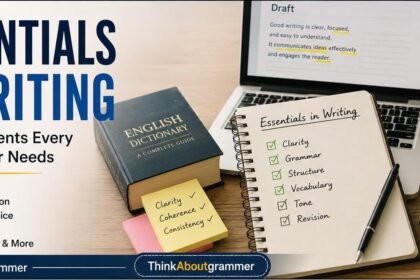
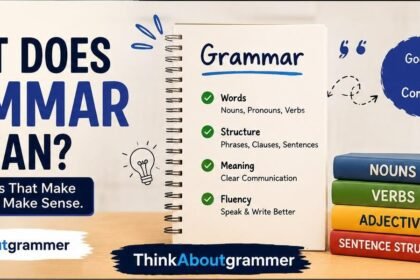
The answer is simple: focus on the fundamentals that make writing effective—clarity, organization, grammar, sentence variety, word choice, and revision. These skills are useful whether you are writing an essay, school assignment, article, email, story, or professional document.
This guide explains the key principles behind strong writing and shows you how to apply them with practical examples.
What Does Blackbeard Writing Mean?
The first thing to understand is that blackbeard writing is not a commonly established grammatical term like passive voice, subject-verb agreement, or sentence fragments.
If you encountered the phrase in a particular course, website, book, assignment, or writing resource, its meaning may depend on that specific context.
However, someone searching for the phrase may ultimately be trying to improve their writing skills. That makes it useful to approach the topic through the core principles of effective English writing.
Good writing should answer three basic questions:
- What am I trying to say?
- Who am I saying it to?
- What is the clearest way to communicate it?
These same principles are essential when following professional email grammar rules, where clarity and accuracy matter.
These questions provide a foundation for almost every type of writing.
Why Clear Writing Matters
Clear writing saves the reader effort.
Consider these two sentences:
Unclear:
Due to the fact that the weather conditions were unfavorable, the event was unable to take place as originally planned.
Clear:
Bad weather prevented the event from taking place.
The second sentence communicates the same basic idea with fewer words.
That does not mean every sentence should be extremely short. Strong writing uses a mixture of short, medium, and longer sentences. The goal is clarity, not minimalism.
The Three Qualities of Effective Writing
Strong writing usually has three important qualities:
- Clarity: The reader understands the message.
- Accuracy: Grammar, spelling, punctuation, and facts are correct.
- Engagement: The writing holds the reader’s attention.
When these qualities work together, even complicated subjects become easier to understand.
Start With a Clear Purpose
Before writing your first sentence, identify your purpose.
Are you trying to:
- Explain something?
- Persuade the reader?
- Tell a story?
- Compare two ideas?
- Describe an experience?
- Provide instructions?
- Entertain an audience?
Your purpose affects everything from vocabulary to sentence structure.
For example, an academic explanation may require formal language:
Photosynthesis is the process through which plants convert light energy into chemical energy.
A blog article can use a more conversational approach:
Plants have an impressive way of turning sunlight into the energy they need to grow.
Both sentences communicate information, but their styles suit different audiences.
Know Your Audience
Good writers do not write for everyone in exactly the same way.
Think about who will read your work.
A beginner may need definitions and examples, while an expert may prefer technical terminology and deeper analysis.
For example, instead of writing:
The device utilizes an advanced photovoltaic energy-conversion mechanism.
For a general audience, you might write:
The device uses solar panels to turn sunlight into electricity.
The second version is easier to understand without sacrificing the main idea.
Ask These Questions Before Writing
Before beginning, consider:
- Who is reading this?
- What do they already know?
- What do they need to learn?
- What tone is appropriate?
- What action should they take after reading?
These questions can prevent your writing from becoming either too complicated or too simplistic.
Build a Strong Structure
Even excellent sentences can become difficult to follow if they are poorly organized.
A useful structure for many articles and essays is:
Introduction → Main Points → Supporting Evidence → Conclusion
For example, an article about improving study habits might follow this structure:
- Explain why effective study habits matter.
- Discuss planning.
- Explain active recall.
- Discuss distractions.
- Explain the importance of reviewing material.
- Summarize the practical steps.
This gives readers a logical path through the information.
Write Strong Introductions
The introduction should tell readers what the subject is and why it matters.
A weak opening might say:
Writing is important in many areas of life. There are many different types of writing.
It is not incorrect, but it does not create much interest.
A stronger opening could be:
A technically correct sentence can still be difficult to read. The difference often comes down to structure, word choice, and whether the writer understands what the reader actually needs.
The second opening creates a problem and immediately gives the reader a reason to continue.
A Simple Introduction Formula
For many informational articles, try this pattern:
Problem → Context → Promise
For example:
Many writers know the grammar rules but still struggle to make their sentences sound natural. The problem is often not grammar alone but organization and word choice. By focusing on a few practical principles, you can make your writing clearer and more effective.
Use Precise Word Choice
Choosing the right word can dramatically improve a sentence.
Compare:
The manager looked at the report.
with:
The manager reviewed the report.
“Reviewed” gives the reader a more specific idea of what happened.
Another example:
The storm was bad.
versus:
The storm caused widespread flooding.
The second sentence provides useful information instead of relying on a vague adjective.
Avoid Unnecessary Words
Look for phrases that can be simplified.
| Wordy Expression | More Direct Alternative |
|---|---|
| At this point in time | Now |
| Due to the fact that | Because |
| In order to | To |
| A large number of | Many |
| In the event that | If |
| Has the ability to | Can |
| At the present time | Currently |
Concise writing is not about deleting words randomly. It is about removing words that do not contribute meaning.
Understand Sentence Structure
A sentence normally needs a subject and a predicate.
For example:
Maria studies grammar.
Maria is the subject.
Studies grammar is the predicate.
Understanding sentence structure helps writers avoid fragments and confusing constructions.
Simple Sentences
A simple sentence contains one independent clause.
The students practiced.
Compound Sentences
A compound sentence joins independent clauses, usually with a coordinating conjunction.
The students practiced, and their writing improved.
Complex Sentences
A complex sentence contains an independent clause and at least one dependent clause.
Because the students practiced regularly, their writing improved.
Using different sentence structures can make writing smoother and more interesting.
Avoid Sentence Fragments
A sentence fragment does not express a complete thought.
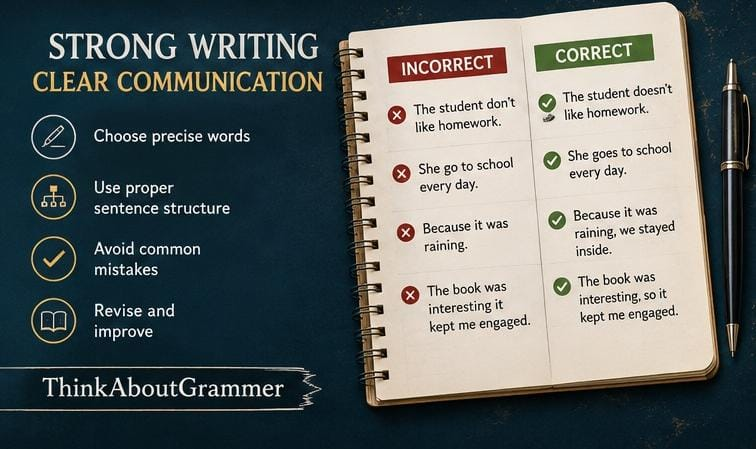
Incorrect:
Because the lesson was difficult.
The reader expects more information.
Correct:
Because the lesson was difficult, the teacher provided additional examples.
However, fragments can sometimes be used deliberately in creative writing for emphasis. In formal writing, complete sentences are generally safer.
Watch for Run-On Sentences
A run-on sentence occurs when independent clauses are improperly joined.
Incorrect:
The article was useful it explained the topic clearly.
There are several ways to correct it.
Correct:
The article was useful. It explained the topic clearly.
Or:
The article was useful because it explained the topic clearly.
Or:
The article was useful, and it explained the topic clearly.
The best solution depends on the intended relationship between the ideas.
Use Active Voice When Appropriate
Active voice often makes writing more direct.
Passive:
The report was completed by the researcher.
Active:
The researcher completed the report.
Active voice places the person or thing performing the action in the subject position.
That said, passive voice is not automatically bad. It can be useful when the action is more important than the person performing it.
For example:
The experiment was conducted under controlled conditions.
Here, the focus is on the experiment rather than the researcher.
Maintain Subject-Verb Agreement
The subject and verb should agree in number.
Incorrect:
The student write every day.
Correct:
The student writes every day.
Another example:
Incorrect:
The results shows a significant difference.
Correct:
The results show a significant difference.
This becomes more difficult when additional words separate the subject from the verb.
The collection of essays is impressive.
The subject is collection, not essays, so the singular verb is is correct.
Use Punctuation Carefully
Punctuation helps readers understand how ideas relate to one another.
Commas
Commas can separate introductory phrases, items in a series, and certain clauses.
After finishing the assignment, Daniel checked his answers.
They can also separate items in a list:
The course covers grammar, punctuation, vocabulary, and sentence structure.
Apostrophes
Apostrophes are commonly used for contractions and possession.
Contraction:
It’s important to revise.
Possession:
The writer’s notebook was on the desk.
Be especially careful with its and it’s.
- Its = possessive form
- It’s = it is / it has
Example:
The company changed its policy.
It’s difficult to explain.
Make Paragraphs Work Together
A paragraph should generally develop one central idea.
A useful paragraph structure is:
Topic sentence → Explanation → Example → Connection
For example:
Strong verbs can make writing more precise. Instead of relying on vague verbs such as “did” or “went,” writers can select words that communicate the exact action. For example, “The scientist examined the results” is more specific than “The scientist looked at the results.” Precise verbs therefore help readers understand the action more clearly.
The paragraph has one central idea: precise verbs improve clarity.
Use Transitions Naturally
Transitions help readers understand relationships between ideas.
Useful transition categories include:
Adding Information
- Furthermore
- In addition
- Also
- Similarly
Showing Contrast
- However
- In contrast
- On the other hand
- Nevertheless
Showing Cause and Effect
- Therefore
- As a result
- Consequently
- Because of this
Giving Examples
- For example
- For instance
- Specifically
- To illustrate
Do not insert transitions into every paragraph simply to make writing appear more sophisticated. Use them when they genuinely clarify the relationship between ideas.
Common Writing Mistakes to Avoid
Even experienced writers make mistakes during drafting.
Here are several common problems worth checking.
1. Overusing Long Sentences
Long sentences are not automatically bad, but sentences with too many ideas can become difficult to follow.
Better approach: Break complex ideas into logical units.
2. Repeating the Same Words
Using the same word repeatedly can make an article feel mechanical.
Instead of repeating “important,” consider contextually appropriate alternatives such as:
- significant
- useful
- valuable
- essential
- meaningful
Do not replace words simply for variety, though. Precision should come before vocabulary variety.
3. Using Vague Language
Words such as “thing,” “stuff,” “good,” and “bad” often provide little information.
Instead of:
The article gives good information.
Try:
The article explains three practical methods for improving sentence structure.
The second version tells the reader exactly what is useful.
4. Excessive Jargon
Technical terminology is useful when the audience understands it.
Otherwise, explain the term the first time you introduce it.
A dependent clause is a group of words containing a subject and verb that cannot stand alone as a complete sentence.
A brief definition makes specialized language much easier to follow.
Drafting and Editing Are Different Skills
One of the most important writing habits is separating drafting from editing.
During drafting, concentrate on getting your ideas onto the page.
During editing, examine:
- Grammar
- Sentence structure
- Organization
- Word choice
- Repetition
- Punctuation
- Accuracy
- Tone
Trying to perfect every sentence while drafting can slow the writing process considerably.
A Practical Editing Checklist
Before publishing or submitting your work, review it systematically.
Content
- Does the article answer the reader’s main question?
- Are the explanations accurate?
- Is every major point relevant?
- Are examples useful?
Structure
- Does the introduction establish the topic?
- Are headings descriptive?
- Does each paragraph have a clear purpose?
- Does the conclusion summarize the main takeaway?
Grammar
- Do subjects and verbs agree?
- Are sentence fragments removed?
- Are run-on sentences corrected?
- Are pronouns clear?
- Is punctuation correct?
Style
- Is the language natural?
- Are unnecessary words removed?
- Are paragraphs easy to scan?
- Is the tone appropriate for the audience?
How to Improve Your Writing Step by Step
You do not need to improve every aspect of your writing at once.
A practical process is:
Step 1: Read More
Read well-written articles, books, essays, and other material.
Pay attention to how authors introduce ideas, transition between paragraphs, and explain difficult concepts.
Step 2: Write Regularly
Regular practice helps you recognize recurring weaknesses.
Even a short daily writing exercise can give you useful material to review.
Step 3: Study Your Mistakes
Do not simply correct an error and forget it.
Ask why the error happened.
For example, if you repeatedly confuse “their” and “there,” learn the distinction and create your own examples.
Step 4: Rewrite
Take an old paragraph and rewrite it.
Try to make it:
- clearer
- shorter
- more specific
- better organized
Rewriting teaches you how to make deliberate choices. For a more structured approach to developing stronger writing skills, explore The Writing Revolution.
Step 5: Read Your Work Aloud
Reading aloud can reveal awkward sentences, unnecessary repetition, and missing words that are easy to overlook while reading silently.
Blackbeard Writing and SEO Content
If you are using writing skills to create online content, grammar is only one part of the job.
SEO writing also requires understanding search intent.
For example, if someone searches for a grammar topic, they may want:
- a definition
- examples
- rules
- common mistakes
- exercises
- practical advice
A useful SEO article should answer those questions rather than repeating the target keyword.
Write for Humans First
A page can contain keywords and still be unhelpful.
Good SEO content should:
- Match the searcher’s intent.
- Answer the main question quickly.
- Organize information with useful headings.
- Provide original examples.
- Use related terminology naturally.
- Avoid unnecessary repetition.
Search optimization should support good writing—not replace it.
How to Create Better Examples
Examples are particularly valuable when explaining grammar. These principles are especially useful when creating expository writing, where the goal is to explain information clearly and logically.
Instead of simply saying:
Use active voice.
Show the difference:
Less direct:
The homework was completed by James.
More direct:
James completed the homework.
Likewise, when explaining punctuation:
Incorrect:
Before leaving check your work.
Correct:
Before leaving, check your work.
Examples transform abstract rules into something readers can recognize and apply.
Frequently Asked Questions About Blackbeard Writing
What is blackbeard writing?
“Blackbeard writing” is not a broadly standardized English grammar term. Its meaning may depend on the specific resource or context where the phrase appears. For general writing improvement, focus on clarity, grammar, organization, vocabulary, and revision.
Is blackbeard writing a grammar method?
There is no widely recognized grammar method officially known as “blackbeard writing.” If the term comes from a particular website, course, book, or assignment, that source may use it in a specialized way.
How can I make my writing clearer?
Use specific words, remove unnecessary phrases, keep paragraphs focused, vary sentence structure, and revise your work after drafting.
What is the most common writing mistake?
There is no single mistake that affects every writer. Common problems include unclear sentence structure, fragments, run-on sentences, subject-verb disagreement, unnecessary repetition, and vague word choice.
Should I always use short sentences?
No. Short sentences can improve clarity, but writing made entirely of short sentences may sound repetitive. Effective writing combines different sentence lengths and structures.
Is passive voice grammatically wrong?
No. Passive voice is grammatically valid and can be useful when the action or result matters more than the person performing it. The important question is whether it serves your purpose.
How can I improve my English writing quickly?
Practice consistently, read high-quality English, study recurring grammar errors, write regularly, and revise your work. Focusing on one weakness at a time often makes improvement more manageable.
Should SEO keywords be repeated frequently?
No. Keywords should appear naturally where relevant. Excessive repetition can make content awkward and reduce its usefulness to readers. Search intent and content quality should remain the priority.
Conclusion
Understanding blackbeard writing can be difficult because the phrase itself is not a universally established English grammar term. Its meaning may depend on the context in which you encountered it.
Regardless of the specific reference, the principles of effective writing remain consistent. Write with a clear purpose, understand your audience, organize your ideas logically, choose precise words, use grammar and punctuation correctly, and revise before publishing.
The most useful takeaway is simple: good writing is not about using complicated words or making every sentence sound impressive. It is about making your ideas easy for another person to understand.
Practice that skill consistently, and your writing will become clearer, stronger, and more effective.