

Introduction
Content writing is the process of creating written material for a specific audience and purpose. It can include blog posts, website pages, product descriptions, social media content, email newsletters, guides, landing pages, and many other formats.
- Introduction
- What Is Content Writing?
- Why Is Content Writing Important?
- What Are the Main Types of Content Writing?
- Blog Content Writing
- SEO Content Writing
- Copywriting vs. Content Writing
- What Makes Good Content Writing?
- 1. It Understands the Audience
- 2. It Has a Clear Purpose
- 3. It Uses Simple Language
- 4. It Provides Specific Examples
- 5. It Is Well Organized
- The Content Writing Process: Step by Step
- Step 1: Understand the Topic
- Step 2: Research the Audience
- Step 3: Research the Topic
- Step 4: Create an Outline
- Step 5: Write the First Draft
- Step 6: Edit for Clarity
- Step 7: Proofread
- Essential Content Writing Skills
- Common Grammar Mistakes in Content Writing
- How to Write a Strong Introduction
- How to Make Content More Engaging
- Content Writing Mistakes to Avoid
- Keyword Stuffing
- Writing for Search Engines Instead of People
- Overly Long Introductions
- Excessive Jargon
- Repeating the Same Point
- How to Improve Your Content Writing
- A Simple Content Writing Checklist
- Content Writing vs. Other Forms of Writing
- Can Content Writing Be a Career?
- Conclusion
But effective content writing is about much more than putting words on a page.
Good content answers questions, solves problems, explains complicated ideas, builds trust, and gives readers a reason to keep reading. For businesses, it can also support search visibility, customer education, lead generation, and brand communication.
Whether you want to become a content writer, improve your business website, or simply write better online content, understanding the fundamentals can make a significant difference.
This guide explains what content writing is, the major types, how the writing process works, what makes content effective, common mistakes to avoid, and practical techniques you can use to improve your writing.
What Is Content Writing?
Content writing is the creation of written content designed to communicate information, ideas, or messages to a particular audience.
A content writer may write for a company, website, publication, marketing campaign, educational platform, or personal brand. The writing style changes according to the goal and audience.
For example:
- A blog article may educate readers about a topic.
- A product description may help someone understand what a product does.
- A landing page may encourage visitors to take an action.
- An email may keep customers informed or engaged.
- A technical guide may explain a complicated process.
- A social media post may attract attention and encourage interaction.
The best content usually combines clarity, relevance, accuracy, structure, and audience awareness.
If you need professionally written, SEO-friendly content for your website or business, you can explore our content writing service to see how we can help create clear, engaging content for your audience.
Why Is Content Writing Important?
People consume enormous amounts of information online every day. Well-written content helps a website or brand communicate effectively in that crowded environment.
It Educates Readers
Content can explain concepts that readers do not understand.
For example, a beginner searching for information about search engine optimization may need a simple explanation of keywords, backlinks, technical SEO, and search intent.
Useful content breaks those concepts into manageable pieces.
It Builds Trust
Readers are more likely to trust information that is clear, accurate, organized, and easy to understand.
Poorly written content can have the opposite effect. Spelling errors, unsupported claims, confusing sentences, and excessive promotional language can make a website appear less credible.
It Supports Marketing
Content is an important part of digital marketing.
A company might publish educational blog posts to attract potential customers, create product guides to answer questions, and write case studies to demonstrate expertise.
It Can Support SEO
Search engines need to understand what a page is about. Clearly structured content helps communicate the subject and makes information easier for both users and search engines to interpret.
However, good SEO content should be created for people first. Repeating a keyword unnecessarily can make writing awkward and reduce its usefulness.
What Are the Main Types of Content Writing?
Content writing covers many formats. Each type has a different purpose and writing approach.
| Type | Main Purpose | Example |
|---|---|---|
| Blog writing | Inform or educate | “How to Start a Vegetable Garden” |
| Website copy | Explain a business or service | About Us page |
| SEO writing | Reach relevant search audiences | Search-focused articles |
| Copywriting | Encourage an action | Sales page |
| Technical writing | Explain complex information | Software documentation |
| Product writing | Describe products | Product description |
| Email writing | Communicate with subscribers | Newsletter |
| Social media writing | Engage audiences | LinkedIn post |
| Case studies | Demonstrate results or processes | Customer success story |
| Ebooks and guides | Provide detailed information | Beginner’s guide |
Let’s look at some of these formats more closely.
Blog Content Writing
Blog writing is one of the most common forms of online content writing. If you want to explore another form of informative writing, learn more about expository writing and how it is used to explain ideas clearly and logically.
A blog article can answer a question, explain a process, provide recommendations, compare options, or explore a subject in depth.
For example, instead of writing:
“Exercise is good. There are many types of exercise.”
A stronger opening might be:
“Choosing an exercise routine can feel complicated when every option seems to promise different benefits. The easiest approach is to start with activities you enjoy and can perform consistently.”
The second example gives the reader context and immediately addresses a practical concern.
SEO Content Writing
SEO content writing combines useful information with search engine optimization principles.
The goal is not simply to insert keywords into an article. Instead, the writer should understand what users are searching for and create content that satisfies that need.
Important SEO considerations include:
- Search intent
- Topic relevance
- Clear headings
- Natural keyword usage
- Helpful internal links
- Readability
- Descriptive titles
- Useful page structure
- Original information and examples
What Is Search Intent?
Search intent refers to the reason behind a person’s search.
Consider the keyword “content writing.”
Someone searching this term might want to know:
- What content writing means
- How content writing works
- How to become a content writer
- What content writers do
- How much content writing costs
- How to improve writing skills
A useful article should consider these possible needs rather than focusing on a single definition.
Copywriting vs. Content Writing
Content writing and copywriting are related, but their primary purposes can differ.
Content writing generally focuses on informing, educating, entertaining, or building a relationship with an audience.
Copywriting often focuses more directly on persuading readers to take an action, such as buying a product, requesting information, or signing up for a service.
For example:
Content writing:
“A ceramic coffee mug is durable, reusable, and suitable for everyday use.”
Copywriting:
“Make your morning coffee better with a durable ceramic mug designed for everyday use.”
The distinction is not absolute. Many professional writers use both informative and persuasive techniques.
What Makes Good Content Writing?
Effective content usually has several characteristics.
1. It Understands the Audience
Before writing, ask:
Who is going to read this?
A beginner and an industry professional may search for the same topic but need completely different explanations.
For beginners, define unfamiliar terms and provide examples.
For experienced readers, you may be able to use more specialized terminology and move more quickly into advanced concepts.
2. It Has a Clear Purpose
Every piece of content should have a reason for existing.
Ask yourself:
- What should the reader learn?
- What problem am I solving?
- What question am I answering?
- What action should the reader take?
- What information is most important?
If the purpose is unclear, the article will often feel unfocused.
3. It Uses Simple Language
Simple writing does not mean simplistic writing.
You can discuss an advanced topic while using straightforward sentences.
Less clear:
“The implementation of an optimization-oriented methodological framework facilitates the enhancement of content discoverability.”
Clearer:
“A well-planned SEO strategy can make your content easier to discover.”
The second sentence communicates the idea faster.
4. It Provides Specific Examples
Examples turn abstract explanations into something readers can understand.
Instead of saying:
“Use strong headlines.”
Show the difference:
Weak:
“Some Things You Should Know About Writing”
Stronger:
“7 Content Writing Tips for Clearer Blog Posts”
The second headline tells readers what they will gain from the article.
5. It Is Well Organized
Even excellent information becomes difficult to use when it is poorly structured.
Use:
- H2 headings for major sections
- H3 headings for supporting topics
- Short paragraphs
- Bullet points
- Numbered lists
- Tables where appropriate
- Examples
- Transitional sentences
Good structure allows readers to scan an article and quickly find what they need.
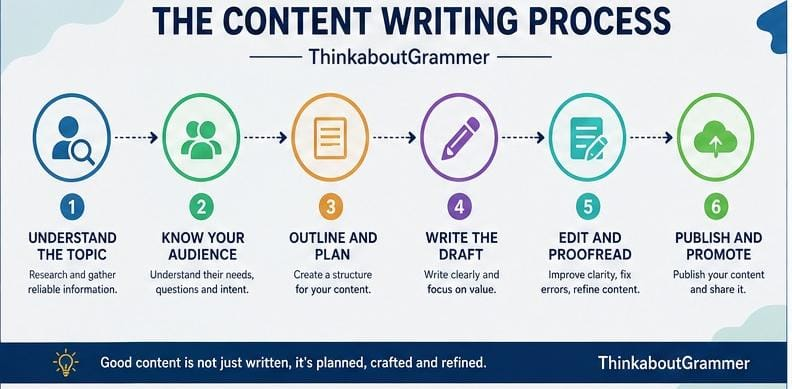
The Content Writing Process: Step by Step
Professional writing becomes easier when you follow a repeatable process.
Step 1: Understand the Topic
Start by defining the subject.
If the topic is broad, determine which aspects are most useful to the intended audience.
For example, an article about “content writing” could focus entirely on careers, but a comprehensive beginner’s guide may need to cover definitions, types, skills, processes, examples, and mistakes.
Step 2: Research the Audience
Think about what readers already know and what they need to learn.
Questions worth considering include:
- What problem brought them here?
- What terminology will they understand?
- What questions are they likely to ask?
- What information would make the article genuinely useful?
Step 3: Research the Topic
Good writing requires reliable information.
Research should help you understand:
- Key concepts
- Important terminology
- Common questions
- Different viewpoints
- Relevant examples
- Supporting evidence
Avoid adding facts simply because they sound impressive. If a claim cannot be supported, reconsider whether it belongs in the article.
Step 4: Create an Outline
An outline prevents the article from becoming a collection of disconnected paragraphs.
For example:
- Definition
- Importance
- Types
- Skills
- Writing process
- SEO considerations
- Common mistakes
- Practical tips
- FAQs
- Conclusion
The outline can change during research. It is a guide, not a rigid rule.
Step 5: Write the First Draft
Focus on communicating ideas rather than making every sentence perfect.
Trying to edit every sentence immediately can interrupt your thought process.
Get the main ideas down first. You can improve wording, grammar, transitions, and structure during editing.
Step 6: Edit for Clarity
After completing the draft, look at each paragraph critically.
Ask:
“Does this sentence help the reader?”
If the answer is no, remove it, rewrite it, or combine it with another sentence.
Step 7: Proofread
Finally, check grammar, spelling, punctuation, capitalization, formatting, and consistency.
Reading the article aloud can reveal awkward sentences that are easy to miss when reading silently.
Essential Content Writing Skills
A strong content writer needs more than good grammar.
Research Skills
Writers need to locate relevant information and distinguish useful sources from unreliable ones.
Grammar and Language Skills
Grammar helps readers understand your message.
Pay particular attention to:
- Subject-verb agreement
- Verb tense
- Sentence structure
- Pronoun use
- Punctuation
- Word choice
- Spelling
Strong vocabulary also helps writers choose precise and effective words. For practical strategies, see this guide on how to improve vocabulary.
Editing Skills
Writing and editing are different skills.
A good editor can identify unnecessary words, weak transitions, repetition, unclear explanations, and inconsistent tone.
SEO Knowledge
Writers working on websites can benefit from understanding basic SEO concepts such as search intent, keywords, headings, internal linking, and content structure.
Communication Skills
A writer must communicate ideas clearly. This becomes especially important when explaining technical or complicated subjects.
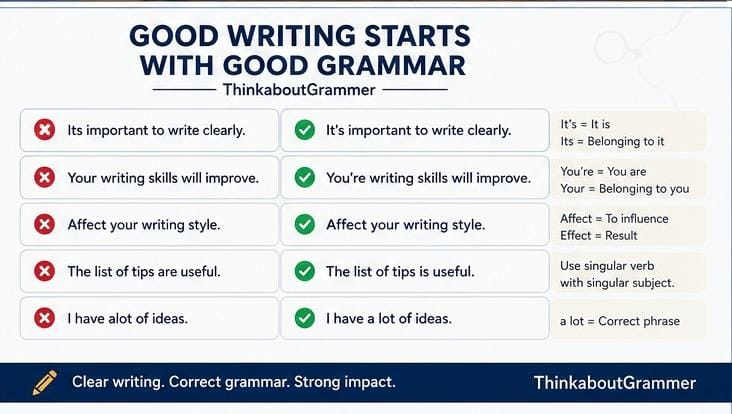
Common Grammar Mistakes in Content Writing
Grammar errors can make otherwise useful content harder to read.
Subject-Verb Agreement
Incorrect:
The list of writing tips are useful.
Correct:
The list of writing tips is useful.
The subject is “list,” which is singular.
Its vs. It’s
Incorrect:
The website changed it’s design.
Correct:
The website changed its design.
“It’s” means “it is” or “it has,” while “its” shows possession.
Your vs. You’re
Incorrect:
Your going to improve your writing.
Correct:
You’re going to improve your writing.
“You’re” is a contraction of “you are.”
Affect vs. Effect
Incorrect:
Poor grammar can effect readability.
Correct:
Poor grammar can affect readability.
In this common usage, “affect” is a verb meaning to influence, while “effect” is usually a noun referring to a result.
Sentence Fragments
Fragment:
Because the article was difficult to understand.
This is not a complete sentence.
Correct:
The reader left because the article was difficult to understand.
How to Write a Strong Introduction
Understanding how conjunctions connect ideas can also improve sentence structure. Learn more about FANBOYS grammar and how coordinating conjunctions can connect related words, phrases, and clauses.
Your introduction has an important job: convince readers that the page is worth reading.
A practical introduction can follow this structure:
- Identify the reader’s problem.
- Introduce the topic.
- Explain why it matters.
- Tell the reader what they will learn.
For example:
“Writing content that people actually want to read can be difficult. You may have useful information, but unclear structure, weak introductions, or complicated sentences can make the message less effective. This guide explains how content writing works and how you can create clearer, more useful content.”
Notice that the introduction does not need to explain everything. Its purpose is to lead naturally into the main discussion.
How to Make Content More Engaging
Useful content does not have to be boring.
Use Direct Language
Instead of:
“It is recommended that writers consider using shorter paragraphs.”
Write:
“Use shorter paragraphs.”
The second version is more direct.
Ask Relevant Questions
Questions can create a natural conversational flow.
For example:
“What would a beginner need to know before trying this?”
Use questions because they help the reader, not simply because they make text look conversational.
Tell Readers What to Do
Practical advice is more valuable when readers know how to apply it.
Instead of:
“Headings are important.”
Try:
“Break long articles into descriptive H2 and H3 headings so readers can scan the page and find relevant sections quickly.”
Content Writing Mistakes to Avoid
Even experienced writers can fall into common traps.
Keyword Stuffing
Repeating the same keyword again and again does not automatically improve content.
Awkward:
“Content writing is important because content writing helps content writers create content writing content.”
The sentence is unnatural and provides little value.
Use keywords naturally and focus on the topic as a whole.
Writing for Search Engines Instead of People
SEO should support good writing rather than replace it.
A page can target the right keyword and still fail to satisfy readers if it does not answer their questions.
Overly Long Introductions
Readers usually want the answer quickly.
Avoid spending several paragraphs discussing how important a topic is before actually addressing it.
Excessive Jargon
Technical terms are useful when the audience understands them. Otherwise, explain them.
For example:
“Search intent means the reason someone performs a search.”
That short definition can make a technical concept accessible to beginners.
Repeating the Same Point
If you have already explained an idea clearly, move forward.
Repetition adds length without necessarily adding value.
How to Improve Your Content Writing
Improvement comes from deliberate practice.
Read High-Quality Writing
Read articles, books, guides, and publications written for different audiences.
Pay attention to:
- How introductions work
- How paragraphs are structured
- How writers transition between ideas
- How examples are used
- How complicated concepts are explained
Practice Writing Regularly
Write short pieces about subjects you understand.
For example, take one topic and explain it in:
- 100 words
- 250 words
- 500 words
This teaches you how to communicate the same core idea at different levels of detail.
Edit Your Own Work
After writing, wait before editing if possible.
A little distance makes awkward phrases and repeated ideas easier to identify.
Replace Weak Words
Look for vague expressions.
Weak:
“There are a lot of things that can make writing better.”
Stronger:
“Clear structure, precise word choice, and useful examples can make writing more effective.”
Specific language gives the reader more information.
A Simple Content Writing Checklist
Before publishing an article, review it with this checklist:
- Is the main purpose clear?
- Does the introduction address the reader’s problem?
- Does the article satisfy the likely search intent?
- Are the headings descriptive?
- Are paragraphs reasonably short?
- Are examples accurate and useful?
- Is the language easy to understand?
- Have unnecessary repetitions been removed?
- Are grammar and punctuation correct?
- Are keywords used naturally?
- Does the conclusion summarize the main takeaway?
- Have factual claims been checked?
Content Writing vs. Other Forms of Writing
Not all writing has the same purpose.
| Writing Type | Primary Goal |
| Content writing | Inform, educate, engage, or support a broader content strategy |
| Copywriting | Persuade readers to take an action |
| Academic writing | Present research and analysis |
| Technical writing | Explain technical information clearly |
| Creative writing | Entertain, express ideas, or tell stories |
| Journalism | Report news and events |
| Business writing | Communicate professional information |
There can be significant overlap between these categories. A blog post, for example, may contain educational information while also using persuasive techniques.
Can Content Writing Be a Career?
Yes. Content writing can be a professional skill used across many industries.
A writer might work on:
- Company blogs
- Websites
- E-commerce stores
- Marketing campaigns
- Newsletters
- Educational resources
- Software documentation
- Social media
- Freelance projects
Beginners can start by building writing samples around subjects they understand. A small portfolio can demonstrate writing ability, research skills, structure, and adaptability.
The exact requirements vary by employer and client, so writers should focus on developing practical skills rather than relying on a single career path.
Frequently Asked Questions About Content Writing
What is content writing in simple words?
Content writing means creating written material for a particular audience and purpose. It can include articles, website pages, product descriptions, guides, emails, and social media content.
What does a content writer do?
A content writer researches topics, plans content, writes drafts, edits material, checks accuracy, and adapts the writing to the intended audience and format.
Is content writing the same as copywriting?
No. Content writing often focuses on informing, educating, or engaging readers, while copywriting is generally more focused on persuasion and encouraging a specific action. However, the two areas often overlap.
What skills are needed for content writing?
Useful skills include grammar, research, editing, communication, audience awareness, organization, and basic SEO knowledge. Strong writers also learn how to adapt their tone and structure to different formats.
How long should a content article be?
There is no universal ideal length. An article should be long enough to satisfy the reader’s needs without adding unnecessary information. A simple question may require a short answer, while a complex topic may need a detailed guide.
Does content writing help SEO?
High-quality content can support an SEO strategy by addressing relevant topics and search intent. However, SEO involves more than writing, including technical factors, site structure, links, and other signals.
How can I improve my content writing?
Read strong writing, practice regularly, study grammar, learn to edit your own work, research your audience, and rewrite weak sentences. Reviewing your writing critically is one of the most useful ways to improve.
What makes content useful to readers?
Useful content answers the reader’s question clearly, provides accurate information, uses understandable language, offers practical examples, and avoids unnecessary filler.
Conclusion
Content writing is ultimately about communication. The goal is not to produce as many words as possible but to make those words useful to the people reading them.
Start by understanding the audience and their purpose for reading. Research the subject carefully, create a logical structure, use clear language, provide specific examples, and edit aggressively for clarity. For online content, consider search intent and SEO without allowing keywords to make the writing unnatural.
Whether you’re creating a blog post, website page, product description, or detailed guide, the same principle applies: give readers the information they need in a form that is easy to understand and use.