


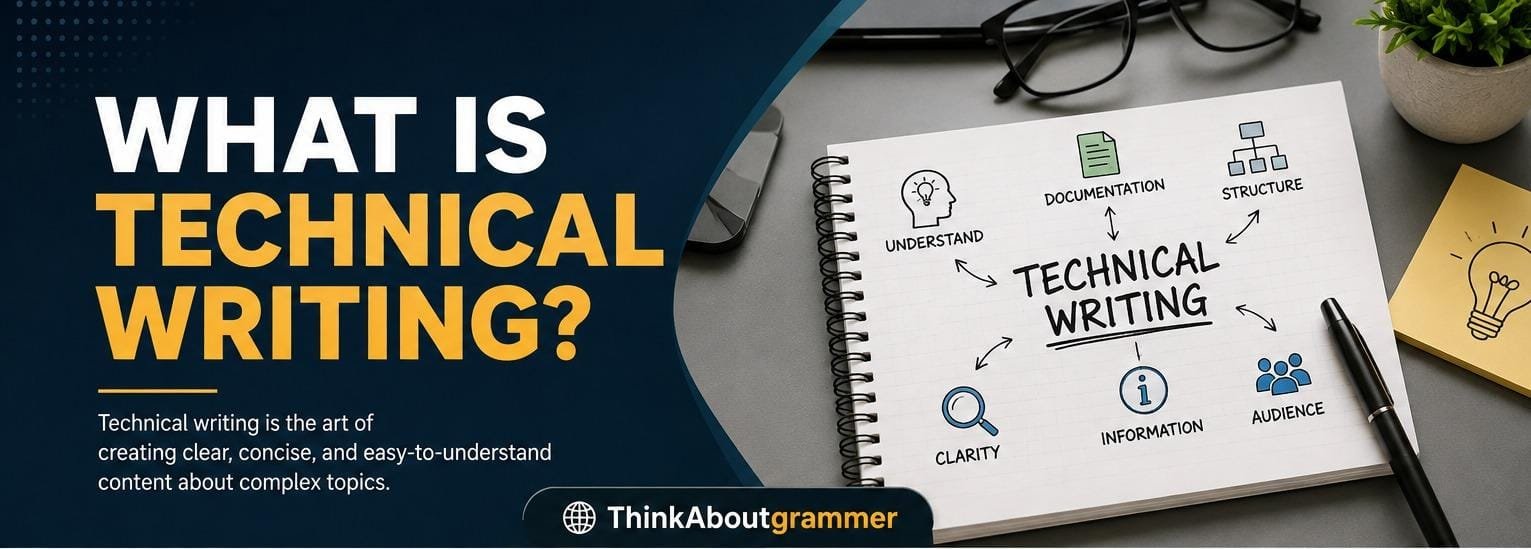
If you have ever read a user manual, software guide, instruction sheet, research report, or product specification, you have probably encountered technical writing. But what is technical writing, exactly?
- What Is Technical Writing?
- What Is the Purpose of Technical Writing?
- Key Characteristics of Technical Writing
- What Are the Main Types of Technical Writing?
- User Manuals
- How-To Guides
- Software Documentation
- Technical Reports
- Standard Operating Procedures
- Specifications
- Technical Writing Examples
- Technical Writing vs. Other Types of Writing
- What Is the Difference Between Technical Writing and Creative Writing?
- What Is the Difference Between Technical Writing and Academic Writing?
- What Skills Does a Technical Writer Need?
- 1. Strong Writing Skills
- 2. Research Skills
- 3. Audience Analysis
- 4. Information Organization
- 5. Editing Skills
- 6. Basic Technical Knowledge
- How to Write a Technical Document
- Step 1: Identify the Purpose
- Step 2: Identify the Audience
- Step 3: Gather Reliable Information
- Step 4: Create an Outline
- Step 5: Write Clearly
- Step 6: Add Helpful Visuals or Examples
- Step 7: Edit and Test
- How Grammar Improves Technical Writing
- Common Technical Writing Mistakes
- Using Too Much Jargon
- Writing for Yourself Instead of the Reader
- Hiding Important Information in Large Paragraphs
- Giving Incomplete Instructions
- Using Ambiguous Language
- Tips for Better Technical Writing
- When Should You Use Technical Writing?
- Is Technical Writing Only for Technology?
- Technical Writing and SEO Content
- Conclusion: What Is Technical Writing?
Technical writing is a form of communication that explains specialized information in a clear, accurate, and useful way. Its purpose is usually to help readers understand a subject, complete a task, solve a problem, or use a product or service correctly.
Unlike creative writing, technical writing does not mainly aim to entertain. It focuses on clarity, accuracy, organization, and the reader’s needs.
In this guide, you will learn what technical writing means, where it is used, what makes it effective, how it differs from other types of writing, and how to improve your own technical writing skills.
What Is Technical Writing?
Technical writing is writing that communicates complex, specialized, or practical information to a specific audience.
The subject can be almost anything that requires explanation or instructions. Examples include technology, engineering, science, medicine, finance, manufacturing, and software.
A technical writer might create:
- User manuals
- Software documentation
- How-to guides
- Standard operating procedures
- Technical reports
- Product specifications
- Research documentation
- Installation instructions
- Help-center articles
- API documentation
- Safety instructions
- Training materials
The central goal is simple: make useful information understandable and actionable.
For example, instead of simply saying:
Install the software.
A technical writer might explain the process:
- Download the installation file.
- Open the file from your Downloads folder.
- Follow the setup instructions.
- Select the installation location.
- Click Install.
- Restart the application after installation is complete.
The second version gives the reader enough information to perform the task.
What Is the Purpose of Technical Writing?
Technical writing exists to communicate information efficiently and accurately.
A good technical document should help the reader answer questions such as:
- What does this product or process do?
- How does it work?
- What steps should I follow?
- What should I do if something goes wrong?
- What information do I need to complete this task?
- What rules or requirements should I follow?
The purpose can vary depending on the document.
| Type of technical writing | Main purpose |
|---|---|
| User manual | Explain how to use a product |
| Tutorial | Teach a process or skill |
| Technical report | Present findings and analysis |
| Software documentation | Explain how software works or how to use it |
| Procedure | Provide standardized steps |
| Specification | Define technical requirements |
| Help article | Solve a user’s problem |
| Safety guide | Explain safe procedures and precautions |
The reader should not have to guess what the writer means.
Key Characteristics of Technical Writing
Effective technical writing has several important characteristics.
Clarity
The information should be easy to understand.
Instead of:
The activation of the device should be undertaken following verification of the appropriate operational parameters.
Write:
Check the operating settings before turning on the device.
The second sentence communicates the same basic idea with fewer words.
Accuracy
Technical information must be correct.
A small error in a measurement, instruction, command, or specification can cause confusion or produce an incorrect result. Writers should therefore verify technical facts before publishing documentation.
Conciseness
Technical writing should provide the necessary information without unnecessary repetition.
For example:
Wordy:
In order to begin the process of installation, it is necessary for the user to first make sure that the installation file has already been downloaded.
Concise:
Before installation, download the installation file.
Concise writing saves the reader time.
Organization
Information should appear in a logical order.
Headings, subheadings, numbered steps, tables, and lists can make complex information easier to navigate.
Objectivity
Technical documents generally focus on information rather than personal opinions.
For example:
The application requires 8 GB of available storage.
This is more appropriate for technical documentation than:
I think this application needs quite a lot of storage.
Audience Awareness
Technical writing should match the reader’s knowledge.
A document written for software developers can use programming terminology that may confuse someone with no technical background. Conversely, documentation for beginners should explain unfamiliar terms.
What Are the Main Types of Technical Writing?

Technical writing takes many forms. The format depends on the purpose and audience.
User Manuals
User manuals explain how to operate a product, device, application, or system.
A printer manual, for example, might explain how to:
- Connect the printer.
- Install the required software.
- Load paper.
- Replace an ink cartridge.
- Print a document.
- Troubleshoot common problems.
How-To Guides
How-to guides focus on completing a specific task.
For example:
How to Create a Backup
- Open the backup application.
- Select the files you want to save.
- Choose a backup location.
- Start the backup.
- Confirm that the files were copied successfully.
The reader should be able to follow the guide without needing to interpret complicated prose.
Software Documentation
Software documentation explains how software works or how users and developers can interact with it.
It may include:
- Installation instructions
- Configuration guides
- Feature descriptions
- Troubleshooting information
- Command references
- API documentation
- Developer guides
Technical Reports
Technical reports present information about a project, experiment, test, investigation, or technical problem.
A report might include:
- Introduction
- Objectives
- Methodology
- Results
- Analysis
- Recommendations
- Conclusion
The exact structure depends on the organization and purpose.
Standard Operating Procedures
A standard operating procedure, often called an SOP, explains how to perform a recurring task consistently.
For example, a laboratory SOP might describe how employees should prepare equipment before an experiment.
SOPs are especially useful when consistency and compliance matter.
Specifications
Specifications describe technical requirements or characteristics.
A product specification might list:
| Specification | Example |
|---|---|
| Storage | 512 GB |
| Memory | 16 GB |
| Display | 15.6 inches |
| Weight | 1.8 kg |
| Operating system | Windows |
Specifications are designed to communicate precise information quickly.
Technical Writing Examples
Examples make the concept easier to understand.
Example 1: Instruction
Less effective:
The user should make sure that the button is pressed in order to activate the system.
Better:
Press the power button to start the system.
The improved version uses direct language and removes unnecessary words.
Example 2: Troubleshooting
Less effective:
If the computer is experiencing a situation where it is not connecting to the network, the user should check the network-related settings.
Better:
If the computer cannot connect to the network, check the network settings.
The second version is shorter and easier to follow.
Example 3: Technical Explanation
Less effective:
Data encryption is basically something that is used to make information more secure by changing it into another form.
Better:
Data encryption converts readable information into an encoded form that unauthorized users cannot easily understand.
The second explanation is more precise.
Technical Writing vs. Other Types of Writing
Technical writing is different from creative, academic, and general business writing.
| Writing type | Primary goal | Typical examples |
|---|---|---|
| Technical writing | Explain specialized information | Manuals, documentation |
| Creative writing | Entertain or express ideas | Stories, novels |
| Academic writing | Analyze and communicate research | Essays, papers |
| Business writing | Communicate professionally | Emails, proposals |
| Copywriting | Persuade an audience | Advertisements, sales pages |
| Journalistic writing | Inform the public | News articles |
There can be overlap. For example, a technical blog can explain a complicated subject while still using an engaging style.
However, technical writing places especially strong emphasis on precision and usability.
What Is the Difference Between Technical Writing and Creative Writing?
The biggest difference is purpose.
Creative writing often uses imagination, descriptive language, emotion, and storytelling. Technical writing generally uses direct language to communicate information or instructions.
Consider these examples.
Creative style:
The machine came alive with a low hum as its lights flickered across the dark workshop.
Technical style:
Press the power button. The status indicator will illuminate when the machine starts.
Neither style is inherently better. Each serves a different purpose.
A technical document should not become unnecessarily literary when the reader simply needs clear instructions.
What Is the Difference Between Technical Writing and Academic Writing?
Academic writing and technical writing can both involve research and specialized subjects, but their goals are often different.
Academic writing frequently develops an argument, evaluates evidence, or contributes to scholarly discussion.
Technical writing usually focuses on practical communication.
For example, a scientific paper may discuss the results of an experiment in depth. A laboratory procedure may explain exactly how to repeat the experiment.
The two forms can therefore overlap, especially in science and engineering.
Technical writing also shares some characteristics with expository writing, particularly when the goal is to explain a complex subject clearly.
What Skills Does a Technical Writer Need?
A successful technical writer needs more than good grammar.
1. Strong Writing Skills
Technical writers must construct clear sentences and paragraphs.
Grammar, punctuation, vocabulary, and sentence structure all affect readability.
2. Research Skills
Writers often need to learn unfamiliar subjects before explaining them.
Good research helps prevent inaccurate or misleading information.
3. Audience Analysis
Before writing, determine who will read the document.
Ask:
- What does the reader already know?
- What does the reader need to accomplish?
- Which terms require explanation?
- What problems might the reader encounter?
4. Information Organization
A writer should know how to turn complicated information into a logical structure.
Headings, lists, tables, diagrams, examples, and step-by-step instructions can all help.
5. Editing Skills
First drafts often contain unnecessary words, unclear sentences, or missing information.
Editing helps make the final document more precise.
6. Basic Technical Knowledge
The required technical knowledge depends on the field.
A software documentation writer may need programming knowledge, while an engineering writer may need to understand engineering concepts and terminology.
How to Write a Technical Document
You can follow a simple process when creating technical content.
Step 1: Identify the Purpose
Start by asking what the document needs to accomplish.
Are you explaining a concept, teaching a task, documenting a system, or presenting research?
Step 2: Identify the Audience
Determine the reader’s experience level.
A beginner guide and an expert reference document should not sound the same.
Step 3: Gather Reliable Information
Collect the facts, requirements, specifications, procedures, and examples you need.
Verify important details before including them.
Step 4: Create an Outline
Organize the information before writing.
For example:
How to Install an Application
- System requirements
- Downloading the software
- Starting installation
- Choosing settings
- Completing installation
- Troubleshooting
Step 5: Write Clearly
Use direct sentences and familiar words when possible.
Instead of:
Prior to commencing the configuration process, ensure that the device is connected.
Write:
Connect the device before configuring it.
Step 6: Add Helpful Visuals or Examples
Some information is easier to understand visually.
Screenshots, diagrams, tables, flowcharts, and examples can make technical concepts clearer.
Step 7: Edit and Test
Read the document from the reader’s perspective.
If it contains instructions, follow the instructions yourself when possible. This can reveal missing steps or confusing wording.
How Grammar Improves Technical Writing
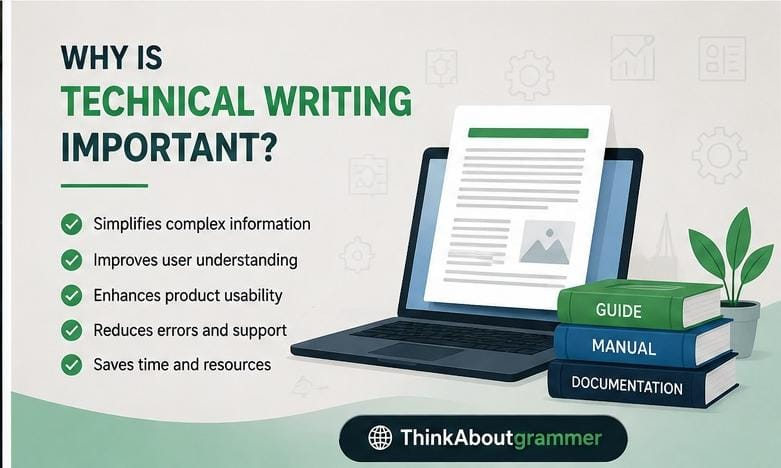
Grammar is important because unclear sentence structure can change the meaning of technical information.
Use Active Voice When Appropriate
Passive:
The file should be opened by the user.
Active:
Open the file.
The active version is more direct.
However, passive voice is not always wrong. It can be useful when the action is more important than the person performing it.
Clear grammar is also important in professional communication. These professional email grammar rules can help you improve clarity and sentence structure.
Keep Sentences Manageable
Long sentences can make technical instructions difficult to follow.
Less clear:
After opening the application and selecting the settings menu, which can be found in the upper-right corner of the screen, choose the security option and then select the setting that controls automatic updates.
Clearer:
Open the application. Select Settings in the upper-right corner. Choose Security. Then select the automatic update setting.
Breaking the process into steps makes the instructions easier to scan.
Use Consistent Terminology
Do not call the same feature three different names unless there is a reason.
For example, if you call something the Download button, continue using that term instead of switching between:
- Download button
- Download option
- Download control
- Download link
Consistency reduces confusion.
Common Technical Writing Mistakes
Even technically accurate documents can be difficult to use if they are poorly written.
Using Too Much Jargon
Technical terms are useful when the audience understands them. Unnecessary jargon can make a document harder to read.
Better approach: explain specialized terms when readers may not know them.
Writing for Yourself Instead of the Reader
The writer may understand the subject extremely well, but the reader might not.
Always ask what information the reader needs at each stage.
Hiding Important Information in Large Paragraphs
Readers often scan technical documents rather than reading every sentence.
Use headings, lists, tables, bold labels, and short paragraphs to make important information easy to find.
Giving Incomplete Instructions
A writer may accidentally skip steps because the process feels obvious to them.
Someone unfamiliar with the task may not know what to do next.
Using Ambiguous Language
Avoid vague instructions such as:
Adjust the settings as needed.
Which settings? What should they be changed to?
A better instruction gives specific information:
Set the temperature to 20°C before starting the test.
Tips for Better Technical Writing
Use these practical habits to improve your work:
- Know your reader. Write at the reader’s level.
- Define unfamiliar terms. Do not assume everyone understands technical vocabulary.
- Use short, direct sentences. Remove unnecessary wording.
- Choose precise verbs. “Click,” “enter,” “select,” and “install” are often clearer than vague phrases.
- Break complex processes into steps.
- Use headings to organize information.
- Keep terminology consistent.
- Use examples for difficult concepts.
- Check facts and measurements carefully.
- Test instructions before publishing them.
- Edit for clarity, not just grammar.
- Remove information that does not help the reader accomplish the goal.
When Should You Use Technical Writing?
Technical writing is appropriate whenever readers need clear information about a specialized subject or process.
You might use it to:
- Explain how a product works
- Document software
- Describe a manufacturing process
- Provide workplace procedures
- Explain scientific findings
- Create training materials
- Document technical requirements
- Help users troubleshoot problems
- Explain installation or configuration steps
If the reader needs to understand, perform, configure, maintain, or troubleshoot something, technical writing may be the right approach.
Is Technical Writing Only for Technology?
No.
The word “technical” does not mean that the subject must involve computers.
Technical writing appears in many industries, including:
- Healthcare
- Engineering
- Education
- Manufacturing
- Finance
- Aviation
- Construction
- Science
- Telecommunications
- Government
- Software development
A medical procedure, engineering specification, equipment manual, and software guide can all be examples of technical writing.
Technical Writing and SEO Content
Technical writing can also be useful online.
A company may publish technical articles to explain products, solve customer problems, or document features. Search-engine optimization can help people find those resources, but usefulness should remain the priority.
For example, an article about fixing a software error should quickly explain:
- What causes the error.
- What it means.
- How to diagnose it.
- How to fix it.
- What to do if the first solution fails.
SEO should support that experience rather than replacing clear technical communication. Technical writing is different from general content writing, which may focus more on informing, engaging, or attracting a broader online audience.
Frequently Asked Questions
What is technical writing in simple words?
Technical writing is writing that explains specialized information, procedures, products, systems, or processes clearly and accurately. It helps readers understand something or complete a specific task.
What are some examples of technical writing?
Common examples include user manuals, software documentation, how-to guides, technical reports, SOPs, product specifications, installation instructions, and troubleshooting guides.
What is the main goal of technical writing?
The main goal is to communicate useful information clearly and accurately so that the reader can understand a subject, perform a task, solve a problem, or make an informed decision.
Is technical writing difficult?
It can be challenging because the writer often has to understand complex information and explain it in a simple way. Strong research, organization, writing, and editing skills make the process easier.
What makes good technical writing?
Good technical writing is clear, accurate, concise, well organized, audience-focused, and consistent. It should give readers the information they need without unnecessary complexity.
Do technical writers need to be experts?
Not always. Technical writers need enough subject knowledge to understand and accurately explain the material. They may also work closely with engineers, developers, researchers, or other subject-matter experts.
Is technical writing the same as academic writing?
No. They can overlap, but academic writing often focuses on research, analysis, and scholarly arguments, while technical writing commonly focuses on practical information, instructions, documentation, and problem-solving.
Can technical writing be used for websites?
Yes. Websites frequently use technical writing for documentation, help centers, tutorials, product guides, FAQs, knowledge bases, and technical articles.
Conclusion: What Is Technical Writing?
So, what is technical writing? It is a practical form of communication designed to make specialized information clear, accurate, and useful.
Effective technical writing does more than use correct grammar. It considers the audience, organizes information logically, chooses precise language, explains difficult ideas, and provides actionable instructions when needed.
Whether you are creating a software guide, user manual, technical report, SOP, or online tutorial, the same principle applies: write so the reader can understand what you mean and know what to do next.