

Have you ever seen three dots in a sentence—like this: …—and wondered what they actually mean?
- What Is an Ellipsis in Grammar?
- What Do Ellipses Mean?
- Using Ellipses to Show Omitted Words
- Ellipses for an Unfinished Thought
- Ellipses to Show Hesitation
- Ellipses Can Create Suspense
- Ellipses in Informal Writing
- Ellipses in Formal Writing
- How Many Dots Are in an Ellipsis?
- Ellipsis Punctuation and Capitalization
- Spaces Around Ellipses
- Common Mistakes With Ellipses
- Mistake 1: Using Ellipses Everywhere
- Mistake 2: Using Too Many Dots
- Mistake 3: Confusing an Ellipsis With a Period
- Mistake 4: Changing the Meaning of a Quotation
- Mistake 5: Using Ellipses Instead of Proper Punctuation
- Ellipsis vs. Dash: What’s the Difference?
- Ellipsis vs. Comma
- Ellipsis vs. Three Periods
- How to Use Ellipses in Quotations
- When Should You Avoid Ellipses?
- Practical Examples of Ellipses in Grammar
- Incorrect vs. Correct Ellipsis Examples
- Example 1: Too Many Dots
- Example 2: Unnecessary Ellipsis
- Example 3: Hesitation
- Example 4: Unfinished Statement
- Example 5: Quotation Omission
- Tips for Using Ellipses Effectively
- 1. Know Why You Are Using One
- 2. Don’t Replace Normal Punctuation
- 3. Be Consistent
- 4. Use Them Sparingly
- 5. Protect the Meaning of Quotations
- Are Ellipses Appropriate in Academic Writing?
- Are Ellipses Grammatically Correct?
- Conclusion: Understanding Ellipses in Grammar
Those three dots are called an ellipsis (plural: ellipses). They can show that words have been omitted, indicate a pause or unfinished thought, or create a particular effect in informal writing. However, ellipses are often misused, especially when writers add them simply because they are unsure how to punctuate a sentence.
Understanding ellipses in grammar helps you recognize what the punctuation means and use it appropriately in essays, articles, dialogue, emails, and everyday writing.
Learn more about what grammar is and how it shapes clear sentence structure.
This guide explains what an ellipsis is, when to use it, how punctuation works around it, and which common mistakes you should avoid.
What Is an Ellipsis in Grammar?
An ellipsis is a punctuation mark consisting of three dots:
…
The plural form is ellipses.
In writing, an ellipsis generally signals that something has been left out or that a thought is incomplete. Its meaning depends on the context.
For example:
I was going to tell you… but I changed my mind.
Here, the ellipsis suggests a pause or hesitation.
An ellipsis can also show that words have been removed from a quotation:
The report states that “regular practice… improves overall performance.”
In this case, the dots tell the reader that part of the original quotation has been omitted.
Ellipsis vs. Ellipses
These two words are easy to confuse.
| Term | Meaning |
|---|---|
| Ellipsis | One set of three dots |
| Ellipses | More than one ellipsis |
| … | The actual punctuation mark |
For example:
There is an ellipsis at the end of the sentence.
The editor used several ellipses to shorten the quotation.
What Do Ellipses Mean?
Ellipses can communicate several different ideas. The intended meaning depends heavily on the sentence.
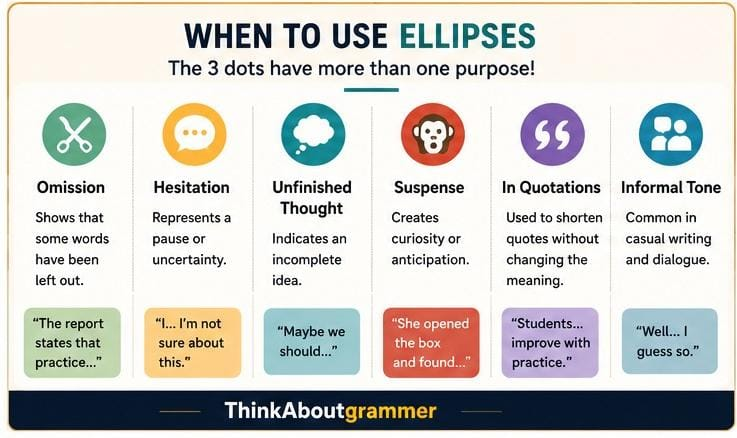
The most common uses are:
- Showing omitted words
- Indicating an unfinished thought
- Showing hesitation or a pause
- Creating suspense
- Representing trailing speech in dialogue
- Suggesting uncertainty or hesitation in informal writing
Let’s examine each use.
Using Ellipses to Show Omitted Words
One of the most formal uses of an ellipsis is to indicate that words have been removed from a quotation.
Suppose the original sentence says:
The new policy was introduced in January because the previous system was no longer effective for most departments.
You could shorten it:
“The new policy was introduced in January… [because] the previous system was no longer effective.”
However, you should not remove words in a way that changes the original meaning.
Example of a Shortened Quotation
Original:
The teacher explained that regular reading improves vocabulary and helps students become more confident writers.
Shortened:
The teacher explained that regular reading “improves vocabulary… [and] helps students become more confident writers.”
The ellipsis tells the reader that part of the original quotation has been omitted.
Why Use an Ellipsis in a Quotation?
Ellipses can make long quotations more focused. Instead of reproducing an entire passage, you can remove material that is not relevant to your point.
However, editing a quotation requires care. You should never use an ellipsis to distort what the original speaker or writer meant.
Ellipses for an Unfinished Thought
An ellipsis can show that a speaker begins a thought but does not finish it.
For example:
If only I had known…
The reader understands that the speaker has more to say, but the thought remains incomplete.
Another example:
Maybe we should…
The speaker stops before completing the sentence.
This use is especially common in dialogue and informal writing.
Examples of Unfinished Thoughts
I thought you were going to…
Well, if that’s what you really want…
Perhaps tomorrow…
The ellipsis creates a sense that something has been left unsaid.
Ellipses to Show Hesitation
People sometimes pause while speaking because they are uncertain about what to say. In dialogue, an ellipsis can reproduce that hesitation.
For example:
“I… I’m not sure that’s the best idea.”
The first ellipsis represents a brief hesitation before the speaker continues.
Another example:
“Well… I suppose you’re right.”
The dots make the dialogue sound hesitant rather than direct.
Ellipses and Dialogue
When writing fictional or conversational dialogue, ellipses can help communicate pauses that would be difficult to express with ordinary punctuation.
Compare:
“I don’t know. Maybe you’re right.”
with:
“I don’t know… maybe you’re right.”
The second version creates a more noticeable pause between the two thoughts.
Ellipses Can Create Suspense
Writers sometimes use ellipses to slow down a sentence and make the reader anticipate what comes next.
For example:
She opened the envelope and discovered…
The sentence deliberately leaves the result unstated.
A continuation might reveal the information:
She opened the envelope and discovered… an invitation to the ceremony.
The pause can make the reveal feel more dramatic.
However, suspense is a stylistic effect, so ellipses should not appear in every dramatic sentence. Overuse quickly becomes distracting.
Ellipses in Informal Writing
You may see ellipses frequently in text messages, social media posts, online conversations, and casual emails.
For example:
I guess we could go…
or:
Hmm… I’m not sure.
In these settings, an ellipsis can communicate tone. Depending on the context, it might suggest hesitation, uncertainty, awkwardness, or a thought that trails off.
The important point is that informal usage does not always follow the same conventions as formal academic writing.
Ellipses in Formal Writing
In formal writing, ellipses have a more limited and deliberate role.
They are especially useful when shortening quotations.
For example:
The study concluded that “consistent practice… can improve performance.”
But using ellipses simply to make prose sound dramatic is usually unnecessary in academic writing.
Instead of:
The results were surprising… and unexpected.
write:
The results were surprising and unexpected.
The second version is clearer and more direct.
Should You Use Ellipses in an Essay?
Yes, but use them carefully.
Ellipses are appropriate when:
- You are omitting part of a quotation.
- You need to show an incomplete thought in quoted dialogue.
- A specific style guide permits the intended use.
They are usually unnecessary when you could simply write a complete sentence.
How Many Dots Are in an Ellipsis?
A standard ellipsis consists of three dots:
…
Writers sometimes create an ellipsis by typing three periods. Many word processors can also format an ellipsis as a single typographic character:
…
Both forms represent the same basic punctuation concept, although formatting conventions vary by style guide and publishing system.
Three Dots vs. Four Dots
You may occasionally see four dots in formal writing.
The fourth mark can represent a period when an ellipsis occurs after a grammatically complete sentence.
For example:
The committee reached its decision. . . . The announcement followed the next morning.
The exact spacing and treatment depend on the style guide being followed. Academic and professional writers should check the required style rather than applying one universal rule.
Ellipsis Punctuation and Capitalization
Whether the word following an ellipsis begins with a capital letter depends on the grammatical structure.
Consider:
I wanted to ask… but I forgot.
Here, but remains lowercase because the sentence continues.
Compare that with:
I wanted to ask you something. … But I forgot.
Here, But begins a new sentence and is therefore capitalized.
The key question is not simply whether an ellipsis appears. Ask whether the words following it form part of the same sentence or begin a new sentence.
Spaces Around Ellipses
Spacing conventions can vary depending on the style guide.
In ordinary informal writing, you will often see:
I don’t know… maybe later.
In some formal publishing styles, spaced periods may be preferred:
I don’t know . . . maybe later.
The important thing is consistency.
If you are writing for school, university, journalism, or a professional publication, follow the style guide required by your instructor, editor, or organization.
Common Mistakes With Ellipses
Ellipses are simple in appearance but easy to overuse.
Mistake 1: Using Ellipses Everywhere
Some writers put ellipses between almost every thought:
I went to the store… and I bought some bread… then I came home…
This can make writing feel fragmented.
Better:
I went to the store, bought some bread, and came home.
Use an ellipsis when the pause or omission has a purpose.
Mistake 2: Using Too Many Dots
An ellipsis normally contains three dots.
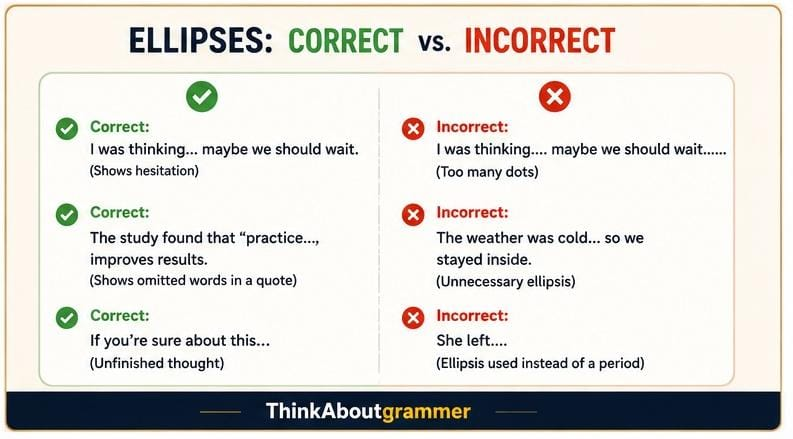
Incorrect:
I don’t know……
Correct:
I don’t know…
Extra dots are generally unnecessary.
Mistake 3: Confusing an Ellipsis With a Period
A period ends a complete sentence. An ellipsis signals omission, hesitation, or an unfinished thought.
For a closer look at how a full stop works in English sentences, see our guide to full stop punctuation.
Compare:
She left.
This is a complete statement.
She left…
This suggests that something remains unsaid or that the thought trails off.
Mistake 4: Changing the Meaning of a Quotation
An ellipsis should not be used to manipulate a quotation.
Suppose someone originally said:
The proposal is expensive, but I believe it could benefit the community.
You should not shorten it to:
“The proposal is expensive…”
if the omitted portion changes the reader’s understanding of the speaker’s position.
When shortening quotations, preserve the original meaning.
Mistake 5: Using Ellipses Instead of Proper Punctuation
An ellipsis should not replace commas, periods, semicolons, or other punctuation simply because a sentence feels long.
When coordinating conjunctions connect ideas, using the correct punctuation is important. Our guide to FANBOYS grammar rules explains these conjunctions in more detail.
For example:
The weather was cold… so we stayed inside.
A normal conjunction works perfectly well:
The weather was cold, so we stayed inside.
The ellipsis changes the tone by creating a pause. If no pause is intended, ordinary punctuation is better.
Ellipsis vs. Dash: What’s the Difference?
An ellipsis and an em dash can both interrupt a sentence, but they create different effects.
Ellipsis
An ellipsis often suggests a pause, hesitation, omission, or trailing thought.
“I thought you might…”
Em Dash
An em dash can signal a sudden interruption, change, or strong break.
“I thought you might—”
The difference becomes especially noticeable in dialogue.
An ellipsis feels like the speaker trails away.
An em dash can feel like the speaker is interrupted or abruptly stops.
Ellipsis vs. Comma
A comma usually connects or separates grammatical elements according to established sentence structure.
An ellipsis is more expressive.
Compare:
Well, I don’t know.
with:
Well… I don’t know.
The comma produces normal grammatical punctuation. The ellipsis creates a noticeable pause.
Ellipsis vs. Three Periods
In everyday typing, people often refer to … as three periods. Technically, an ellipsis is a punctuation mark used for specific purposes, particularly omission or trailing thoughts.
The typographic character … is called the ellipsis character.
So you might encounter:
I was thinking…
or:
I was thinking…
The visual appearance differs, but the intended punctuation is closely related.
How to Use Ellipses in Quotations
When removing words from a quotation, make sure the remaining words still form a grammatically understandable and accurate representation.
A useful process is:
- Identify the part of the quotation you actually need.
- Remove unnecessary material.
- Insert an ellipsis where the omission occurs.
- Read the shortened quotation carefully.
- Check that the meaning has not been changed.
- Follow the required citation and style rules.
Example
Original:
“Students who read regularly often develop stronger vocabulary skills and become more comfortable expressing their ideas.”
Shortened:
“Students who read regularly… develop stronger vocabulary skills.”
The shortened quotation focuses on the relevant idea while indicating that words have been omitted.
When Should You Avoid Ellipses?
You do not need an ellipsis every time a sentence contains a pause.
Avoid them when:
- A comma already performs the job.
- A period would clearly end the thought.
- A conjunction can connect the ideas naturally.
- You are using them only to make ordinary writing sound dramatic.
- They make formal writing less precise.
- Repeated ellipses make the text difficult to read.
A good rule is simple: use an ellipsis when the omission or pause communicates something meaningful.
Practical Examples of Ellipses in Grammar
Here are several examples showing different functions.
| Purpose | Example | What it communicates |
|---|---|---|
| Omission | “The results… were significant.” | Words were removed |
| Hesitation | “I… don’t know.” | The speaker hesitates |
| Unfinished thought | “If you really wanted to…” | The thought trails off |
| Suspense | “Then the door opened…” | Anticipation |
| Informal tone | “Well… maybe.” | Uncertainty or hesitation |
Incorrect vs. Correct Ellipsis Examples
Example 1: Too Many Dots
Incorrect:
Maybe we should go……..
Better:
Maybe we should go…
Example 2: Unnecessary Ellipsis
Less effective:
She finished her work… and went home.
Better:
She finished her work and went home.
Unless the writer specifically wants to create a pause, the ellipsis adds little.
Example 3: Hesitation
Plain:
“I don’t think that’s right.”
With hesitation:
“I… don’t think that’s right.”
The second sentence communicates uncertainty or hesitation.
Example 4: Unfinished Statement
“I was going to tell you something, but…”
The speaker intentionally leaves the thought incomplete.
Example 5: Quotation Omission
Original:
“The program was designed to help new students understand the campus, meet other students, and become familiar with university resources.”
Shortened:
“The program was designed to help new students… become familiar with university resources.”
The ellipsis shows that part of the quotation has been omitted.
Tips for Using Ellipses Effectively
Keep these practical guidelines in mind:
1. Know Why You Are Using One
Before adding an ellipsis, ask yourself what it communicates.
Is it showing:
- omitted text?
- hesitation?
- an unfinished thought?
- suspense?
If the answer is none of these, you may not need it.
2. Don’t Replace Normal Punctuation
An ellipsis is not a general-purpose punctuation mark.
Use commas, periods, colons, semicolons, and dashes when they are grammatically appropriate.
3. Be Consistent
If you’re following a particular style guide, use its rules for spacing, quotation marks, capitalization, and sentence punctuation.
4. Use Them Sparingly
A few purposeful ellipses can be effective. A page filled with them can become difficult to read.
5. Protect the Meaning of Quotations
When using an ellipsis to remove material from someone else’s words, make sure the shortened version remains faithful to the original meaning.
Are Ellipses Appropriate in Academic Writing?
Yes, but academic writing generally benefits from restraint.
Ellipses are particularly useful when quoting a source and removing material that is not relevant to the discussion.
For example:
The researcher argues that “careful planning… reduces unnecessary errors.”
However, academic writing should prioritize precision. If an ellipsis makes the sentence ambiguous or gives the quotation a misleading meaning, rewrite the quotation or include more of the original text.
Always follow the citation style required for your assignment or publication.
Are Ellipses Grammatically Correct?
Yes. Ellipses are grammatically acceptable when they serve an appropriate purpose.
The problem is not the punctuation itself. The problem is using it incorrectly or excessively.
For example:
“I was thinking… maybe we should wait.”
This can be perfectly appropriate in dialogue because the dots represent hesitation.
But:
The meeting… started at nine… and ended at noon…
is unnecessarily fragmented if the writer simply means:
The meeting started at nine and ended at noon.
Grammar is not only about whether punctuation is technically possible. Good writing also depends on clarity, purpose, and context.
Frequently Asked Questions About Ellipses in Grammar
What are ellipses in grammar?
Ellipses are three dots (…) used to indicate omitted words, hesitation, an unfinished thought, or a trailing pause. Their exact function depends on the context.
Is an ellipsis three dots or three periods?
An ellipsis is commonly represented by three dots (…). In digital typography, it may also appear as a single ellipsis character (…).
Can I use an ellipsis at the end of a sentence?
Yes. An ellipsis can appear at the end of a sentence when the writer wants to indicate that the thought trails off, remains incomplete, or has been deliberately left unsaid.
What is the difference between an ellipsis and an em dash?
An ellipsis generally suggests omission, hesitation, or a trailing thought. An em dash creates a stronger break and can indicate interruption, emphasis, or a sudden change in thought.
Should there be spaces around an ellipsis?
Spacing conventions vary according to the writing style being followed. Informal writing commonly uses …, while some formal styles use spaced periods such as . . .. Follow the applicable style guide.
Can ellipses be used in formal writing?
Yes. One important formal use is showing that words have been omitted from a quotation. They should be used deliberately rather than as decoration.
Is using four dots correct?
It can be correct in certain formal punctuation systems when an ellipsis occurs alongside a period marking the end of a complete sentence. The exact convention depends on the applicable style guide.
Why do writers use ellipses in dialogue?
Writers can use ellipses to show hesitation, uncertainty, a pause, or an unfinished statement. They help communicate aspects of speech that ordinary punctuation may not capture.
Conclusion: Understanding Ellipses in Grammar
Understanding ellipses in grammar is less about memorizing complicated rules and more about recognizing what the three dots are supposed to communicate.
An ellipsis can show that words have been omitted from a quotation, indicate hesitation, leave a thought unfinished, or create suspense. In formal writing, it should be used carefully and consistently. In informal writing and dialogue, it can help communicate tone and pauses.
The most useful rule is simple: don’t add an ellipsis just because you can. Use it when the missing words, pause, or unfinished thought actually matters.
Once you understand that purpose, choosing between an ellipsis, comma, period, or dash becomes much easier.