



Introduction
Learning Turkish grammar can feel unusual at first, especially if your native language is English. Turkish builds words differently, uses suffixes extensively, and follows sentence patterns that may not look familiar.
- Introduction
- What Makes Turkish Grammar Different?
- Turkish Sentence Structure
- Turkish Nouns and Grammatical Cases
- Turkish Vowel Harmony
- Turkish Personal Pronouns
- Turkish Verbs
- Turkish Present Continuous Tense
- Turkish Simple Past Tense
- Turkish Future Tense
- How to Make Negative Sentences in Turkish
- How to Ask Questions in Turkish
- Turkish Plural Forms
- Possession in Turkish
- Turkish Adjectives
- Turkish Adverbs
- Turkish Postpositions
- Turkish Word Formation
- Turkish Word Order Can Change for Emphasis
- Common Turkish Grammar Mistakes
- 1. Putting the Verb in the Wrong Position
- 2. Forgetting Vowel Harmony
- 3. Joining the Question Particle to the Previous Word
- 4. Using Subject Pronouns Too Often
- 5. Confusing Definite and Indefinite Objects
- A Practical Way to Learn Turkish Grammar
- Step 1: Learn Basic Sentence Structure
- Step 2: Learn the Major Suffixes
- Step 3: Master Vowel Harmony
- Step 4: Practice Verb Conjugation
- Step 5: Learn Grammar Through Sentences
- A Quick Turkish Grammar Reference
- Turkish Grammar vs. English Grammar
- Tips for Understanding Long Turkish Words
- How to Practice Turkish Grammar Effectively
- Conclusion
The good news is that Turkish grammar is highly systematic. Once you understand a few core principles—especially vowel harmony, suffixes, cases, verb conjugation, and word order—many sentences become much easier to understand.
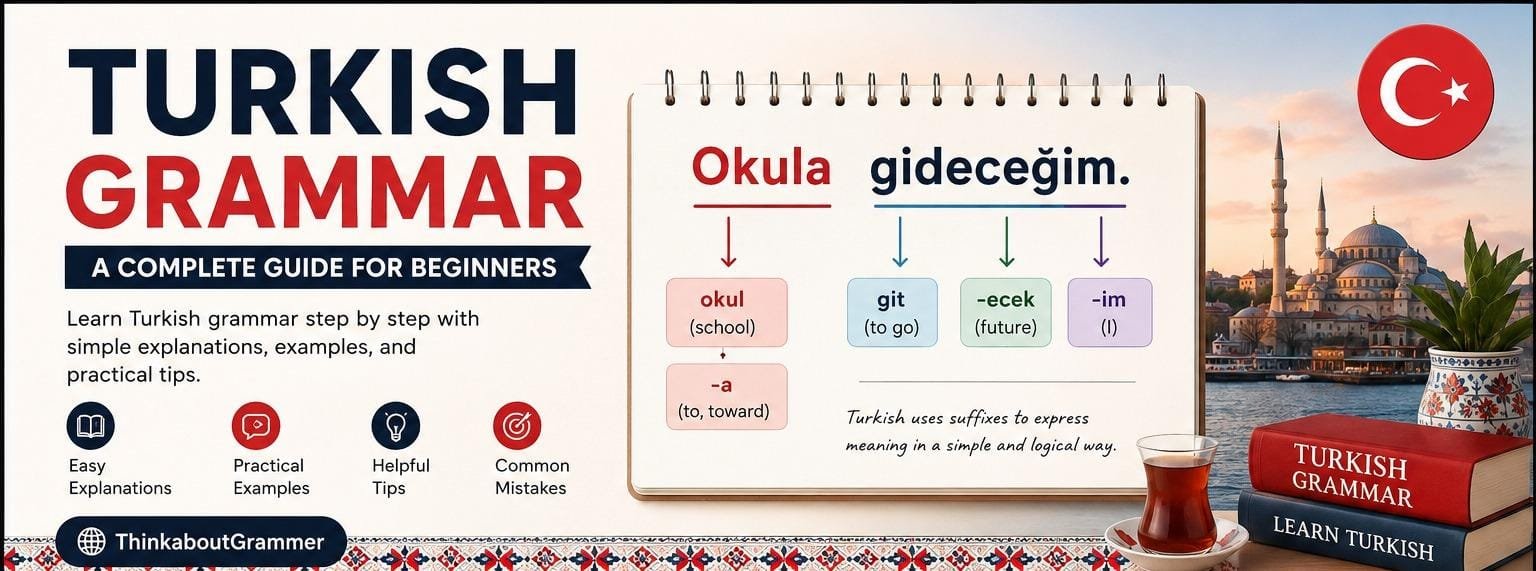
For example, English often expresses grammatical information with separate words:
I will go to school.
Turkish can express several pieces of information through the verb and noun endings:
Okula gideceğim.
Here, okul means “school,” while -a marks direction and gideceğim expresses “I will go.”
This guide breaks Turkish grammar into manageable sections so you can understand how the language works rather than simply memorize isolated rules.
What Makes Turkish Grammar Different?
Turkish belongs to the Turkic language family and has several grammatical features that distinguish it from English. If you’re still learning the fundamentals, understanding what grammar is can help you see how these different parts of a language work together.
The most important characteristics include:
- Agglutinative word formation
- Vowel harmony
- Extensive use of suffixes
- Subject-object-verb (SOV) word order
- Grammatical cases
- No grammatical gender
- Flexible word order for emphasis
- Verbs that carry information about the subject
Turkish Uses Suffixes Extensively
One of the first things you notice in Turkish is that suffixes are extremely important.
Instead of using many separate words, Turkish often attaches grammatical information to a word.
For example:
ev = house
evler = houses
evlerimiz = our houses
evlerimizden = from our houses
The basic word remains recognizable while additional suffixes add meaning.
This is one reason Turkish can produce words that look long to English speakers.
Turkish Does Not Have Grammatical Gender
Unlike languages such as French, German, or Spanish, Turkish nouns are not generally classified as masculine or feminine.
The pronoun o can mean:
- he
- she
- it
The meaning is determined by context.
For example:
O öğretmen.
He/She is a teacher.
You normally need context to know whether o refers to a man or woman.
Turkish Sentence Structure
The basic Turkish sentence structure is usually:
Subject + Object + Verb
English generally follows:
Subject + Verb + Object
Compare these examples:
| English | Turkish |
|---|---|
| I drink tea. | Ben çay içerim. |
| She reads a book. | O kitap okur. |
| We watch a movie. | Biz film izleriz. |
Notice that the verb normally appears at the end of the Turkish sentence.
Subject Pronouns Are Often Omitted
Turkish verbs can indicate who performs an action, so subject pronouns are often unnecessary.
For example:
Gidiyorum.
I am going.
The ending in gidiyorum tells the listener that the subject is “I.”
You can say:
Ben gidiyorum.
This means “I am going” with additional emphasis on I.
So Turkish often omits pronouns when the meaning is already clear.
Turkish Nouns and Grammatical Cases
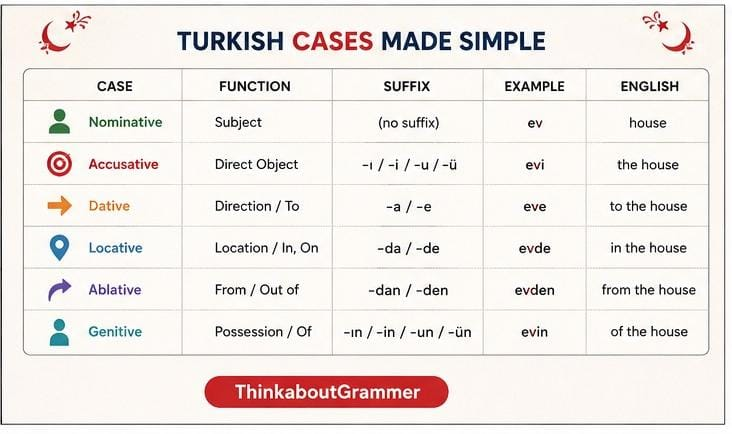
Turkish uses noun cases to show the relationship between a noun and the rest of a sentence.
The major cases are:
| Case | Common Function | Example |
|---|---|---|
| Nominative | Basic subject | ev |
| Accusative | Definite object | evi |
| Dative | Direction/to | eve |
| Locative | Location/in/on/at | evde |
| Ablative | From/out of | evden |
| Genitive | Possession/of | evin |
Understanding these endings is essential for Turkish grammar.
Nominative Case
The nominative is the basic form of a noun.
Ev büyük.
The house is big.
Ev does not have a case suffix here.
Accusative Case
The accusative often marks a specific or definite direct object.
The suffix can appear as:
- -ı
- -i
- -u
- -ü
depending on vowel harmony.
For example:
Kitap okuyorum.
I am reading a book.
Kitabı okuyorum.
I am reading the book.
The second sentence refers to a specific book.
This distinction is important because Turkish does not always mark every object with the accusative suffix.
Dative Case
The dative generally expresses movement toward something or a destination.
Common forms are:
- -a
- -e
Examples:
Okula gidiyorum.
I am going to school.
Eve geldim.
I came home.
Locative Case
The locative generally means “in,” “on,” or “at.”
The common endings are:
- -da
- -de
- -ta
- -te
Examples:
Evdeyim.
I am at home.
Okulda çalışıyor.
He/She is working at school.
Ablative Case
The ablative commonly expresses movement away from something or origin.
The endings include:
- -dan
- -den
- -tan
- -ten
Examples:
Evden çıkıyorum.
I am leaving the house.
İstanbul’dan geldim.
I came from Istanbul.
Turkish Vowel Harmony
Vowel harmony is one of the most important concepts in Turkish grammar.
Turkish suffixes often change their vowels to match the vowel pattern of the word they follow.
The basic Turkish vowels are:
a, e, ı, i, o, ö, u, ü
For many suffixes, the choice depends on the final vowel of the preceding word.
Two-Way Vowel Harmony
Some suffixes use either a or e.
For example, the dative suffix appears as:
- -a
- -e
Examples:
okul → okula
school → to school
ev → eve
house → to the house
The final vowel determines which form is appropriate.
Four-Way Vowel Harmony
Some suffixes have four possible vowel forms:
- ı
- i
- u
- ü
For example:
kitap → kitabı
ev → evi
okul → okulu
gün → günü
You do not need to memorize every individual form separately. Learning the vowel harmony system makes the patterns much easier to predict.
Turkish Personal Pronouns
Here are the basic Turkish personal pronouns:
| Turkish | English |
|---|---|
| ben | I |
| sen | you (singular/informal) |
| o | he/she/it |
| biz | we |
| siz | you (plural/formal) |
| onlar | they |
Sen vs. Siz
Turkish distinguishes between sen and siz.
Sen is generally used with one person in informal situations.
Siz can be used:
- for more than one person
- as a polite or formal form of “you”
For example:
Sen nasılsın?
How are you?
Siz nasılsınız?
How are you? / How are you all?
The appropriate choice depends on the relationship and situation.
Turkish Verbs
Turkish verbs usually appear at the end of a sentence and receive suffixes that express tense, person, negation, and other grammatical information.
The dictionary form of a Turkish verb generally ends in:
- -mak
- -mek
Examples:
gelmek = to come
gitmek = to go
yapmak = to do/make
okumak = to read
yazmak = to write
The ending is removed when conjugating the verb.
For example:
gelmek → geliyorum
This means “I am coming.”
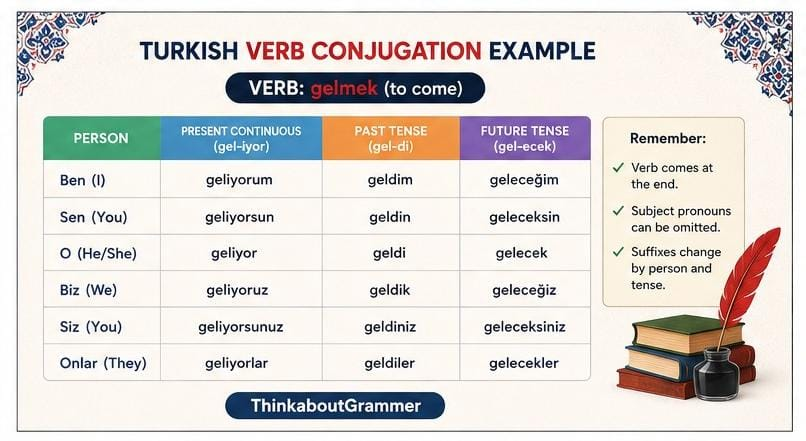
Turkish Present Continuous Tense
The present continuous is commonly formed using -iyor with appropriate vowel and consonant adjustments.
Examples:
geliyorum = I am coming
geliyorsun = you are coming
geliyor = he/she is coming
geliyoruz = we are coming
geliyorsunuz = you are coming
geliyorlar = they are coming
The pattern can be summarized as:
verb stem + -iyor + personal ending
For example:
okumak → okuyorum
to read → I am reading
çalışmak → çalışıyorum
to work → I am working
Why Does -iyor Sometimes Look Different?
Sound changes can occur when suffixes are attached.
For instance:
yemek → yiyorum
The surface form changes rather than simply producing yemiyorum for the positive present continuous.
These changes become easier to recognize with exposure and practice.
Turkish Simple Past Tense
The Turkish definite past commonly uses -di, with vowel and consonant variations such as:
- -dı
- -di
- -du
- -dü
- -tı
- -ti
- -tu
- -tü
Examples:
geldim = I came
gittim = I went
okudum = I read
yazdım = I wrote
The exact suffix depends on vowel harmony and sound rules.
Turkish Future Tense
The future tense commonly uses:
- -ecek
- -acak
Examples:
geleceğim = I will come
gideceğim = I will go
çalışacak = he/she will work
okuyacağız = we will read
The personal ending is added after the future marker.
How to Make Negative Sentences in Turkish
Negation is another area where Turkish differs from English.
For many verbs, the negative marker is:
-ma / -me
For example:
geliyorum = I am coming
gelmiyorum = I am not coming
Similarly:
çalışıyorum = I am working
çalışmıyorum = I am not working
The negative marker is placed between the verb stem and the tense/person endings.
How to Ask Questions in Turkish
Turkish commonly uses the question particle:
- mı
- mi
- mu
- mü
Its vowel changes according to vowel harmony.
Examples:
Geldin mi?
Did you come?
Evde misin?
Are you at home?
Öğrenci misin?
Are you a student?
An important point is that the question particle is generally written separately.
Common Mistake
Incorrect:
Geldinmi?
Correct:
Geldin mi?
The particle is separate, although personal endings can attach to the question particle.
For example:
Öğrenci misin?
Here, misin consists of the question particle plus the second-person ending.
Turkish Plural Forms
The basic plural suffixes are:
- -lar
- -ler
Examples:
kitap → kitaplar
book → books
ev → evler
house → houses
çocuk → çocuklar
child → children
öğrenci → öğrenciler
student → students
Again, vowel harmony determines whether -lar or -ler is used.
A Useful Rule
If the last vowel is one of:
a, ı, o, u
the suffix generally uses -lar.
If the last vowel is one of:
e, i, ö, ü
the suffix generally uses -ler.
Possession in Turkish
Turkish expresses possession using suffixes.
For example:
kitabım = my book
kitabın = your book
kitabı = his/her book
kitabımız = our book
kitabınız = your book
kitapları = their book/books, depending on context
Possessive constructions can initially look complicated because both the possessor and possessed noun can receive endings.
Consider:
Ali’nin kitabı
This means:
Ali’s book
Here:
- Ali’nin marks Ali as the possessor.
- kitabı marks the possessed noun.
Turkish Adjectives
Turkish adjectives normally come before the noun they describe.
Examples:
büyük ev
big house
güzel şehir
beautiful city
eski araba
old car
Unlike English, Turkish adjectives generally do not change form to agree with the noun.
For example:
büyük ev = big house
büyük evler = big houses
The adjective büyük remains unchanged.
Turkish Adverbs
Adverbs modify verbs, adjectives, or other adverbs.
Examples include:
hızlı = fast/quickly
yavaş = slowly
çok = very/a lot
bugün = today
For example:
Hızlı koşuyor.
He/She is running quickly.
Çok güzel.
Very beautiful.
Context determines whether certain words function as adjectives or adverbs.
Turkish Postpositions
English commonly uses prepositions, which usually come before nouns:
in the house
after school
with my friend
Turkish commonly uses postpositions, which appear after the relevant noun or phrase.
Examples include:
sonra = after
önce = before
için = for
gibi = like/as
For example:
okuldan sonra
after school
senin için
for you
çocuk gibi
like a child
This is another important difference between Turkish and English.
Turkish Word Formation
Turkish can create complex words by adding suffixes to a root.
Consider the basic word:
ev = house
You can build:
evler = houses
evlerim = my houses
evlerimde = in my houses
evlerimden = from my houses
This demonstrates why learning Turkish vocabulary together with common suffixes can be more useful than memorizing words completely in isolation.
Think in Word Families
Instead of learning only:
okul = school
also learn related forms such as:
okullar = schools
okulda = at school
okuldan = from school
okula = to school
Seeing these patterns helps you recognize grammatical endings when reading or listening.
Turkish Word Order Can Change for Emphasis
Although subject-object-verb is the basic pattern, Turkish word order can be flexible.
Different arrangements may place emphasis on different parts of a sentence.
For example, a basic sentence might be:
Ali kitabı okudu.
Ali read the book.
Changing the order can shift the focus or emphasis.
This does not mean beginners should freely rearrange every word. It is better to learn the standard structure first and then study emphasis and information structure.
Common Turkish Grammar Mistakes
1. Putting the Verb in the Wrong Position
English speakers may naturally place the verb before the object.
Incorrect beginner-style structure:
Ben okuyorum kitap.
Standard Turkish:
Ben kitap okuyorum.
The verb normally comes at the end.
2. Forgetting Vowel Harmony
Learners sometimes memorize one suffix form and use it everywhere.
For example, the plural suffix is not always -lar.
Correct:
kitaplar
but:
evler
Learning the vowel harmony pattern prevents this mistake.
3. Joining the Question Particle to the Previous Word
Incorrect:
Geldinmi?
Correct:
Geldin mi?
The question particle is normally written separately.
4. Using Subject Pronouns Too Often
There is nothing inherently wrong with using ben, sen, or biz, but Turkish often leaves the subject pronoun out because the verb already provides the necessary information.
Instead of always saying:
Ben gidiyorum.
You can simply say:
Gidiyorum.
5. Confusing Definite and Indefinite Objects
Compare:
Kitap okuyorum.
“I am reading a book.”
Kitabı okuyorum.
“I am reading the book.”
The accusative ending can change the meaning significantly.
A Practical Way to Learn Turkish Grammar
Trying to memorize every Turkish grammar rule at once can become overwhelming. A better approach is to build your knowledge gradually.
Step 1: Learn Basic Sentence Structure
Start with:
Subject + Object + Verb
Practice simple sentences until the pattern feels natural.
Step 2: Learn the Major Suffixes
Focus on the most useful endings first:
- plural
- accusative
- dative
- locative
- ablative
- possessive
- tense endings
- negation
- question forms
Step 3: Master Vowel Harmony
You do not need to understand every sound rule immediately. Start by recognizing the two-way and four-way patterns.
Step 4: Practice Verb Conjugation
Choose a small group of common verbs such as:
- gelmek — to come
- gitmek — to go
- yapmak — to do/make
- almak — to take/buy
- vermek — to give
- okumak — to read
- yazmak — to write
Conjugate them in different tenses.
Step 5: Learn Grammar Through Sentences
Instead of memorizing:
-den = from
learn complete examples:
Evden geliyorum.
I am coming from home.
Then create variations:
Okuldan geliyorum.
I am coming from school.
İstanbul’dan geliyorum.
I am coming from Istanbul.
This connects grammar with real usage.
Building grammar alongside vocabulary is also useful because a larger vocabulary makes it easier to recognize grammatical patterns in real Turkish sentences. You can also learn practical strategies to improve your vocabulary.
A Quick Turkish Grammar Reference
| Grammar Feature | Main Pattern | Example |
|---|---|---|
| Plural | -lar/-ler | evler |
| Accusative | -(y)ı/i/u/ü | kitabı |
| Dative | -(y)a/e | eve |
| Locative | -da/de/ta/te | evde |
| Ablative | -dan/den/tan/ten | evden |
| Negation | -ma/-me | gelmiyorum |
| Question | mı/mi/mu/mü | Geldin mi? |
| Infinitive | -mak/-mek | gelmek |
| Future | -acak/-ecek | gelecek |
| Present continuous | -iyor | geliyor |
| Past | -di and variants | geldi |
| Plural | -lar/-ler | kitaplar |
The exact form of a suffix can change because of vowel harmony and consonant rules, so these are patterns rather than formulas that can be applied blindly.
Turkish Grammar vs. English Grammar
Understanding the biggest differences can make Turkish much easier for English speakers.
| Feature | English | Turkish |
|---|---|---|
| Basic word order | SVO | SOV |
| Grammatical gender | Limited pronoun distinction | No grammatical gender |
| Plural | Usually separate word ending | Suffix |
| Possession | Often separate words | Possessive suffixes |
| Cases | Limited | Several productive noun cases |
| Questions | Auxiliary verbs/question words | Question particle and sentence structure |
| Negation | Often auxiliary verbs | Negative suffixes/particles |
| Prepositions | Common | Postpositions are common |
| Subject pronouns | Frequently required | Often omitted |
| Word formation | Less suffix-heavy | Highly suffix-based |
The key lesson is that Turkish grammar should not always be translated word-for-word into English. Turkish has its own logical system.
English also has grammatical features that may work differently from Turkish, including contractions in grammar. Recognizing these differences can help learners avoid automatically applying English grammar rules when studying Turkish.
Tips for Understanding Long Turkish Words
When you see a long Turkish word, do not immediately assume it is impossible to understand.
Break it into smaller pieces.
For example, imagine a word containing:
root + plural + possessive + case
Rather than memorizing the entire word as one unit, identify each grammatical part.
Ask yourself:
- What is the root?
- Is there a plural suffix?
- Is possession being expressed?
- Is there a case ending?
- Is there a tense or personal ending?
- Has vowel harmony changed the suffix?
This method turns long words into smaller, recognizable pieces.
How to Practice Turkish Grammar Effectively
A good practice routine does not need to be complicated.
Try this sequence:
- Learn one grammar rule.
- Study three or four examples.
- Create your own sentences.
- Change the tense or case.
- Make the sentences negative.
- Turn them into questions.
- Read Turkish sentences and identify the suffixes.
For example, start with:
Evdeyim.
I am at home.
Then practice:
Evde değilim.
I am not at home.
Evde misin?
Are you at home?
This approach helps you see how Turkish grammar operates rather than treating every sentence as a separate memorization task.
Frequently Asked Questions About Turkish Grammar
Is Turkish grammar difficult?
Turkish grammar can seem difficult at first because its structure differs considerably from English. However, many patterns are regular. Once you understand suffixes, vowel harmony, cases, and basic verb conjugation, the language becomes more predictable.
What is the basic word order in Turkish?
The basic Turkish sentence pattern is generally Subject + Object + Verb (SOV). For example, Ben kitap okuyorum literally follows “I book am-reading.” Turkish can change word order for emphasis, but beginners should start with the standard pattern.
Does Turkish have grammatical gender?
No. Turkish nouns do not generally have masculine, feminine, or neuter grammatical genders. The pronoun o can refer to “he,” “she,” or “it,” depending on context.
What is vowel harmony in Turkish?
Vowel harmony is a system in which suffix vowels change according to the vowels in the word they attach to. For example, the plural ending can be -lar or -ler, as in kitaplar and evler.
Why are Turkish words so long?
Turkish is an agglutinative language, meaning grammatical information is often added through suffixes. A single word can therefore contain a root plus several grammatical endings.
Do Turkish verbs always come at the end?
The verb normally appears at the end of a standard Turkish sentence. However, Turkish has flexible word order, and speakers can move elements to change emphasis or focus.
How does Turkish make a sentence negative?
Many Turkish verbs use the negative suffix -ma/-me. For example, geliyorum means “I am coming,” while gelmiyorum means “I am not coming.”
How long does it take to learn Turkish grammar?
There is no single timeline because progress depends on factors such as your previous language experience, study consistency, vocabulary, and exposure to Turkish. Learning the core grammar patterns first can make later study much more efficient.
Conclusion
Understanding Turkish grammar becomes much easier when you stop viewing it as a collection of unrelated rules. Turkish is built around recognizable patterns: suffixes, vowel harmony, grammatical cases, verb conjugation, and subject-object-verb sentence structure.
Start with simple sentences, learn the most common suffixes, and practice how those endings change meaning. Pay particular attention to vowel harmony and the difference between definite and indefinite objects.
Most importantly, study grammar through real sentences. Once you can recognize the root and the suffixes attached to it, even longer Turkish words begin to look far less intimidating.
The practical takeaway is simple: learn the patterns, practice them in context, and build your understanding step by step.