

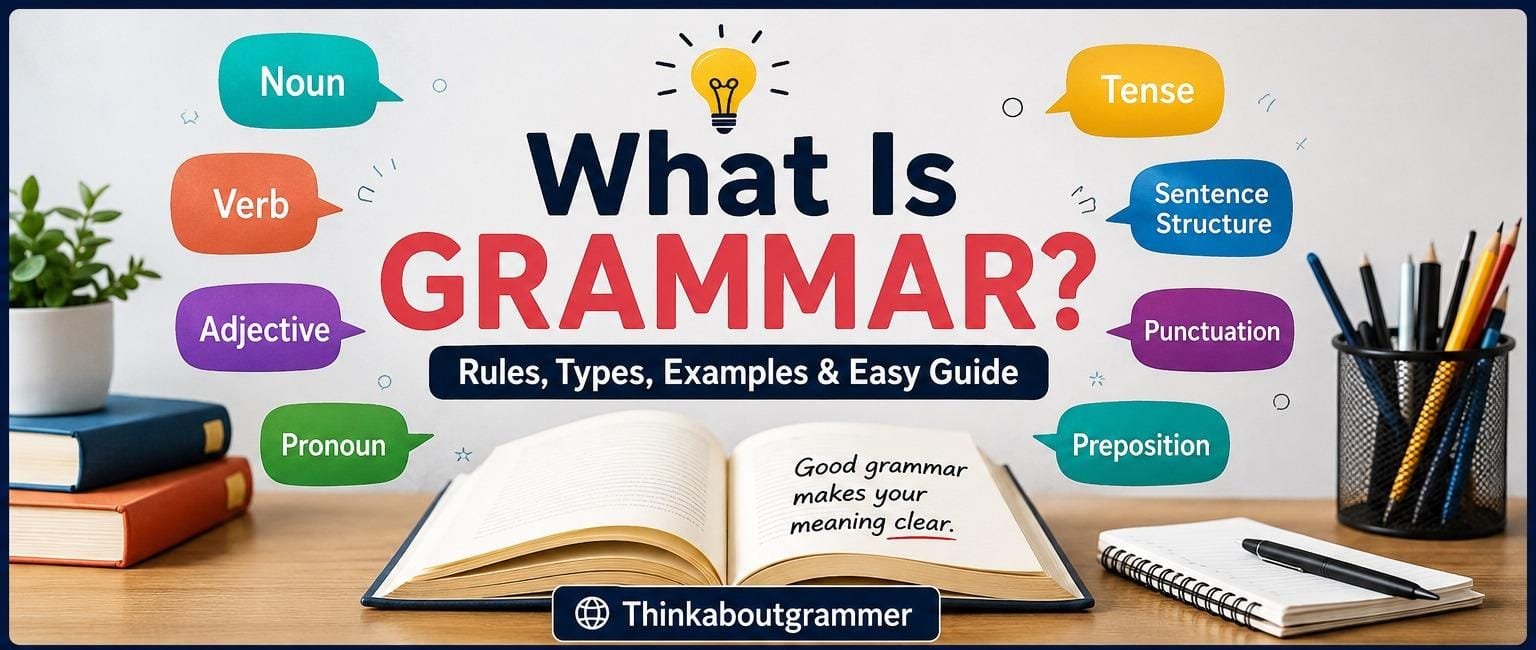
Grammar is the system that helps us put words together so our ideas are clear, logical, and easy to understand. Every time you speak, write a message, read a sentence, or ask a question, you are using grammar—even if you do not consciously think about the rules.
- What Is Grammar?
- Why Is Grammar Important?
- Grammar Helps You Communicate Clearly
- Grammar Improves Your Writing
- Grammar Helps You Sound More Professional
- What Are the Main Parts of Grammar?
- What Is Sentence Structure?
- What Are the Eight Parts of Speech?
- What Are Verb Tenses?
- What Is Subject-Verb Agreement?
- What Are Articles in English Grammar?
- What Are Clauses?
- What Is Punctuation, and How Does It Relate to Grammar?
- Common Grammar Mistakes to Avoid
- Mistake 1: Subject-Verb Agreement
- Mistake 2: Confusing Its and It’s
- Mistake 3: Confusing Your and You’re
- Mistake 4: Sentence Fragments
- Mistake 5: Run-On Sentences
- Mistake 6: Incorrect Apostrophes
- Is Grammar the Same as Spelling?
- Is Grammar the Same as Punctuation?
- How Can You Improve Your Grammar?
- 1. Learn One Concept at a Time
- 2. Read High-Quality English
- 3. Write Regularly
- 4. Read Your Writing Aloud
- 5. Learn From Your Mistakes
- Should You Memorize Every Grammar Rule?
- Grammar Rules vs. Grammar in Real Life
- Why Context Matters in Grammar
- A Simple Way to Think About Grammar
- Quick Grammar Checklist
- Conclusion: What Is Grammar?
But what is grammar, exactly? Is it simply a collection of rules you have to memorize? Not quite. Grammar is better understood as the framework of a language. It explains how words work together, how sentences are formed, how meaning changes, and how we communicate accurately.
Whether you are learning English for school, work, exams, or everyday communication, understanding basic grammar can make writing and speaking much easier.
In this guide, we will explain grammar in simple terms, explore its main parts, look at practical examples, and discuss common mistakes that English learners and native speakers often make.
What Is Grammar?
Grammar is the set of patterns, rules, and structures that determine how words are used and combined to communicate meaning in a language.
In English, grammar covers areas such as:
- Parts of speech
- Sentence structure
- Verb tenses
- Subject-verb agreement
- Pronouns
- Articles
- Prepositions
- Conjunctions
- Modifiers
- Clauses
- Punctuation and sentence boundaries
For example, consider these two sentences:
Correct: She goes to school every day.
Incorrect: She go to school every day.
The meaning of the second sentence can still be understood, but the verb does not agree with the subject. Grammar helps us choose goes because the subject she is third-person singular in the present tense.
Grammar therefore does more than make writing “look correct.” It helps readers and listeners understand exactly what we mean.
Why Is Grammar Important?
Good grammar makes communication clearer and more effective.
Imagine receiving this message:
Yesterday I go store buy some books then meet friend.
You may understand the general idea, but the sentence feels incomplete and confusing.
Now compare it with:
Yesterday, I went to the store to buy some books, and then I met a friend.
The second version clearly shows when something happened, what happened, and what happened next.
Grammar is particularly useful when you need to communicate information precisely.
Grammar Helps You Communicate Clearly
A small grammatical change can sometimes change the meaning of a sentence.
Compare:
- Let’s eat, Grandma.
- Let’s eat Grandma.
The punctuation completely changes the meaning.
The first sentence is an invitation to Grandma. The second sentence creates a very different—and obviously unintended—meaning.
Grammar Improves Your Writing
Strong grammar makes essays, emails, reports, articles, applications, and other forms of writing easier to read.
It helps your reader move naturally from one idea to the next without having to stop and figure out what you meant.
Grammar Helps You Sound More Professional
Grammar is especially important in formal situations.
For example:
Informal:
I wanna know if you can send me the details.
More formal:
I would like to know if you could send me the details.
Neither sentence is necessarily wrong in every situation. The better choice depends on the context, audience, and purpose.
What Are the Main Parts of Grammar?
English grammar contains many different elements, but you can understand the system more easily by breaking it into smaller parts.
1. Parts of Speech
Parts of speech describe the roles words play in sentences.
The traditional categories include:
| Part of Speech | Function | Example |
|---|---|---|
| Noun | Names a person, place, thing, or idea | teacher |
| Pronoun | Replaces a noun | she |
| Verb | Shows an action or state | run |
| Adjective | Describes a noun | bright |
| Adverb | Modifies a verb, adjective, or adverb | quickly |
| Preposition | Shows relationships | under |
| Conjunction | Connects words or ideas | and |
| Interjection | Expresses emotion | wow |
Consider this sentence:
The young student carefully opened the old book.
- student = noun
- young = adjective
- carefully = adverb
- opened = verb
- the = article/determiner
- old = adjective
- book = noun
Understanding parts of speech gives you a foundation for learning more advanced grammar.
What Is Sentence Structure?
Sentence structure refers to how words, phrases, and clauses are arranged to form a complete sentence.
A basic English sentence often follows this pattern:
Subject + Verb + Object
For example:
Maria reads books.
- Maria = subject
- reads = verb
- books = object
However, English sentences can become much more complex.
Maria reads history books because she enjoys learning about the past.
The sentence contains a main clause and a dependent clause.
Simple Sentences
A simple sentence contains one independent clause.
The dog barked.
It can still contain additional information:
The large brown dog barked loudly outside.
Despite its length, it remains a simple sentence because it has one independent clause.
Compound Sentences
A compound sentence joins two independent clauses.
I wanted to go outside, but it started raining.
The two complete ideas are connected by but.
Complex Sentences
A complex sentence contains an independent clause and at least one dependent clause.
I stayed inside because it was raining.
The main idea is:
I stayed inside.
The dependent clause is:
because it was raining.
Compound-Complex Sentences
A compound-complex sentence combines features of compound and complex sentences.
I wanted to go outside, but I stayed home because it was raining.
These sentences can express relationships between several ideas, but they need careful punctuation and structure.
What Are the Eight Parts of Speech?
Many English grammar lessons teach eight traditional parts of speech. These categories help explain how words function.
Nouns
A noun identifies a person, place, thing, or concept.
Examples include:
- teacher
- city
- computer
- happiness
- friendship
Nouns can be singular or plural:
The student is reading.
The students are reading.
Pronouns
Pronouns replace nouns to avoid unnecessary repetition.
Instead of:
Sarah told Sarah’s brother that Sarah would call later.
We can write:
Sarah told her brother that she would call later.
Common pronouns include I, you, he, she, it, we, they, me, him, her, us, and them.
Verbs
Verbs express actions, events, or states.
Examples:
- walk
- think
- write
- become
- seem
- understand
Compare:
James writes every morning.
James wrote yesterday.
The verb changes to show when the action happened.
Adjectives
Adjectives provide information about nouns and pronouns.
She bought a new laptop.
It was a difficult exam.
Words such as new and difficult add descriptive information.
Adverbs
Adverbs can modify verbs, adjectives, or other adverbs.
He ran quickly.
She is very talented.
They arrived quite early.
Not every adverb ends in -ly, so identifying them requires looking at their function rather than simply their spelling.
Prepositions
Prepositions show relationships involving location, time, direction, and other connections.
Examples include:
- in
- on
- under
- beside
- between
- during
- after
- before
For example:
The keys are on the table.
We arrived after lunch.
Conjunctions
Conjunctions connect words, phrases, or clauses.
To learn more about coordinating conjunctions and how FANBOYS grammar helps connect ideas, see our detailed guide to FANBOYS grammar.
Common coordinating conjunctions include:
- for
- and
- nor
- but
- or
- yet
- so
For example:
I wanted tea, but my friend wanted coffee.
Interjections
Interjections are words or short expressions that communicate emotion or reaction.
Examples:
Wow! That was impressive.
Oh! I forgot my notebook.
They are common in conversational and informal English.
What Are Verb Tenses?
Verb tense helps communicate when an action or state occurs.
English has several commonly taught tense forms.
| Tense | Example |
| Simple present | I work every day. |
| Present continuous | I am working now. |
| Simple past | I worked yesterday. |
| Past continuous | I was working at noon. |
| Present perfect | I have worked here before. |
| Past perfect | I had worked there before moving. |
| Simple future | I will work tomorrow. |
Tenses can seem difficult because English uses different structures to express time and aspect.
The best way to learn them is not simply to memorize names. Focus on what the speaker wants to communicate.
For example:
I lived in London for five years.
This can describe a completed period.
But:
I have lived in London for five years.
Usually presents the situation as continuing to the present.
What Is Subject-Verb Agreement?
Subject-verb agreement means that the subject and verb must match appropriately in number and, in some cases, person.
For example:
Correct:
The student works hard.
Incorrect:
The student work hard.
With a plural subject:
Correct:
The students work hard.
Incorrect:
The students works hard.
This becomes especially important with subjects that appear far away from their verbs.
For example:
The collection of old books is valuable.
The subject is collection, not books. Because collection is singular, the singular verb is is appropriate.
What Are Articles in English Grammar?
English commonly uses three articles:
- a
- an
- the
A and an are generally indefinite articles.
I saw a bird.
She ate an apple.
The is the definite article.
I saw a bird. The bird was sitting in a tree.
The first mention introduces a bird. The second sentence refers to a specific bird already identified in the conversation.
Choosing articles correctly can be challenging for English learners because different languages use articles differently—or may not use them at all.
What Are Clauses?
A clause is a group of words containing a subject and a verb.
There are two major types.
Independent Clauses
An independent clause can stand alone as a complete sentence.
She finished her homework.
Dependent Clauses
A dependent clause cannot normally stand alone as a complete sentence.
Because she finished her homework
This leaves the reader expecting more information.
We can combine the two:
She watched television because she finished her homework.
Understanding clauses makes it easier to construct longer and more sophisticated sentences.
What Is Punctuation, and How Does It Relate to Grammar?
Punctuation is not exactly the same thing as grammar, but the two work closely together.
For a closer look at one of the most common punctuation marks, learn more about full stop punctuation and how it helps separate complete thoughts.
Common punctuation marks include:
- Periods
- Commas
- Question marks
- Exclamation marks
- Colons
- Semicolons
- Apostrophes
- Quotation marks
Consider the difference:
After eating the students went outside.
The reader may have to pause to understand the sentence.
A comma can improve clarity:
After eating, the students went outside.
Punctuation should support the structure and meaning of your sentences rather than being added randomly.
Common Grammar Mistakes to Avoid
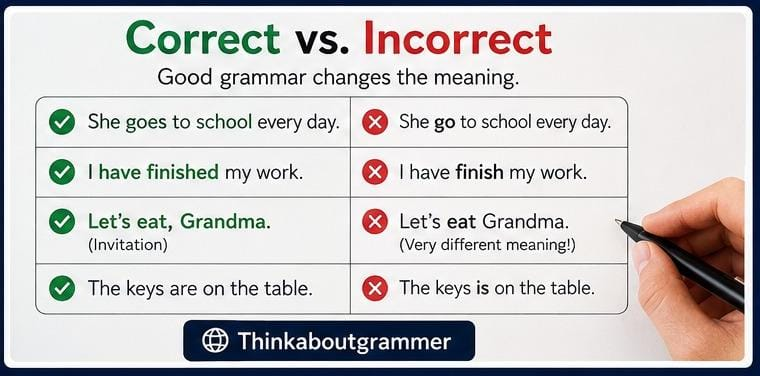
Even experienced writers can make grammatical mistakes. Here are several common ones.
Mistake 1: Subject-Verb Agreement
Incorrect:
She walk to school every morning.
Correct:
She walks to school every morning.
Mistake 2: Confusing Its and It’s
Its is possessive.
The company changed its policy.
It’s means it is or it has.
It’s raining outside.
A simple test is to replace it’s with it is. If the sentence still makes sense, the contraction may be correct.
Understanding contractions grammar can make it easier to recognize when shortened forms such as “it’s,” “you’re,” and “don’t” are used correctly.
Mistake 3: Confusing Your and You’re
Your shows possession:
Is this your book?
You’re means you are:
You’re very helpful.
Mistake 4: Sentence Fragments
A sentence fragment is an incomplete sentence presented as though it were complete.
Fragment:
Because I was tired.
Complete:
I went to bed because I was tired.
Mistake 5: Run-On Sentences
A run-on sentence improperly joins complete thoughts.
Incorrect:
I finished my homework I went outside.
Correct:
I finished my homework, and I went outside.
Or:
I finished my homework. I went outside.
Mistake 6: Incorrect Apostrophes
Apostrophes can show possession or form contractions.
The teacher’s desk.
Don’t forget your book.
Do not automatically add an apostrophe whenever you see a plural noun.
Incorrect:
I bought three apple’s.
Correct:
I bought three apples.
Is Grammar the Same as Spelling?
No. Grammar and spelling are related to language, but they are different.
Spelling concerns how words are written.
recieve ❌
receive ✅
Grammar concerns how words function and combine.
She go to school. ❌
She goes to school. ✅
A sentence can have correct spelling but incorrect grammar:
She go to school every day.
All the words are spelled correctly, but the verb does not agree with the subject.
Likewise, a sentence can have good grammar but a spelling mistake:
She goes to skool every day.
The grammatical structure is fine, but skool is misspelled.
Is Grammar the Same as Punctuation?
Not exactly.
Grammar deals mainly with the structure and use of language, while punctuation provides written signals that help organize and clarify text.
For example:
I know what you mean.
This is grammatically complete.
Changing the punctuation can alter how the sentence is read:
I know what you mean!
The grammar is essentially the same, but the exclamation mark changes the tone.
How Can You Improve Your Grammar?
Grammar improves through a combination of learning, reading, writing, and reviewing.
1. Learn One Concept at a Time
Do not try to memorize every grammar rule at once.
Start with fundamentals such as:
- Parts of speech
- Sentence structure
- Subject-verb agreement
- Basic verb tenses
- Pronouns
- Articles
- Prepositions
- Punctuation
Once these become familiar, move to more advanced topics.
2. Read High-Quality English
Reading well-written books, articles, essays, and reputable publications exposes you to natural sentence structures.
Pay attention to how writers:
- Begin sentences
- Connect ideas
- Use punctuation
- Shift between tenses
- Introduce examples
- Organize paragraphs
3. Write Regularly
Writing gives you an opportunity to apply grammar rather than simply recognize it.
Try writing a short paragraph every day. Then review it for:
- Verb tense
- Subject-verb agreement
- Sentence completeness
- Pronoun use
- Punctuation
- Word choice
4. Read Your Writing Aloud
Reading aloud can reveal problems that are easy to miss when reading silently.
If you repeatedly stumble over a sentence, the structure may need revision.
5. Learn From Your Mistakes
Instead of correcting a mistake and immediately forgetting it, understand why it was wrong.
For example:
He don’t like coffee.
The correction is:
He doesn’t like coffee.
The useful lesson is that doesn’t is used with a third-person singular subject such as he, she, or it.
Should You Memorize Every Grammar Rule?
No.
Grammar rules are useful, but effective communication requires more than memorization.
A learner might memorize the rule that says a sentence needs a subject and verb, yet still struggle to create natural sentences.
A better approach is to combine:
- Rule knowledge
- Examples
- Reading
- Writing practice
- Editing
- Feedback
Think of grammar as a toolkit. You do not need to think about every tool every time you write. With practice, many grammatical choices become more automatic.
Grammar Rules vs. Grammar in Real Life
One interesting thing about English is that formal grammar and everyday language are not always identical.
For example, in casual conversation, people may use structures that would be changed in formal writing.
Consider:
Who did you talk to?
This is extremely common in everyday English.
More formal writing may use:
With whom did you speak?
The second version is grammatically traditional and formal, but it can sound unnatural in ordinary conversation.
This is why good grammar education should consider context, audience, and purpose, not just whether a sentence follows a textbook rule.
Why Context Matters in Grammar
Grammar choices depend partly on what you want to communicate.
Compare:
I have eaten.
I ate.
Both can be grammatical, but they may communicate different relationships between the action and the present situation.
Similarly:
Could you open the window?
and:
Open the window.
Both can communicate a request, but the first is generally more indirect and polite.
Grammar is therefore not simply about avoiding mistakes. It helps speakers and writers communicate time, relationships, emphasis, possibility, politeness, and meaning.
A Simple Way to Think About Grammar
If grammar feels complicated, use this simple idea:
Words are the building materials, and grammar is the system that tells you how to put those materials together.
For example:
birds / sky / fly
These words contain an idea, but they are not organized into a standard sentence.
Grammar helps turn them into:
Birds fly in the sky.
The words provide the content. Grammar gives that content structure.
Quick Grammar Checklist
Before submitting an important piece of writing, ask yourself:
- Does every sentence express a complete idea?
- Do subjects and verbs agree?
- Are the verb tenses consistent?
- Are pronouns clear?
- Have I used articles correctly?
- Are my sentences properly punctuated?
- Have I avoided unnecessary repetition?
- Are any sentences too long or difficult to follow?
- Does the tone match my audience?
- Have I proofread the final version?
You do not need perfect grammar in every casual message. But for academic, professional, or formal writing, this checklist can catch many common problems.
Frequently Asked Questions About What Is Grammar
What is grammar in simple words?
Grammar is the system that explains how words are organized and used to create meaningful sentences. It includes sentence structure, verb forms, word relationships, and many other language patterns.
Why do we need grammar?
We need grammar to communicate ideas clearly and accurately. It helps readers and listeners understand relationships between words, actions, people, time, and ideas.
What are the basic parts of grammar?
Important areas include parts of speech, sentence structure, verb tenses, subject-verb agreement, pronouns, articles, prepositions, conjunctions, clauses, and punctuation.
Is grammar only about rules?
No. Grammar includes rules and patterns, but it is also about how language actually works in different contexts. Formal writing, casual conversation, academic English, and professional communication can use language differently.
What is the difference between grammar and vocabulary?
Vocabulary is the collection of words a person knows or uses. Grammar explains how those words are combined and changed to communicate meaning.
For example, knowing run, yesterday, and park gives you vocabulary. Grammar allows you to form:
I ran in the park yesterday.
Can I improve my grammar without memorizing rules?
Yes. Learning basic rules helps, but reading, writing, listening, and reviewing corrections are also important. Regular exposure to well-structured English can help you recognize grammatical patterns naturally.
Why is English grammar difficult for some learners?
English has many irregular verbs, complex tense structures, articles, prepositions, spelling patterns, and exceptions. Learners may also be influenced by the grammar of their first language.
What should I learn first in English grammar?
Start with sentence structure, nouns, pronouns, verbs, adjectives, adverbs, subject-verb agreement, basic verb tenses, articles, and punctuation. Once these foundations are comfortable, move toward clauses and more advanced structures.
Conclusion: What Is Grammar?
So, what is grammar? In simple terms, grammar is the structure that allows us to arrange words and express ideas clearly.
It covers much more than memorizing rules. Grammar helps us understand how sentences work, how verbs communicate time, how words relate to one another, and how small changes can affect meaning.
You do not need to master every grammatical concept overnight. Start with the fundamentals, study real examples, read regularly, and practice writing. When you understand why a sentence works—not just whether it is right or wrong—grammar becomes much easier to use.
The practical takeaway is simple: learn the patterns, practice them in real sentences, and always consider your audience and purpose. That is how grammar becomes a useful communication skill rather than a list of rules to memorize.