



Introduction
Have you ever been asked to explain a topic clearly without trying to persuade your reader or tell a story? That is where expository writing comes in.
- Introduction
- What Is Expository Writing?
- Key Characteristics of Expository Writing
- 1. A Clear Purpose
- 2. Factual Information
- 3. Logical Organization
- 4. Clear Language
- 5. Supporting Details
- 6. An Objective Tone
- What Are the Main Types of Expository Writing?
- 1. Descriptive Expository Writing
- 2. Process Exposition
- 3. Compare-and-Contrast Exposition
- 4. Cause-and-Effect Exposition
- 5. Classification and Division
- 6. Definition Exposition
- Expository Writing vs. Other Types of Writing
- How to Structure an Expository Essay
- How to Write an Effective Expository Thesis Statement
- How to Write an Expository Paragraph
- Step 1: Choose One Main Point
- Step 2: Write a Topic Sentence
- Step 3: Explain the Point
- Step 4: Add an Example
- Step 5: Connect the Ideas
- Example of Expository Writing
- Incorrect vs. Correct Expository Writing
- Common Expository Writing Mistakes
- Mistake 1: Trying to Cover Too Much
- Mistake 2: Using Unsupported Claims
- Mistake 3: Overusing Complicated Vocabulary
- Mistake 4: Mixing Facts With Unclear Opinions
- Mistake 5: Repeating the Same Point
- Mistake 6: Ignoring Transitions
- How to Make Expository Writing More Engaging
- How to Improve Your Expository Writing
- 1. Understand the Assignment
- 2. Research the Topic
- 3. Define Your Main Point
- 4. Create an Outline
- 5. Draft Without Overediting
- 6. Check Organization
- 7. Check Evidence and Examples
- 8. Edit for Clarity
- 9. Proofread Grammar
- 10. Read It Like a Reader
- Useful Grammar Tips for Expository Writing
- Maintain Consistent Verb Tense
- Avoid Sentence Fragments
- Watch Subject-Verb Agreement
- Use Precise Pronouns
- Expository Writing Checklist
- Conclusion
Expository writing is a form of writing designed to explain, inform, describe, or clarify a subject using facts, evidence, examples, and logical organization. You can find it in school essays, textbooks, instruction manuals, news features, workplace reports, how-to guides, and many online articles.
The challenge is that explaining something well is not always as easy as it sounds. A strong expository piece needs a clear purpose, an organized structure, accurate information, and language that readers can easily understand.
This guide explains what expository writing is, how it works, the different types, how to structure an effective essay, common mistakes to avoid, and practical examples you can use to improve your own writing.
What Is Expository Writing?
Expository writing is writing that explains or provides information about a particular topic.
The writer’s main goal is to help the reader understand something. Unlike persuasive writing, it does not primarily attempt to convince readers to adopt an opinion. Unlike narrative writing, it does not focus mainly on telling a story.
For example:
Topic: How recycling works
An expository paragraph might explain how recyclable materials are collected, sorted, processed, and turned into new products.
The focus is on clear explanation and relevant information, rather than personal opinions.
The Main Purpose of Expository Writing
Most expository writing answers questions such as:
- What is something?
- How does it work?
- Why does something happen?
- What are its characteristics?
- What are the steps involved?
- What are the similarities and differences between two things?
- What caused a particular event?
A useful way to remember its purpose is:
Expository writing helps the reader know and understand.
Key Characteristics of Expository Writing
Although expository texts can take many forms, effective examples usually share several characteristics.
1. A Clear Purpose
The reader should quickly understand what the writing is trying to explain.
If the topic is “How earthquakes occur,” every major point should contribute to that explanation.
2. Factual Information
Expository writing generally relies on information that can be supported by reliable evidence.
For example:
Water changes from a liquid to a gas through evaporation.
This provides information rather than expressing a personal preference.
3. Logical Organization
Ideas should appear in an order that makes sense.
A writer might organize information by:
- Time
- Steps
- Cause and effect
- Comparison
- Importance
- General idea followed by specific examples
4. Clear Language
The goal is not to make writing sound complicated. The goal is to make ideas understandable.
Instead of:
The precipitation phenomenon occurs subsequent to atmospheric condensation.
A clearer version is:
Rain forms when water vapor cools and condenses into droplets.
5. Supporting Details
A strong explanation does more than make a statement. It provides details, examples, facts, definitions, or evidence that help the reader understand the point.
6. An Objective Tone
Expository writing usually maintains an informative tone rather than relying heavily on emotional language.
Compare:
Opinion-based:
Online learning is obviously the best way for students to study.
Expository:
Online learning allows students to access lessons and educational materials through digital platforms.
The second sentence provides information without making an unsupported judgment.
What Are the Main Types of Expository Writing?
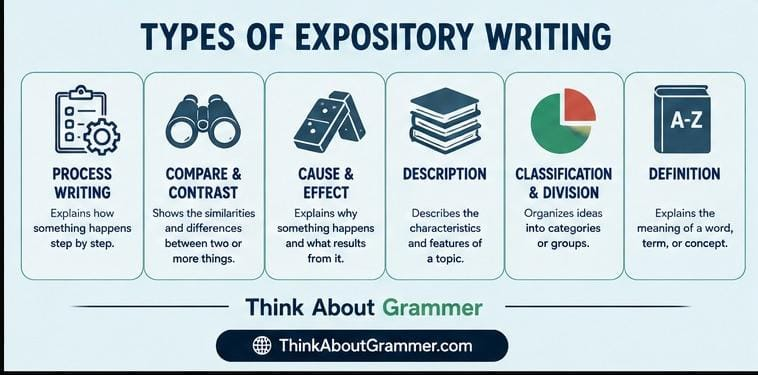
Expository writing is not limited to one format. Several common types are used depending on the writer’s purpose.
1. Descriptive Expository Writing
This type explains the characteristics, features, or qualities of something.
For example, an essay might explain the structure of the human heart, describing its chambers, valves, and major functions.
The purpose is to give the reader a clear understanding of the subject.
2. Process Exposition
Process writing explains how something happens or how to do something.
Examples include:
- How bread is made
- How photosynthesis works
- How to prepare for an examination
- How a bill becomes a law
A process explanation normally follows a logical sequence.
3. Compare-and-Contrast Exposition
This type explains the similarities and differences between two or more subjects.
For example, a writer could compare traditional classrooms with online classrooms.
A useful structure might look like this:
| Traditional Learning | Online Learning |
|---|---|
| Usually takes place in a physical classroom | Takes place through digital platforms |
| Direct face-to-face interaction | Remote communication |
| Fixed classroom environment | Often offers greater location flexibility |
The goal is to explain the comparison rather than simply declare one option superior.
4. Cause-and-Effect Exposition
Cause-and-effect writing explains why something happens and what results from it.
For example:
Excessive rainfall can saturate the soil, increase surface runoff, and contribute to flooding.
The writer connects causes with their consequences.
5. Classification and Division
This form organizes a broad subject into meaningful categories.
For example, an article about renewable energy could divide the topic into:
- Solar energy
- Wind energy
- Hydropower
- Geothermal energy
- Biomass energy
Classification makes complex subjects easier to understand.
6. Definition Exposition
Definition writing explains what a term, concept, object, or idea means.
For example, an article about “photosynthesis” might define the process and then explain how plants use light energy to produce chemical energy.
A good definition goes beyond a dictionary-style sentence by providing context and examples.
Expository Writing vs. Other Types of Writing
Understanding what expository writing is becomes easier when you compare it with other major writing styles.
| Writing Type | Main Purpose | Typical Question |
| Expository | Explain or inform | How or why does it work? |
| Narrative | Tell a story | What happened? |
| Persuasive | Influence an opinion | Why should you agree? |
| Descriptive | Create a detailed impression | What does it look, feel, or sound like? |
These categories can sometimes overlap. For example, an article may explain a subject while using a few descriptive details. However, the primary purpose determines the dominant writing type.
How to Structure an Expository Essay
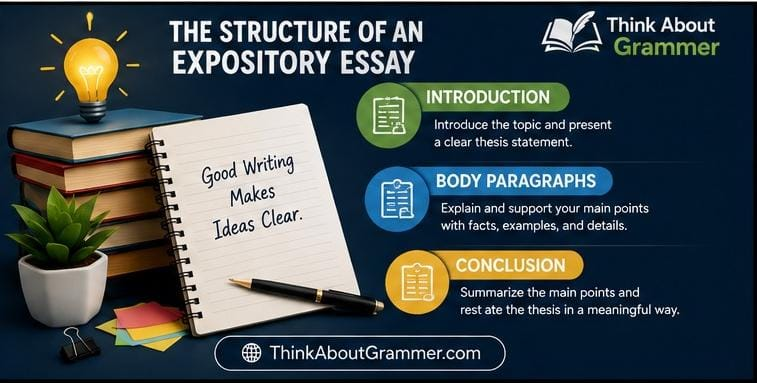
A well-organized expository essay generally contains three major parts:
- Introduction
- Body
- Conclusion
The Introduction
The introduction establishes the topic and tells the reader what the essay will explain.
A strong introduction often includes:
- A relevant opening statement
- Background information
- A clear thesis statement
For example:
Topic: Benefits of regular reading
A thesis might be:
Regular reading can strengthen vocabulary, improve comprehension, and expose readers to new ideas.
This tells the reader exactly what the essay will discuss.
The Body Paragraphs
Each body paragraph should focus on one major idea.
A simple paragraph structure is:
Topic sentence → Explanation → Evidence or example → Connection
For example:
Regular reading can improve vocabulary because readers encounter words in meaningful contexts. When an unfamiliar word appears repeatedly in different sentences, readers can often infer its meaning from surrounding information. Over time, this repeated exposure can expand their working vocabulary.
The paragraph begins with a central point and then develops it.
The Conclusion
The conclusion brings the explanation to a natural close.
It can:
- Restate the central idea in fresh language
- Summarize the main points
- Reinforce the importance of the topic
Avoid introducing a completely new argument in the conclusion.
How to Write an Effective Expository Thesis Statement
The thesis is one of the most important parts of an expository essay.
A strong thesis tells readers what the essay will explain.
Weak Thesis
Exercise is good.
This statement is too broad.
Better Thesis
Regular physical activity supports several aspects of well-being, including cardiovascular fitness, muscle strength, and overall physical function.
The second version gives the reader a clearer idea of what the essay will cover.
A Simple Thesis Formula
For many school assignments, you can use:
Topic + main focus + key points
For example:
Solar energy is an important renewable resource because it can generate electricity without directly producing greenhouse gas emissions during operation.
The exact structure will depend on the assignment, but the principle remains the same: make the focus clear.
How to Write an Expository Paragraph
A useful expository paragraph should have one central idea.
Follow these steps:
Step 1: Choose One Main Point
Do not attempt to explain five unrelated ideas in one paragraph.
Step 2: Write a Topic Sentence
The topic sentence introduces the paragraph’s main point.
Public transportation can reduce the number of individual vehicles on busy roads.
Step 3: Explain the Point
Add information that helps the reader understand the statement.
When more people travel by buses or trains, fewer separate cars may be needed for the same number of passengers.
Step 4: Add an Example
For instance, one bus can carry many passengers who might otherwise travel in separate vehicles.
Step 5: Connect the Ideas
Finish by showing why the information matters or transition naturally to the next point.
Example of Expository Writing
Here is a short original example:
How Sleep Supports Learning
Sleep plays an important role in learning and memory. During sleep, the brain processes and organizes information encountered during the day. This can help students retain new material and prepare for future learning. Adequate sleep may also support attention, making it easier to concentrate during lessons or while studying. For these reasons, sleep is an important part of an effective learning routine.
Notice that the paragraph does not tell a personal story or attempt to persuade the reader through emotional language. Instead, it explains a topic using connected information.
Incorrect vs. Correct Expository Writing
Small changes can make an explanation much clearer.
Example 1: Too Vague
Incorrect:
Technology has changed everything and is really important today.
Improved:
Digital technology has changed how people communicate, access information, and complete many everyday tasks.
The improved version identifies specific areas instead of making a vague claim.
Example 2: Too Much Opinion
Incorrect:
Smartphones are amazing inventions that have completely transformed our lives for the better.
Improved:
Smartphones combine communication, internet access, navigation, photography, and other functions in a single portable device.
The second sentence focuses on explanation rather than personal judgment.
Example 3: Weak Organization
Incorrect:
Recycling reduces waste. Some products use recycled materials. People collect bottles. Recycling can also save resources. Sorting is important.
Improved:
Recycling generally begins with the collection and sorting of recyclable materials. The materials are then processed so they can be used in the manufacture of new products. By returning usable materials to production, recycling can reduce the amount of waste sent to disposal facilities and decrease the need for some new raw materials.
The improved paragraph connects the ideas logically.
Common Expository Writing Mistakes
Even a knowledgeable writer can weaken an explanation through poor organization or unclear language.
Mistake 1: Trying to Cover Too Much
A broad topic can quickly become difficult to manage.
Instead of:
The history of technology
Try:
How personal computers changed workplace communication
A narrower topic gives you room to explain the subject properly.
Mistake 2: Using Unsupported Claims
Avoid presenting questionable statements as facts.
Weak:
Everyone learns better when they study in the morning.
Better:
Some students may prefer morning study sessions because they feel more alert at that time.
The second sentence avoids an absolute claim that cannot reasonably apply to everyone.
Mistake 3: Overusing Complicated Vocabulary
Complex words do not automatically make writing more academic.
Instead of choosing a long word simply because it sounds impressive, choose the word that communicates your meaning most accurately.
Mistake 4: Mixing Facts With Unclear Opinions
Expository writing can become confusing when the writer moves between objective explanation and unsupported personal judgment.
If an opinion is relevant, clearly distinguish it from factual information.
Mistake 5: Repeating the Same Point
Each paragraph should contribute something useful.
If three paragraphs all explain the same idea using slightly different wording, the essay will feel repetitive.
Mistake 6: Ignoring Transitions
Transitions help readers understand how ideas relate.
Useful transitions include:
- For example
- In contrast
- Similarly
- As a result
- Therefore
- In addition
- First
- Next
- Finally
- In other words
Strong grammar and sentence structure are essential for clear writing. For additional practice, explore our SAT Grammar Rules.
How to Make Expository Writing More Engaging
Informative writing does not have to be boring.
Start With a Question
Why does a metal spoon become hot when left in a cup of tea?
This immediately gives the reader something to think about.
Use a Realistic Example
Abstract information becomes easier to understand when connected to a familiar situation.
Explain Technical Terms
If your audience may not know a specialized term, define it when you first use it.
Vary Sentence Structure
Combine shorter sentences with longer explanatory ones.
For example:
Photosynthesis requires light. Plants use that energy to drive chemical reactions that help produce the sugars they need for growth.
The varied structure makes the explanation easier to read.
How to Improve Your Expository Writing
If you want to develop stronger writing skills and organize your ideas more effectively, read The Writing Revolution.
1. Understand the Assignment
Identify exactly what you have been asked to explain.
2. Research the Topic
Use reliable sources and take notes on the information directly relevant to your topic.
3. Define Your Main Point
Ask yourself:
What should the reader understand after reading this?
4. Create an Outline
List the major ideas before writing full paragraphs.
5. Draft Without Overediting
Get your main ideas onto the page first.
6. Check Organization
Make sure every paragraph has a clear purpose and that the ideas appear in a logical order.
7. Check Evidence and Examples
Ask whether important claims have enough explanation or support.
8. Edit for Clarity
Remove unnecessary words and rewrite confusing sentences.
9. Proofread Grammar
Look for:
- Subject-verb agreement
- Verb tense consistency
- Sentence fragments
- Run-on sentences
- Punctuation errors
- Spelling mistakes
- Pronoun problems
10. Read It Like a Reader
Ask:
Could someone unfamiliar with this topic understand my explanation?
If the answer is no, add clarification rather than simply adding more words.
Useful Grammar Tips for Expository Writing
Clear grammar makes explanations easier to follow, and these Professional Email Grammar Rules can help you improve sentence structure and clarity.
Maintain Consistent Verb Tense
Incorrect:
Water boils at 100°C and then changed into steam.
Correct:
Water boils at 100°C and then changes into steam.
Avoid Sentence Fragments
Fragment:
Because the process requires energy.
Complete sentence:
The process requires energy because the molecules must overcome attractive forces.
Watch Subject-Verb Agreement
Incorrect:
The results shows a clear pattern.
Correct:
The results show a clear pattern.
Use Precise Pronouns
Instead of:
When a student reads the material, they should review it carefully.
The sentence can be made more precise depending on the intended meaning:
Students should review the material carefully after reading it.
The best choice depends on context and the audience.
Expository Writing Checklist
Before submitting your work, ask yourself:
- Is my topic clearly defined?
- Is my purpose to explain or inform?
- Does my introduction prepare the reader?
- Is my thesis specific?
- Does each paragraph have one main idea?
- Have I provided useful supporting details?
- Are my examples relevant?
- Is my information accurate?
- Are my ideas logically organized?
- Have I used appropriate transitions?
- Is my language clear and precise?
- Have I avoided unnecessary opinions?
- Have I checked grammar and punctuation?
- Does my conclusion reinforce the main idea?
If you can answer yes to most of these questions, your draft is likely on the right track.
Frequently Asked Questions About Expository Writing
What is expository writing in simple terms?
Expository writing is writing that explains or informs the reader about a topic using clear information, logical organization, examples, and supporting details.
What are the four main types of expository writing?
Common forms include descriptive, process, compare-and-contrast, and cause-and-effect writing, although classification and definition are also widely used.
What is the difference between expository and persuasive writing?
Expository writing primarily explains or informs, while persuasive writing aims to convince the reader to accept a particular position or take an action.
Does expository writing use opinions?
It can include interpretation when appropriate, but its primary focus should remain on explaining information rather than presenting unsupported personal opinions.
What is the basic structure of an expository essay?
A typical expository essay contains an introduction with a thesis, body paragraphs that develop the explanation, and a conclusion that summarizes the central ideas.
Can an expository essay use examples?
Yes. Examples are often useful because they make abstract or complicated information easier for readers to understand.
How long should an expository essay be?
There is no universal length. The appropriate length depends on the assignment, topic, audience, and amount of explanation required.
What makes expository writing effective?
Clear purpose, accurate information, logical organization, relevant evidence, precise language, strong transitions, and easy-to-follow explanations are key qualities.
Conclusion
Expository writing is fundamentally about helping readers understand. Whether you are explaining a scientific process, comparing two ideas, describing how something works, or examining cause and effect, the same principles apply: establish a clear purpose, organize your ideas logically, support important points, and use language that readers can easily follow.
The best expository writing does not try to impress readers with complicated vocabulary or unnecessary detail. Instead, it makes information clear, accurate, organized, and useful.
When you finish your next piece, ask one simple question: Does my writing make the topic easier to understand? If it does, you are using expository writing effectively.