


Learning a new word is much more than memorizing its definition. A student may be able to repeat a dictionary meaning but still struggle to recognize the word in a sentence, explain it in their own words, or understand what it is not.
- What Is the Frayer Model for Vocabulary?
- Why Is the Frayer Model Useful for Vocabulary?
- The Four Parts of a Frayer Model Vocabulary Organizer
- Frayer Model Vocabulary Example
- Frayer Model Example for English Vocabulary
- Frayer Model Vocabulary Example for Science
- Frayer Model Vocabulary Example for Mathematics
- How to Use the Frayer Model in the Classroom
- Step 1: Choose an Important Vocabulary Word
- Step 2: Introduce the Word
- Step 3: Develop the Definition
- Step 4: Identify Characteristics
- Step 5: Generate Examples
- Step 6: Generate Non-Examples
- Step 7: Review the Completed Model
- Frayer Model Vocabulary Template
- How Students Can Make Better Frayer Models
- Frayer Model vs. Simple Definition
- When Should Teachers Use the Frayer Model?
- Frayer Model for English Learners
- Using Sentences With the Frayer Model
- Common Frayer Model Mistakes
- Mistake 1: Copying a Dictionary Definition
- Mistake 2: Giving an Example That Does Not Fit
- Mistake 3: Treating Non-Examples as Opposites
- Mistake 4: Listing Characteristics That Are Too General
- Mistake 5: Filling Every Box Without Thinking
- How to Assess a Frayer Model
- Digital Frayer Model Activities
- Frayer Model Activities Beyond the Worksheet
- Partner Challenge
- Example or Non-Example Game
- Vocabulary Gallery Walk
- Mystery Word
- Vocabulary Comparison
- How the Frayer Model Supports Deeper Vocabulary Learning
- Tips for Getting the Most From Frayer Model Vocabulary Activities
- Conclusion: Making Frayer Model Vocabulary Work
That is where the Frayer Model vocabulary strategy can help.
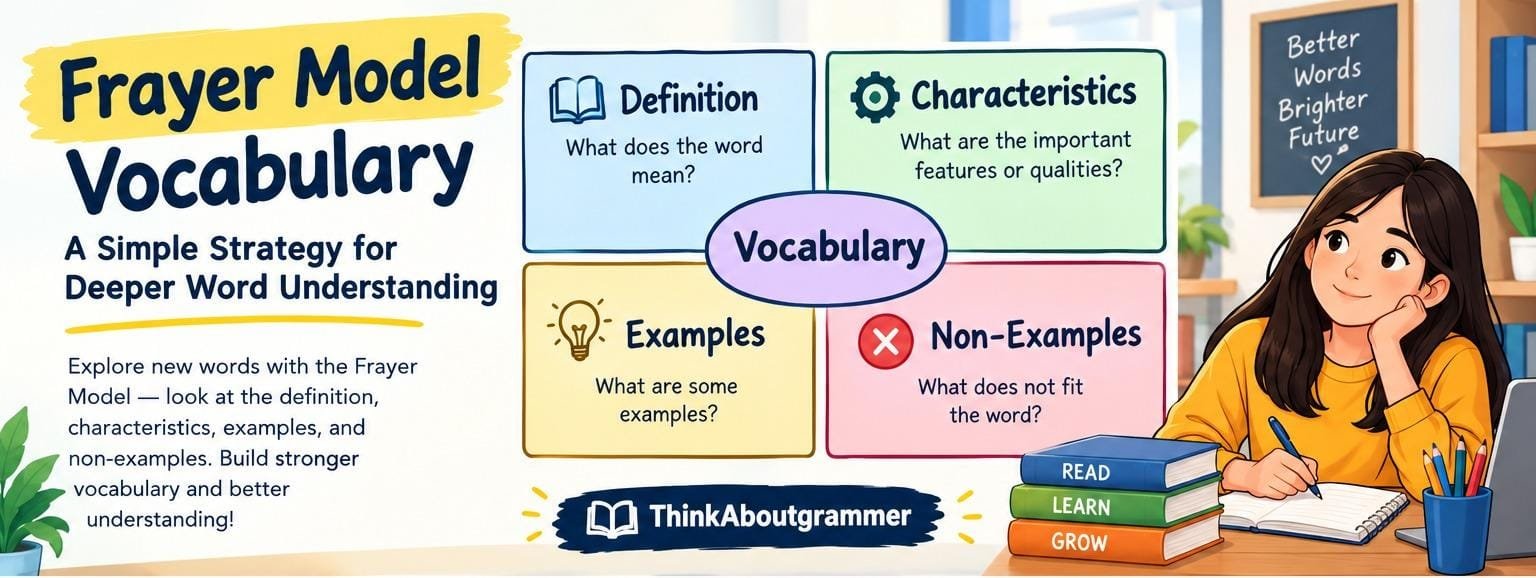
The Frayer Model is a graphic organizer that encourages learners to explore a word from several different angles. Instead of writing only a definition, students typically examine the word’s definition, characteristics, examples, and non-examples. This deeper approach helps connect vocabulary to meaning, context, and prior knowledge. For more strategies, see our guide on how to improve your vocabulary.
Whether you are a teacher looking for an effective vocabulary activity or a student trying to remember difficult academic terms, the Frayer Model provides a simple framework for turning unfamiliar words into meaningful knowledge.
What Is the Frayer Model for Vocabulary?
The Frayer Model is a vocabulary-learning strategy that organizes information about a word into four sections.
The traditional four parts are:
- Definition – What does the word mean?
- Characteristics – What are the important features of the word?
- Examples – What are examples of the word or concept?
- Non-examples – What does not fit the word or concept?
A word is usually placed in the center of a four-box organizer, with each section surrounding it.
For example, consider the vocabulary word “triangle.”
| Frayer Model Section | Example |
|---|---|
| Definition | A polygon with three sides and three angles |
| Characteristics | Three sides, three vertices, three angles |
| Examples | Equilateral triangle, right triangle, isosceles triangle |
| Non-examples | Square, rectangle, circle |
The goal is not simply to memorize “a triangle has three sides.” Students develop a fuller understanding of the concept by identifying its properties and comparing it with things that do not belong.
Why Is the Frayer Model Useful for Vocabulary?
Vocabulary becomes easier to understand when learners make connections between words and concepts.
A traditional vocabulary exercise might ask students to copy a definition five times. While that can provide exposure to a word, it does not necessarily encourage deeper understanding.
The Frayer Model asks students to think.
They have to determine what a word means, identify its important characteristics, find appropriate examples, and distinguish it from non-examples.
This can support several important vocabulary skills, including:
- Understanding word meanings
- Recognizing concepts
- Using words in context
- Making connections to prior knowledge
- Distinguishing related concepts
- Explaining ideas in their own words
- Remembering academic vocabulary
- Developing independent learning habits
The strategy is particularly useful when students encounter unfamiliar subject-specific vocabulary in science, mathematics, social studies, English, and other subjects.
The Four Parts of a Frayer Model Vocabulary Organizer
Understanding each section is important because the four parts serve different purposes.
1. Definition
The definition explains the meaning of the target word or concept.
A strong definition should be clear and appropriate for the learner’s level. Students should not simply copy a complicated dictionary definition they do not understand.
For example:
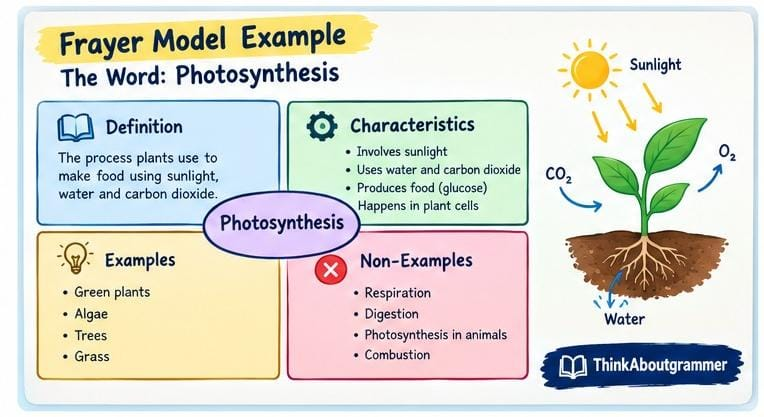
Word: Photosynthesis
Weak definition:
“The physiochemical process by which plants convert light energy into chemical energy.”
Student-friendly definition:
“The process plants use to make food using sunlight, water, and carbon dioxide.”
The second version may be easier for a younger learner to understand and remember.
2. Characteristics
Characteristics describe the important features, qualities, or properties of the word.
For example, consider the word mammal.
Possible characteristics include:
- Has hair or fur
- Breathes air
- Produces milk for its young
- Is a warm-blooded vertebrate
- Most give birth to live young
Characteristics should help students recognize what makes the concept different from other concepts.
3. Examples
Examples show the word or concept in action.
For mammal, examples could include:
- Dog
- Whale
- Elephant
- Bat
- Human
Examples make abstract vocabulary more concrete.
Instead of only knowing a definition, students can connect the concept to familiar things.
4. Non-Examples
Non-examples are things that do not belong to the category.
For mammal, non-examples might include:
- Eagle
- Lizard
- Salmon
- Frog
This section is especially valuable because it encourages students to think about boundaries.
If a student knows that a whale is a mammal but does not understand why, comparing a whale with a fish can lead to deeper thinking.
Frayer Model Vocabulary Example
Let’s look at a complete example using the word “democracy.”
| Section | Response |
|---|---|
| Definition | A system of government in which people have a role in choosing their leaders or making decisions. |
| Characteristics | Citizen participation, elections, representation, voting, political rights |
| Examples | A country holding competitive elections in which citizens choose representatives |
| Non-examples | A dictatorship in which one ruler holds unchecked political power |
The important point is that the organizer is not simply a definition worksheet. Each section contributes another layer of understanding.
Frayer Model Example for English Vocabulary
The strategy works especially well for English language arts vocabulary.
Suppose students are learning the word “reluctant.”
| Section | Example |
|---|---|
| Definition | Unwilling or hesitant to do something |
| Characteristics | Shows hesitation, uncertainty, or unwillingness |
| Examples | A student who hesitates to speak in front of the class |
| Non-examples | Someone who eagerly volunteers for an activity |
Students can also add a sentence:
“Maya was reluctant to answer because she was unsure of her response.”
This extra step connects vocabulary knowledge with actual language use.
Frayer Model Vocabulary Example for Science
Science classes contain many specialized terms that can be difficult to remember.
Consider “evaporation.”
Definition
The process in which a liquid changes into a gas.
Characteristics
- Involves a liquid
- Produces a gas
- Can happen at the surface of a liquid
- Often occurs when molecules gain enough energy to escape
Examples
- Water disappearing from a puddle
- Wet clothes drying
- Water leaving a container over time
Non-examples
- Ice melting
- Water freezing
- Gas changing into a liquid
This example shows why non-examples can be helpful. Students can compare evaporation with other changes of state instead of treating every science term as an isolated fact.
Frayer Model Vocabulary Example for Mathematics
The Frayer Model is not limited to language arts.
It can also be used to teach mathematical concepts.
Consider “prime number.”
| Section | Example |
|---|---|
| Definition | A whole number greater than 1 with exactly two positive factors: 1 and itself |
| Characteristics | Greater than 1; exactly two positive factors |
| Examples | 2, 3, 5, 7, 11 |
| Non-examples | 1, 4, 6, 8, 9 |
Students can then explain why 9 is not prime:
“Nine is not prime because it has more than two positive factors: 1, 3, and 9.”
That explanation demonstrates conceptual understanding rather than simple memorization.
How to Use the Frayer Model in the Classroom
Teachers can introduce the strategy in several ways.
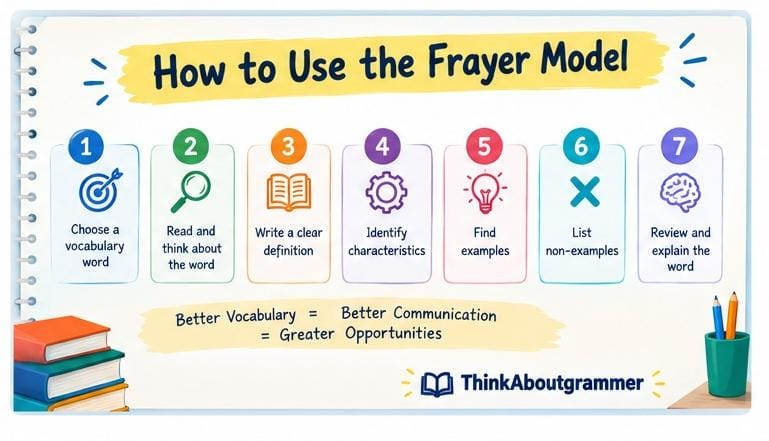
Step 1: Choose an Important Vocabulary Word
Select a word that students genuinely need to understand.
Good choices include:
- Academic vocabulary
- Subject-specific terminology
- Difficult concepts
- Words that appear repeatedly in a text
- Words with easily confused meanings
Avoid filling the organizer with dozens of unimportant words. A smaller number of meaningful terms can produce more useful discussion.
Step 2: Introduce the Word
Write the target word where everyone can see it.
Ask students what they already know.
Questions might include:
- Have you seen this word before?
- What do you think it means?
- Where might you encounter it?
- Does it remind you of another word?
At this stage, incorrect guesses can be useful starting points for discussion.
Step 3: Develop the Definition
Provide or develop a clear definition.
Whenever possible, encourage students to rewrite the meaning in language they understand.
For example:
Word: contrast
Student-friendly meaning: To show how two things are different.
Step 4: Identify Characteristics
Ask students what features are associated with the word.
This may require teacher guidance, especially when the concept is unfamiliar.
Step 5: Generate Examples
Students can brainstorm examples individually, with partners, or as a class.
The teacher can then check whether each example actually fits the concept.
Step 6: Generate Non-Examples
Ask students to identify things that might seem related but do not fit the definition.
This is often where the most interesting discussion happens.
Step 7: Review the Completed Model
Finally, have students explain the word without simply reading the organizer.
They might:
- Explain it to a partner
- Write a sentence
- Create their own example
- Draw a picture
- Compare it with a related word
Frayer Model Vocabulary Template
A simple template can look like this:
| Definition | Characteristics |
|---|---|
| What does the word mean? | What features describe it? |
| Target Word | Target Word |
| Examples | Non-examples |
| What things fit this word? | What things do not fit this word? |
Teachers can print this format, place it in a notebook, or recreate it digitally.
How Students Can Make Better Frayer Models
Not every completed organizer provides the same level of learning.
A student might fill every box but still misunderstand the word.
Here are some ways to improve the quality of responses.
Use Your Own Words
Instead of copying a dictionary definition, explain the concept naturally.
Copied definition:
“A state of being characterized by absence of conflict.”
Student-friendly version:
“A situation where people or groups are not fighting or arguing.”
The second version is more accessible. Learning vocabulary synonyms can also help students recognize related meanings and expand their word knowledge.
Choose Specific Examples
Weak examples are often too vague.
For example, if the word is “transparent,” simply writing “glass” may not always be enough.
A stronger example might be:
“A clear window that allows light to pass through so objects can be seen.”
The example demonstrates the concept.
Make Non-Examples Clearly Different
A non-example should help clarify the boundary of the concept.
For transparent, a brick wall is a much clearer non-example than something that is merely slightly less transparent.
Explain Why
Students should sometimes explain why an example or non-example fits.
For instance:
“A wooden door is a non-example of transparent because you cannot see clearly through it.”
That explanation demonstrates reasoning.
Frayer Model vs. Simple Definition
A simple definition tells you what a word means.
A Frayer Model goes further.
| Simple Vocabulary Study | Frayer Model |
|---|---|
| Definition | Definition |
| May involve memorization | Encourages active thinking |
| Limited context | Multiple connections |
| Usually one piece of information | Four perspectives |
| May not include comparisons | Includes non-examples |
Neither approach is automatically appropriate for every situation. A quick definition may be sufficient for a familiar or straightforward word. The Frayer Model becomes particularly useful when students need deeper conceptual understanding.
When Should Teachers Use the Frayer Model?
The strategy can be useful at different points in a lesson.
Before Reading
Use it to activate prior knowledge.
Students can predict the meaning of important vocabulary before encountering it in a text.
During Reading
Students can stop and build Frayer Models for unfamiliar or important terms.
This is useful when vocabulary is essential to understanding the material.
After Reading
Students can complete the organizer after learning the concept.
This can serve as a review activity.
Before an Assessment
Completed models can become study tools.
Students can quickly review definitions, characteristics, examples, and non-examples instead of rereading an entire chapter.
Frayer Model for English Learners
The strategy can also support students who are developing English vocabulary.
Visuals, sentence examples, and familiar language can make abstract concepts easier to understand.
For example, a teacher teaching “enormous” could include:
- Definition: Very large
- Characteristics: Much bigger than usual
- Example: An enormous elephant
- Non-example: A tiny ant
A drawing or picture can provide an additional connection between the word and its meaning.
Teachers should also be careful not to make definitions unnecessarily complicated. Clear language is often more helpful than formal dictionary wording.
Using Sentences With the Frayer Model
Although the traditional model uses four sections, adding a sentence can make the activity even more practical for language learning.
For example:
Word: “generous”
Definition: Willing to give or share freely.
Characteristics: Giving, helpful, unselfish.
Examples: Donating books, sharing food, helping someone in need.
Non-examples: Refusing to share something that could easily be shared.
Sentence:
“The generous student donated several books to the classroom library.”
The sentence demonstrates how the vocabulary word functions in real communication.
Common Frayer Model Mistakes
The Frayer Model is simple, but students can still misuse it.
Mistake 1: Copying a Dictionary Definition
A complicated definition may technically be correct but still be meaningless to the learner.
Better approach: Rewrite the definition using clear, familiar language.
Mistake 2: Giving an Example That Does Not Fit
Students sometimes choose something associated with a word rather than something that actually demonstrates the concept.
Better approach: Ask, “Does this example meet the definition?”
Mistake 3: Treating Non-Examples as Opposites
A non-example does not always have to be the exact opposite of the target word.
For a category such as mammal, a bird is a non-example even though “bird” is not the opposite of “mammal.”
Mistake 4: Listing Characteristics That Are Too General
Writing “It is a thing” or “It is important” does not help much.
Characteristics should provide meaningful information about the concept.
Mistake 5: Filling Every Box Without Thinking
The purpose is not to complete four empty spaces as quickly as possible.
The real goal is to understand the vocabulary.
How to Assess a Frayer Model
Teachers can use several criteria when evaluating student work.
A simple rubric might look like this:
| Criteria | Strong | Developing | Needs Support |
|---|---|---|---|
| Definition | Accurate and clear | Partly accurate | Incorrect or unclear |
| Characteristics | Relevant and specific | Some relevant details | Mostly unrelated |
| Examples | Accurate and meaningful | Some accurate examples | Mostly incorrect |
| Non-examples | Clearly outside the concept | Some confusion | Does not distinguish concept |
| Explanation | Shows strong understanding | Shows partial understanding | Shows limited understanding |
The purpose of assessment should be to determine whether the student understands the concept, not simply whether all four boxes contain words.
Digital Frayer Model Activities
The strategy can also work in digital learning environments.
Students can create Frayer Models using:
- Digital whiteboards
- Presentation software
- Online graphic organizers
- Learning management systems
- Shared classroom documents
Digital versions offer additional possibilities.
Students can add:
- Images
- Audio pronunciation
- Short videos
- Links to examples
- Sentences
- Drawings
This can make vocabulary study more interactive, particularly when students are learning concepts that are difficult to visualize.
Frayer Model Activities Beyond the Worksheet
The organizer does not have to remain a paper exercise.
Try these activities:
Partner Challenge
Give pairs a vocabulary word and ask one student to describe it without saying the word.
The partner identifies the word using the characteristics and examples.
Example or Non-Example Game
Read different situations aloud.
Students decide whether each situation is an example or non-example and explain why.
Vocabulary Gallery Walk
Place completed Frayer Models around the classroom.
Students walk around, read their classmates’ responses, and add questions or suggestions.
Mystery Word
Provide the characteristics, examples, and non-examples without revealing the word.
Students use the clues to identify the vocabulary term.
Vocabulary Comparison
Create Frayer Models for two related words and compare them.
For example:
- renewable vs. nonrenewable
- fiction vs. nonfiction
- predator vs. prey
- metaphor vs. simile
This can help students distinguish concepts that are easy to confuse.
How the Frayer Model Supports Deeper Vocabulary Learning
The strength of the Frayer Model comes from its multiple perspectives.
When learners study a word through a definition alone, they have one primary connection.
When they examine:
- What it means
- What it looks like
- What belongs to it
- What does not belong to it
- How it can be used
they develop a richer mental representation of the concept.
This is particularly important for abstract academic vocabulary. The strategy can also be useful when studying SAT vocabulary words and other challenging academic terms.
A word such as “justice” cannot be learned as easily as a concrete object such as “pencil.” Students may need definitions, situations, examples, comparisons, and discussion to develop a meaningful understanding.
The Frayer Model provides a structure for that exploration.
Tips for Getting the Most From Frayer Model Vocabulary Activities
Keep these practical principles in mind:
- Choose important words. Focus on vocabulary students actually need.
- Use student-friendly definitions. Clarity matters more than complicated wording.
- Require reasoning. Ask students why something is an example or non-example.
- Use context. Connect vocabulary to sentences, texts, or real situations.
- Encourage discussion. Vocabulary learning does not have to be silent worksheet work.
- Add visuals when appropriate. Pictures can help make abstract concepts concrete.
- Review the models later. Repeated exposure helps reinforce learning.
- Compare related words. This can prevent confusion between similar concepts.
- Accept thoughtful revisions. Students may improve their definitions as their understanding develops.
- Focus on understanding rather than completion. Four filled boxes do not automatically mean a word has been learned.
Frequently Asked Questions About Frayer Model Vocabulary
What is the Frayer Model in vocabulary?
The Frayer Model is a graphic organizer used to develop deeper understanding of vocabulary. It traditionally examines a word through its definition, characteristics, examples, and non-examples.
What are the four parts of the Frayer Model?
The four traditional sections are definition, characteristics, examples, and non-examples. Together, these sections help learners understand both what a concept is and what it is not.
What is an example of a Frayer Model?
For the word “triangle,” the definition could be “a polygon with three sides,” characteristics could include three sides and three angles, examples could include right and equilateral triangles, and non-examples could include squares and circles.
Is the Frayer Model only for vocabulary?
No. Although it is widely used for vocabulary instruction, it can also help students understand mathematical concepts, scientific terms, historical ideas, and other academic concepts.
Why are non-examples important in the Frayer Model?
Non-examples help students understand the boundaries of a concept. They encourage learners to identify why something does not fit instead of simply memorizing what does fit.
Can students use the Frayer Model independently?
Yes. Once students understand how the organizer works, they can use it independently to study unfamiliar vocabulary. Teachers can initially provide guidance and gradually reduce support.
Can the Frayer Model be used with young learners?
Yes. The format can be adapted for different ages. Younger students can use pictures, simple definitions, and familiar examples, while older students can explore complex academic concepts.
How can teachers make Frayer Models more engaging?
Teachers can add pictures, sentences, partner discussions, example-or-non-example games, digital activities, and comparison tasks. The most effective activity is usually one that requires students to explain their reasoning rather than simply fill in boxes.
Conclusion: Making Frayer Model Vocabulary Work
The Frayer Model vocabulary strategy turns vocabulary learning into a deeper thinking activity. Instead of asking students to memorize a definition, it encourages them to explore a word’s meaning, characteristics, examples, and non-examples.
Its flexibility is one of its biggest strengths. A Frayer Model can be used for an English vocabulary word, a science concept, a mathematical term, or a social studies idea. It can also be adapted with sentences, images, comparisons, and classroom discussion.
The practical takeaway is simple: choose an important word, define it clearly, identify its key characteristics, provide strong examples, and deliberately consider what does not fit. When students can explain all four parts in their own words, they are much closer to genuinely understanding the vocabulary.