


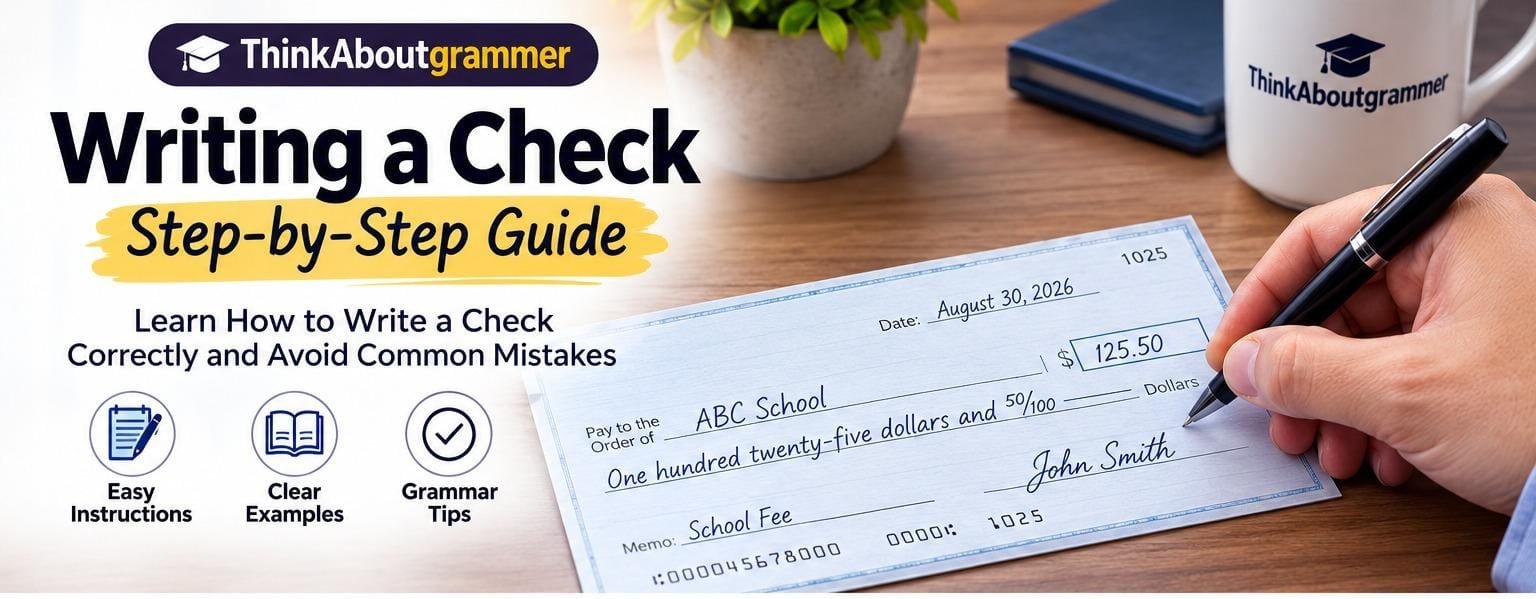
Writing a check may seem old-fashioned in a world of mobile banking, digital wallets, and online payments, but checks are still used for rent, bills, gifts, business payments, and other transactions. If you have never written one before—or you simply want to make sure you are doing it correctly—the process is easier than it looks.
- What Does “Writing a Check” Mean?
- Why Is It Important to Write a Check Correctly?
- What Information Is on a Check?
- How to Write a Check Step by Step
- 1. Write the Date
- 2. Write the Payee’s Name
- 3. Write the Amount in Numbers
- 4. Write the Amount in Words
- 5. Add a Memo if Needed
- 6. Sign the Check
- 7. Review the Check Before Giving It Away
- How to Write a Check for $100
- How to Write Cents on a Check
- What If the Check Amount Has No Cents?
- What If You Make a Mistake While Writing a Check?
- Common Mistakes When Writing a Check
- Writing Different Amounts
- Forgetting the Signature
- Spelling the Payee Incorrectly
- Leaving Important Fields Blank
- Forgetting to Record the Payment
- Can You Write a Check to Yourself?
- Can You Write a Check to “Cash”?
- What Is a Blank Check?
- How Long Does It Take to Write a Check?
- Writing a Check vs. Writing a Cheque
- Is “Writing a Check” Grammatically Correct?
- Writing a Check: Common Grammar Mistakes
- Incorrect: “I am write a check.”
- Incorrect: “I writing a check.”
- Incorrect: “I writed a check.”
- Incorrect: “I have wrote a check.”
- Write, Wrote, Written, or Writing?
- Useful Expressions Related to Checks
- A Simple Check-Writing Checklist
- Tips for Writing Checks More Safely
- Keep Your Checks Secure
- Keep Track of Payments
- Protect Your Account Information
- Check Your Bank Records
- Avoid Signing Checks in Advance
- Frequently Asked Questions About Writing a Check
- Conclusion
Writing a check involves more than putting a name and amount on a piece of paper. You need to enter the date, payee, numerical amount, written amount, and signature accurately. A small mistake can create confusion or cause the check to be rejected or delayed.
This guide explains how to write a check step by step, what each section means, common mistakes to avoid, and some useful grammar points about the phrase “writing a check.”
What Does “Writing a Check” Mean?
“Writing a check” means completing a check so that another person or organization can receive a specified amount of money from your bank account.
For example:
Maria is writing a check to her landlord for the monthly rent.
In this sentence, “writing” is the present participle of the verb “write,” while “a check” is the object.
The phrase can also refer generally to the process of preparing a check for payment.
Check vs. Cheque
The words check and cheque have the same meaning when referring to a bank payment.
- Check is the standard spelling in American English.
- Cheque is commonly used in British English and several other varieties of English.
Examples:
- American English: “I need to write a check.”
- British English: “I need to write a cheque.”
If you are writing for an American audience, “writing a check” is the appropriate spelling.
Why Is It Important to Write a Check Correctly?
A check is a financial document, so accuracy matters. Information on the check tells the bank who should receive the money and how much should be paid.
An incorrectly completed check may create problems such as:
- Confusion about the payment amount
- Difficulty processing the check
- Delays in payment
- Potential fraud concerns
- The need to replace the check
Taking a few extra seconds to review every field can help prevent avoidable errors.
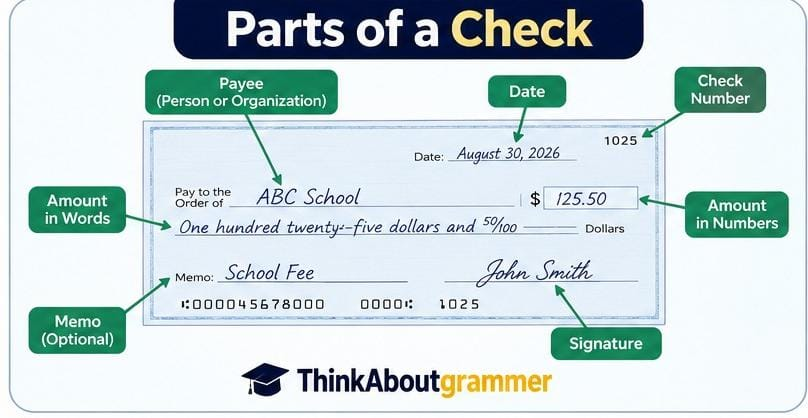
What Information Is on a Check?
Before writing a check, it helps to understand the main sections.
| Check Section | What You Enter |
|---|---|
| Date | The date the check is written |
| Payee | Person or organization receiving the money |
| Numerical amount | Amount written in numbers |
| Written amount | Amount written in words |
| Memo | Optional note explaining the payment |
| Signature | Your authorized signature |
The exact layout can vary between banks, but most personal checks contain these basic elements.
How to Write a Check Step by Step
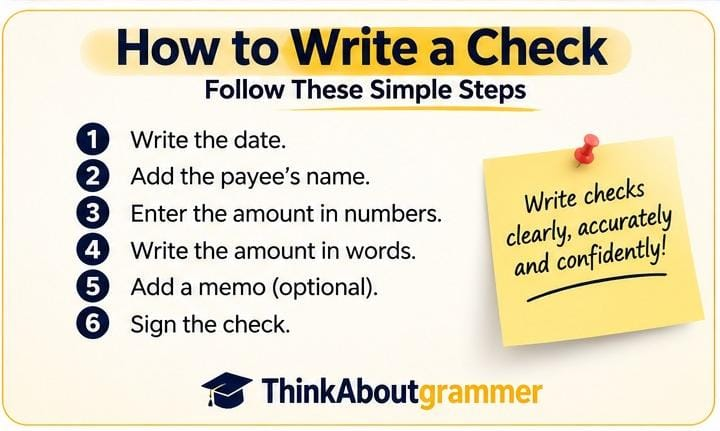
Writing a check is a straightforward process when you handle each section separately.
1. Write the Date
Start by entering the date in the date field.
For example:
August 30, 2026
You may also see formats such as:
08/30/2026
Use the format that is appropriate for your check and situation.
Make sure the date is clear and accurate. If you accidentally enter the wrong date, you may need to void the check and write a new one, depending on the circumstances.
2. Write the Payee’s Name
The payee is the person or organization that should receive the money.
For example, if you are paying your school for a fee, you might write:
ABC School
If you are paying an individual, write that person’s name clearly.
Avoid leaving the payee field blank when possible. A blank payee field can create unnecessary security risks because someone else could potentially complete it.
3. Write the Amount in Numbers
Locate the box or field designed for the numerical amount.
If you need to pay $125.50, write:
$125.50
Make sure the numbers are easy to read and that the decimal point is in the correct position.
For example:
Correct: $125.50
Incorrect: $1,255.00
A misplaced decimal can dramatically change the payment amount.
4. Write the Amount in Words
Next, write the payment amount in words on the line provided.
For $125.50, you could write:
One hundred twenty-five dollars and 50/100
The numerical amount and written amount should agree.
For example:
| Numerical Amount | Written Amount | Result |
|---|---|---|
| $50.00 | Fifty dollars and 00/100 | Correct |
| $125.50 | One hundred twenty-five dollars and 50/100 | Correct |
| $125.50 | One hundred fifty dollars and 50/100 | Incorrect |
This is one of the most important parts of writing a check correctly.
5. Add a Memo if Needed
The memo line is usually optional.
You can use it to explain the purpose of the payment, such as:
- Rent – September
- School fee
- Birthday gift
- Invoice 1045
- Utilities
A memo can help you remember what a payment was for when reviewing your bank records later.
6. Sign the Check
Finally, sign your name in the signature area.
Your signature should generally match the signature your bank has on file. Without a valid signature, the check may not be processed.
Do not sign a blank check and hand it to someone unless you fully understand the risks involved.
7. Review the Check Before Giving It Away
Before handing over or mailing the check, review every important field.
Check that:
- The date is correct.
- The payee’s name is spelled correctly.
- The numerical amount is correct.
- The written amount matches the numerical amount.
- The memo is accurate if you included one.
- Your signature is present.
A quick review can catch mistakes before the check leaves your hands.
How to Write a Check for $100
Suppose you want to pay someone exactly $100.
You would enter:
Numerical amount: $100.00
Written amount: One hundred dollars and 00/100
The two amounts communicate the same payment.
You can use the same basic approach for other amounts.
Examples of Check Amounts
| Amount | Written Form |
|---|---|
| $25.00 | Twenty-five dollars and 00/100 |
| $75.50 | Seventy-five dollars and 50/100 |
| $200.00 | Two hundred dollars and 00/100 |
| $425.75 | Four hundred twenty-five dollars and 75/100 |
| $1,000.00 | One thousand dollars and 00/100 |
When writing amounts in words, accuracy is more important than using a complicated style.
How to Write Cents on a Check
Cents can be written as a fraction of a dollar.
For example, $48.25 can be written as:
Forty-eight dollars and 25/100
Similarly, $19.99 can be written as:
Nineteen dollars and 99/100
The number before the slash represents the cents, while 100 represents one hundred cents in a dollar.
Some check-writing formats use words for the dollar amount and a fraction for the cents.
What If the Check Amount Has No Cents?
For an even-dollar amount such as $300, you can write:
Three hundred dollars and 00/100
Some people instead write a line after the word “dollars” to prevent additional writing.
The important point is that the written amount should clearly communicate the exact value.
What If You Make a Mistake While Writing a Check?
If you make an important mistake, the safest option is usually to avoid trying to alter the check and instead follow your bank’s guidance on voiding it and writing a replacement.
For example, if you accidentally write $850 instead of $580, do not assume that simply crossing out the number will solve the problem.
A practical approach is:
- Stop writing on the incorrect check.
- Mark it as void according to your bank’s recommended procedure.
- Keep a record of the voided check.
- Write a new check with the correct information.
If you are unsure whether a correction is acceptable, contact your bank.
Common Mistakes When Writing a Check
Even a simple check can contain mistakes. Here are some of the most common ones.
Writing Different Amounts
One of the biggest problems is having different numerical and written amounts.
Incorrect:
- Numerical amount: $450.00
- Written amount: Four hundred dollars
These amounts do not match.
Always compare both fields before signing the check.
Forgetting the Signature
A check without the required signature may not be accepted.
Before giving someone the check, look at the signature line.
Spelling the Payee Incorrectly
If the recipient’s name is incorrect, the check may become difficult to deposit or process.
When paying a business, use the correct business name whenever possible.
Leaving Important Fields Blank
Avoid leaving essential fields incomplete, especially the payee and payment amount.
Forgetting to Record the Payment
After writing a check, record the payment in your check register, budgeting system, or other financial records.
This helps you keep track of your available balance.
Can You Write a Check to Yourself?
Yes, in situations where your bank allows it, you can write a check payable to yourself.
For example, the payee field could contain your own name.
People may use this when moving money between accounts or handling certain banking transactions. However, banking procedures can vary, so check with your financial institution if you are unsure.
Can You Write a Check to “Cash”?
A check can potentially be made payable to Cash, but doing so carries additional risk.
A check payable to cash may be usable by whoever possesses it, depending on the circumstances and applicable banking procedures.
For that reason, it is generally safer to identify the intended recipient rather than leaving the payee broadly defined.
What Is a Blank Check?
A blank check is a check that has not been completely filled out.
For example, a check with a signature but no specified amount or payee can create significant security concerns.
You should treat blank signed checks carefully and avoid giving someone a signed check with important fields incomplete.
How Long Does It Take to Write a Check?
Actually completing a check usually takes only a minute or two once you know what each field means.
The process is essentially:
- Date it.
- Name the payee.
- Enter the numerical amount.
- Write the amount in words.
- Add a memo if useful.
- Sign it.
- Review everything.
The time it takes for the recipient to deposit or process the check is a separate matter and depends on the banks and circumstances involved.
Writing a Check vs. Writing a Cheque
If you are learning English, you may wonder why some websites use check while others use cheque.
Both spellings refer to the same financial instrument.
American English
I am writing a check to pay the bill.
British English
I am writing a cheque to pay the bill.
Neither spelling is universally “more correct.” The appropriate choice depends on the variety of English you are using.
Is “Writing a Check” Grammatically Correct?
Yes. “Writing a check” is grammatically correct.
If you want to understand the basic meaning and purpose of grammar, our what is grammar guide explains the fundamentals of English grammar in simple terms.
The word writing comes from the verb write.
The verb changes as follows:
- Write — base form
- Writes — third-person singular present
- Wrote — simple past
- Written — past participle
- Writing — present participle/gerund
Examples:
Base form: I need to write a check.
Present participle: I am writing a check.
Past tense: I wrote a check yesterday.
Past participle: I have written a check.
The phrase “writing a check” can function as part of a verb phrase or as a noun phrase.
“Writing a Check” as an Activity
Consider:
Writing a check is easy once you understand the process.
Here, “writing a check” acts as the subject of the sentence. It refers to the activity itself.
Compare that with:
I am writing a check.
Here, “writing” is part of the present progressive verb phrase “am writing.”
Writing a Check: Common Grammar Mistakes
The phrase itself is simple, but learners sometimes confuse related forms.
Incorrect: “I am write a check.”
Correct: “I am writing a check.”
After am/is/are in the present progressive, use the -ing form.
Incorrect: “I writing a check.”
Correct: “I am writing a check.”
The present progressive requires a form of the verb to be before the -ing form.
For more guidance on using clear and accurate English in formal communication, explore our professional grammar rules guide.
Incorrect: “I writed a check.”
Correct: “I wrote a check.”
The simple past of write is the irregular form wrote, not “writed.”
Incorrect: “I have wrote a check.”
Correct: “I have written a check.”
After have/has, use the past participle written.
Write, Wrote, Written, or Writing?
These four forms are easy to confuse.
| Form | Example |
|---|---|
| Write | I need to write a check. |
| Writes | She writes checks for the business. |
| Wrote | He wrote a check yesterday. |
| Written | We have written the check. |
| Writing | She is writing a check now. |
Remember:
write → wrote → written
The -ing form is:
write → writing
Useful Expressions Related to Checks
If you are learning English, these expressions may also be useful:
- Write a check
- Cash a check
- Deposit a check
- Sign a check
- Mail a check
- Receive a check
- Issue a check
- Void a check
- Endorse a check
- Check the balance
Examples:
Please write a check for the amount shown on the invoice.
She deposited the check at her bank.
He forgot to sign the check.
The company issued a check for the refund.
Good writing also depends on proper punctuation, and our full stop punctuation guide explains when and how to use this important punctuation mark correctly.
A Simple Check-Writing Checklist
Before handing over a check, use this quick checklist:
- Date entered
- Payee named
- Numerical amount entered
- Written amount entered
- Numerical and written amounts match
- Memo added if necessary
- Signature included
- Payment recorded
This simple routine can make writing checks much less stressful.
Tips for Writing Checks More Safely
Checks contain financial information, so basic caution is important.
Keep Your Checks Secure
Store unused checks somewhere safe and avoid leaving them unattended.
Keep Track of Payments
Record checks you write so you know what payments are outstanding.
Protect Your Account Information
Be careful about sharing images or copies of checks because checks can contain sensitive financial information.
Check Your Bank Records
Review your account activity regularly so you can identify payments you recognize and notice anything unexpected.
Avoid Signing Checks in Advance
Do not routinely sign checks before all important information has been completed.
Frequently Asked Questions About Writing a Check
1. How do you write a check correctly?
Enter the date, payee, numerical amount, written amount, optional memo, and signature, then verify that all information matches.
2. How do you write $500 on a check?
Write $500.00 in the numerical amount field and an equivalent written amount such as Five hundred dollars and 00/100.
3. Is “writing a check” grammatically correct?
Yes, “writing a check” is grammatically correct and uses “writing” as the -ing form of the verb “write.”
4. What is the difference between check and cheque?
“Check” is standard American English, while “cheque” is commonly used in British English and several other English varieties.
5. What happens if the written and numerical amounts are different?
A mismatch can cause processing problems, so you should correct the issue by following your bank’s procedures rather than assuming the check will be accepted.
6. Can you write a check to yourself?
Yes, you can generally make a check payable to yourself, although specific banking procedures may vary.
7. Should you write anything on the memo line?
The memo line is usually optional, but adding a short description such as “Rent” or an invoice number can help you keep better records.
8. What is the past tense of “write” when talking about checks?
The simple past is wrote, as in “I wrote a check yesterday,” while the past participle is written, as in “I have written a check.”
Conclusion
Writing a check is a simple process once you understand what belongs in each section. Enter the date, identify the payee, write the amount in numbers and words, add a memo when useful, sign the check, and review everything before handing it over.
From a grammar perspective, remember the basic forms write, wrote, written, and writing. And if you are writing for an American audience, “check” is the standard spelling, while “cheque” is commonly used in British English.
The best practical habit is simple: slow down, check every field, and make sure the payment amount is consistent before signing.