

Grammar is one of those words people hear constantly, especially at school, work, or when learning English. But what does grammar mean, exactly?
- What Does Grammar Mean?
- Why Is Grammar Important?
- How Does Grammar Work?
- What Are the Main Parts of English Grammar?
- 1. Nouns
- 2. Pronouns
- 3. Verbs
- 4. Adjectives
- 5. Adverbs
- 6. Prepositions
- 7. Conjunctions
- 8. Articles
- 9. Interjections
- What Is Sentence Structure?
- What Are Tenses in Grammar?
- What Is Subject-Verb Agreement?
- What Is Punctuation, and Is It Grammar?
- Grammar Rules vs. Grammar Patterns
- Common Grammar Mistakes
- Subject-Verb Agreement Errors
- Sentence Fragments
- Run-On Sentences
- Incorrect Pronoun Use
- Confusing “Your” and “You’re”
- How Can You Improve Your Grammar?
- 1. Read Regularly
- 2. Learn From Your Mistakes
- 3. Practice Writing
- 4. Learn Grammar in Context
- 5. Build Your Vocabulary Alongside Grammar
- Is Grammar the Same in Every Language?
- What Does Grammar Mean in Everyday Communication?
- A Quick Grammar Reference Table
- Conclusion: What Does Grammar Mean?
In simple terms, grammar is the system of rules and patterns that helps us put words together to communicate clear meaning. It explains how words can change, where they belong in a sentence, and how different parts of a sentence work together.
You do not need to memorize hundreds of complicated rules to understand grammar. In fact, you already use grammar every time you speak or write. The goal of studying grammar is to understand those patterns and use them more accurately.
This guide explains what grammar means, why it matters, the major parts of English grammar, common mistakes, and practical ways to improve your skills.
What Does Grammar Mean?
Grammar means the rules and patterns used to form meaningful words, phrases, clauses, and sentences in a language.
For example, consider these two sentences:
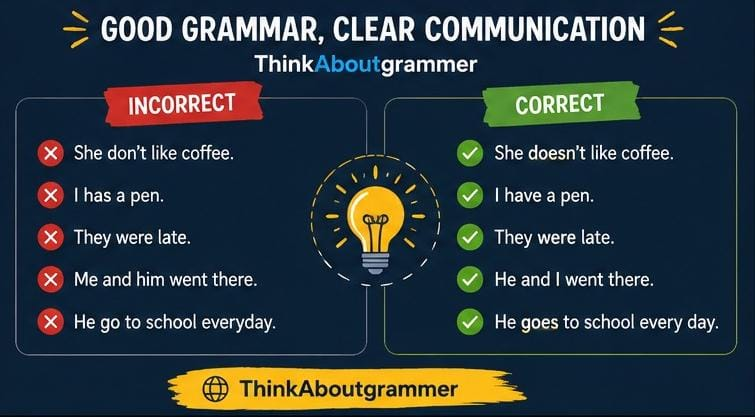
- She walks to school every day. ✓
- She walk to school every day. ✗
Both sentences contain understandable words, but the second sentence does not follow the standard subject-verb agreement pattern in English.
Grammar helps us understand why “She walks” is correct while “She walk” is incorrect in this context.
Grammar covers much more than mistakes, however. It includes how sentences are constructed, how verbs express time, how pronouns work, and how words relate to one another.
For a broader introduction to the subject, read our guide on what is grammar and learn how grammar shapes everyday communication.
Why Is Grammar Important?
Grammar gives language structure. Without recognizable patterns, it would be much harder to communicate precise ideas.
Good grammar can help you:
- Express ideas clearly
- Make sentences easier to understand
- Avoid confusion
- Communicate professionally
- Write stronger essays and articles
- Speak more accurately
- Understand how English sentences work
- Improve your overall language skills
Grammar is especially useful when the meaning of a sentence could change depending on its structure.
Compare:
The teacher praised the student.
with:
The student praised the teacher.
The same basic words are used, but changing their grammatical positions changes who performed the action.
How Does Grammar Work?
Grammar works through patterns that determine how words interact.
A simple English sentence often follows a pattern such as:
Subject + Verb + Object
For example:
Maria + opened + the door.
Here:
- Maria = subject
- opened = verb
- the door = object
Changing the order can make the sentence confusing or change its meaning.
Grammar vs. Vocabulary
Grammar and vocabulary are related, but they are not the same.
Vocabulary refers to the words you know and use.
Grammar refers to how those words are organized and used.
For example, you might know the words:
yesterday, movie, watch, I
Grammar helps you arrange them correctly:
I watched a movie yesterday.
Knowing many words is useful, but knowing how to combine them is equally important.
What Are the Main Parts of English Grammar?
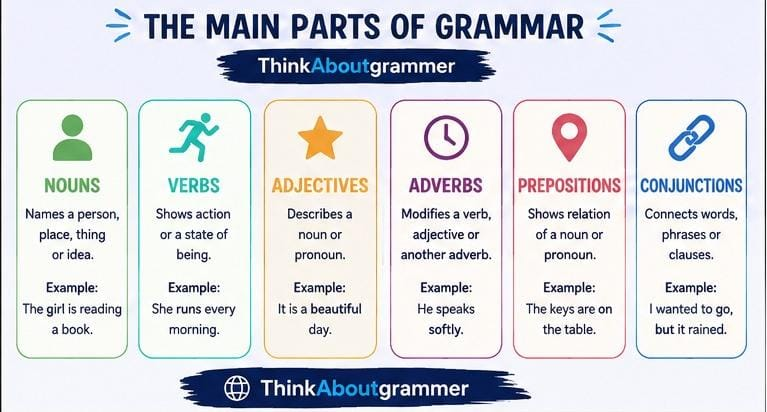
English grammar includes several major areas. Understanding these areas makes the subject much easier to learn.
1. Nouns
A noun names a person, place, thing, or idea.
Examples:
- teacher
- city
- book
- computer
- happiness
- freedom
Example:
The student opened the book.
“Student” and “book” are nouns.
2. Pronouns
A pronoun can replace a noun to avoid unnecessary repetition.
Common pronouns include:
- I
- you
- he
- she
- it
- we
- they
- them
- us
For example:
Sarah finished Sarah’s homework.
This sounds repetitive. We can write:
Sarah finished her homework.
“Her” is a pronoun.
3. Verbs
A verb expresses an action, occurrence, or state.
Examples include:
- run
- write
- think
- become
- know
- seem
Example:
The children played outside.
“Played” is the verb.
4. Adjectives
An adjective describes or modifies a noun or pronoun.
Examples:
- large
- blue
- interesting
- careful
- beautiful
Compare:
I bought a car.
and:
I bought a blue car.
The adjective “blue” gives us additional information about the car.
5. Adverbs
An adverb can modify a verb, adjective, another adverb, or sometimes an entire sentence.
Examples:
- quickly
- carefully
- very
- often
- yesterday
Example:
She carefully opened the package.
“Carefully” tells us how she opened it.
6. Prepositions
A preposition shows a relationship between words, often involving location, time, direction, or connection.
Examples:
- in
- on
- under
- beside
- between
- after
- before
Example:
The keys are on the table.
“On” shows the relationship between the keys and the table.
7. Conjunctions
A conjunction connects words, phrases, or clauses.
Common examples include:
- and
- but
- or
- because
- although
- while
Example:
I wanted to go, but I was tired.
“But” connects two ideas.
If you want to understand coordinating conjunctions in more detail, our FANBOYS grammar guide explains how words such as for, and, nor, but, or, yet, and so connect ideas.
8. Articles
English commonly uses three articles:
- a
- an
- the
Examples:
I saw a dog.
She ate an apple.
The dog was friendly.
Articles may seem small, but using them correctly is an important part of English grammar.
9. Interjections
An interjection expresses a sudden feeling, reaction, or response.
Examples:
- Wow!
- Oh!
- Ouch!
- Hey!
For example:
Wow! That was unexpected.
Interjections are more common in informal communication than formal academic writing.
What Is Sentence Structure?
Sentence structure refers to the way words, phrases, and clauses are arranged to create a sentence.
A sentence needs an appropriate grammatical structure to communicate a complete thought.
Simple Sentences
A simple sentence contains one independent clause.
The baby slept.
Another example:
James studies mathematics.
Compound Sentences
A compound sentence joins two independent clauses, often with a coordinating conjunction.
I finished my homework, and I watched television.
The two complete ideas are:
- I finished my homework.
- I watched television.
Complex Sentences
A complex sentence contains an independent clause and at least one dependent clause.
I stayed home because it was raining.
The clause “I stayed home” can stand alone, while “because it was raining” depends on the main clause.
Compound-Complex Sentences
A compound-complex sentence combines features of compound and complex sentences.
For example:
I finished my homework because I wanted to relax, and my brother cleaned his room.
These structures allow writers to express relationships between ideas more precisely.
What Are Tenses in Grammar?
Verb tense helps show when an action or situation happens.
English commonly uses present, past, and future forms, along with different aspects.
Compare:
I walk to school.
I walked to school.
I will walk to school.
The verb forms tell us when the action occurs.
Present Tense
Used for actions, situations, or facts connected with the present.
She works at the library.
Past Tense
Used for completed actions or situations in the past.
She worked at the library last year.
Future Forms
English uses several structures to talk about the future.
She will work tomorrow.
The choice of tense or construction depends on the meaning and context.
What Is Subject-Verb Agreement?
Subject-verb agreement means that the subject and verb should match appropriately in number and person.
For example:
The dog runs quickly. ✓
The dogs run quickly. ✓
Notice the difference between dog/runs and dogs/run.
A common mistake is:
The students studies every evening. ✗
Correct:
The students study every evening. ✓
Because “students” is plural, the verb should be “study.”
What Is Punctuation, and Is It Grammar?
Punctuation and grammar are closely connected, but they are not exactly the same thing.
Grammar concerns the structure and use of language.
Punctuation uses marks such as periods, commas, question marks, and quotation marks to help organize written language.
One of the most basic punctuation marks is the period, so beginners may also find our guide to full stop punctuation useful for learning when and how to end sentences correctly.
For example:
Let’s eat, Grandma.
and:
Let’s eat Grandma.
The comma changes how the sentence is interpreted.
Common punctuation marks include:
| Mark | Name | Example |
|---|---|---|
| . | Period | I finished my work. |
| , | Comma | After lunch, we left. |
| ? | Question mark | Where are you going? |
| ! | Exclamation mark | What a surprise! |
| : | Colon | Bring three things: a pen, paper, and a ruler. |
| ; | Semicolon | I was tired; I continued working. |
Grammar Rules vs. Grammar Patterns
It is useful to think of grammar as more than a list of strict rules.
Languages develop patterns that speakers recognize naturally.
For example, English speakers generally understand that:
The cat chased the mouse.
follows a familiar subject-verb-object pattern.
Grammar also changes depending on context. The language used in a text message may be different from the language used in a formal report.
For example:
Hey, can you send that over?
is perfectly natural in an informal conversation.
A formal email might instead say:
Could you please send the document when you have a moment?
Both are grammatical, but they suit different situations.
Common Grammar Mistakes
Even experienced writers sometimes make grammar errors. Here are several common ones.
Subject-Verb Agreement Errors
Incorrect:
The team are playing well.
Depending on the variety of English and intended meaning, this can be acceptable in some contexts. In standard American English, however, collective nouns such as “team” are commonly treated as singular:
The team is playing well.
The important point is to maintain consistency with the variety and style of English you are using.
Sentence Fragments
A sentence fragment is an incomplete grammatical unit presented as though it were a complete sentence.
Incorrect:
Because I was tired.
Correct:
I went to bed early because I was tired.
The first example begins with a dependent word, “because,” but does not provide a complete main clause.
Run-On Sentences
A run-on sentence incorrectly joins complete ideas without appropriate punctuation or conjunctions.
Incorrect:
I finished my homework I went outside.
Possible corrections:
I finished my homework, and I went outside.
or:
I finished my homework. I went outside.
Incorrect Pronoun Use
Incorrect:
Me and Daniel went to the store.
In formal standard English, a better version is:
Daniel and I went to the store.
The pronoun “I” functions as part of the subject.
Confusing “Your” and “You’re”
These words sound similar but have different grammatical functions.
Your shows possession:
Is this your book?
You’re is a contraction of “you are”:
You’re very helpful.
How Can You Improve Your Grammar?
Improving grammar does not require studying everything at once. A gradual approach is usually easier.
1. Read Regularly
Read high-quality English from different sources and pay attention to sentence structure.
Notice:
- How sentences begin
- Where commas appear
- How verbs change
- How paragraphs connect ideas
- How writers use different sentence types
2. Learn From Your Mistakes
When you find an error, do not simply correct it and move on.
Ask:
Why was this sentence incorrect?
Understanding the reason helps you recognize the same pattern later.
3. Practice Writing
Write short paragraphs about familiar subjects.
After writing, check:
- Does every sentence express a complete thought?
- Does each subject agree with its verb?
- Are verb tenses consistent?
- Are pronouns clear?
- Is punctuation appropriate?
4. Learn Grammar in Context
Instead of memorizing isolated rules, study examples.
For instance, rather than memorizing a definition of the present perfect tense, compare examples:
I have finished my work.
She has visited London.
Seeing grammar in real sentences makes its function easier to understand.
5. Build Your Vocabulary Alongside Grammar
Grammar becomes more useful when you have enough vocabulary to express different ideas.
Learn new words together with example sentences rather than studying word lists alone.
Is Grammar the Same in Every Language?
No. Different languages have different grammatical systems.
English usually relies heavily on word order to communicate relationships between parts of a sentence.
Other languages may use different systems, including changes to word endings or more flexible word order.
Even within English, grammar can vary between regions and varieties.
For example, British, American, Australian, and other varieties of English may differ in vocabulary, pronunciation, spelling, and some grammatical preferences.
This does not mean one variety is automatically “better.” The appropriate form depends on the audience and context.
What Does Grammar Mean in Everyday Communication?
Grammar is not limited to school exercises or English exams.
You use grammar whenever you:
- Send a message
- Write an email
- Ask a question
- Tell a story
- Give instructions
- Post online
- Write an essay
- Have a conversation
When you say:
Where are you going?
you are using grammatical patterns to form a question.
When you say:
I went to the store yesterday.
you are using grammar to communicate an action that happened in the past.
In other words, grammar is part of everyday communication, whether you consciously think about it or not.
A Quick Grammar Reference Table
| Grammar concept | What it does | Example |
|---|---|---|
| Noun | Names a person, place, thing, or idea | The teacher smiled. |
| Pronoun | Replaces a noun | She smiled. |
| Verb | Shows action or state | She smiled. |
| Adjective | Describes a noun | A bright room |
| Adverb | Modifies a word or phrase | He spoke quietly. |
| Preposition | Shows relationships | The book is under the desk. |
| Conjunction | Connects ideas | I stayed because it rained. |
| Article | Introduces a noun | The car is outside. |
| Tense | Shows time or aspect | She walked home. |
Frequently Asked Questions
What does grammar mean in simple words?
Grammar is the system of patterns and rules that explains how words are formed, arranged, and used to create meaningful sentences.
Why do we need grammar?
We need grammar because it helps us organize language so that other people can understand our meaning clearly and accurately.
What are the basic parts of grammar?
Major areas include nouns, pronouns, verbs, adjectives, adverbs, prepositions, conjunctions, articles, sentence structure, agreement, and verb tenses.
Is grammar only about avoiding mistakes?
No. Grammar is not simply a collection of things you should not do. It describes how language is structured and how different forms create meaning.
What is the difference between grammar and vocabulary?
Vocabulary is the collection of words you know, while grammar explains how those words are organized and used in sentences.
Can grammar change over time?
Yes. Languages naturally change. New expressions develop, existing forms can become less common, and grammatical preferences can vary across communities and periods.
Is punctuation part of grammar?
Punctuation is not identical to grammar, but the two are closely related in writing. Punctuation helps readers understand how written sentences are organized and interpreted.
How can I get better at English grammar?
Read regularly, write often, study grammar in context, review your mistakes, and practice specific areas such as sentence structure, verb tenses, and subject-verb agreement.
Conclusion: What Does Grammar Mean?
So, what does grammar mean? At its core, grammar is the system that helps us organize language and communicate meaning.
It includes much more than correcting mistakes. Grammar covers word classes, sentence structure, verb forms, agreement, relationships between words, and the patterns that make communication understandable.
The best way to learn grammar is to combine explanations with real examples and regular practice. Start with the basics, pay attention to how English is used around you, and gradually build your understanding.
Once grammar stops feeling like a collection of confusing rules and starts looking like a set of useful patterns, English becomes much easier to understand and use.