


When you search for “fix it grammar,” you are probably trying to correct a sentence, check whether something sounds right, or understand why a particular piece of English feels awkward. The good news is that grammar mistakes are often easier to fix once you know what to look for.
- What Does “Fix It Grammar” Mean?
- Why Is Correct Grammar Important?
- How to Fix Grammar Mistakes Step by Step
- 1. Read the Entire Sentence
- 2. Find the Subject and Verb
- 3. Check Subject-Verb Agreement
- 4. Check Verb Tense
- 5. Check Articles
- 6. Check Pronouns
- Common Grammar Mistakes and How to Fix Them
- Punctuation Can Change a Sentence
- Sentence Fragments
- Run-On Sentences
- Commonly Misused Words
- Incorrect vs. Correct Grammar Examples
- How to Make a Correct Sentence Sound More Natural
- How to Fix Grammar in Your Own Writing
- Should You Use a Grammar Checker?
- How to Fix Grammar Without Changing Your Meaning
- A Simple Grammar-Fixing Formula
- Final Grammar Checklist
- Conclusion
Grammar is not simply about memorizing hundreds of rules. It is about making your meaning clear. A sentence can contain the right words but still be confusing because of incorrect verb forms, punctuation, word order, or agreement.
This guide explains how to fix grammar problems step by step. You will learn how to identify common errors, correct them, and make your writing clearer and more natural.
What Does “Fix It Grammar” Mean?
The phrase “fix it grammar” is commonly used when someone wants help correcting the grammar of a sentence or piece of writing.
For example:
- Incorrect: She go to school every day.
- Correct: She goes to school every day.
Here, the problem is subject-verb agreement. The singular subject she requires the verb goes, not go.
Someone searching for “fix it grammar” may also be looking for:
- A grammar correction
- A sentence checker
- Help rewriting an awkward sentence
- An explanation of a grammar mistake
- Correct punctuation
- Better word choice
- Help making English sound more natural
Why Is Correct Grammar Important?
Good grammar helps readers understand exactly what you mean.
Compare these two sentences:
Incorrect: The teacher told the student he was late.
The sentence can be unclear because it is not immediately obvious who was late.
A clearer version might be:
Correct: The teacher told the student that the student was late.
Or, depending on the intended meaning:
Correct: The teacher told the student that he was late for class.
Grammar also makes writing easier to read. Whether you are writing an email, school assignment, article, report, or social media post, clear sentences help your message communicate effectively.
How to Fix Grammar Mistakes Step by Step
If you want to fix grammar yourself, avoid changing words randomly. Use a simple process.
1. Read the Entire Sentence
Start by reading the sentence slowly.
Ask:
- Does the sentence make sense?
- Is the meaning clear?
- Does it sound natural?
- Is anything missing?
For example:
Incorrect: Because I was tired.
This is not necessarily wrong in every context, but by itself it is an incomplete sentence.
Better: I went to bed early because I was tired.
The second version expresses a complete thought.
2. Find the Subject and Verb
Every complete sentence normally needs a subject and a properly formed verb.
Incorrect: The students studying for the test.
Correct: The students are studying for the test.
The original sentence is missing the helping verb are.
3. Check Subject-Verb Agreement
The subject and verb must agree in number.
| Incorrect | Correct |
|---|---|
| He walk to work. | He walks to work. |
| They likes music. | They like music. |
| My friend live here. | My friend lives here. |
| The dogs runs outside. | The dogs run outside. |
A useful trick is to identify whether the subject is singular or plural before checking the verb.
4. Check Verb Tense
Make sure the verb expresses the correct time.
Incorrect: Yesterday, I go to the store.
Correct: Yesterday, I went to the store.
The word yesterday tells us that the action happened in the past, so the past-tense verb went is appropriate.
Another example:
Incorrect: I am living here since 2022.
Correct: I have been living here since 2022.
The second sentence correctly connects an action that began in the past with the present.
5. Check Articles
English commonly uses a, an, and the before nouns.
Incorrect: I bought new phone.
Correct: I bought a new phone.
Use a before a singular countable noun beginning with a consonant sound and an before a vowel sound.
Examples:
- a car
- a university
- an apple
- an hour
Notice that the choice depends on sound, not simply the first letter. We say a university because “university” begins with a /y/ sound.
6. Check Pronouns
Pronouns should clearly refer to the appropriate nouns.
Unclear: When Sarah spoke to Maria, she was upset.
Who was upset—Sarah or Maria?
A clearer sentence could be:
Sarah was upset when she spoke to Maria.
Clear pronoun use prevents confusion.
Common Grammar Mistakes and How to Fix Them
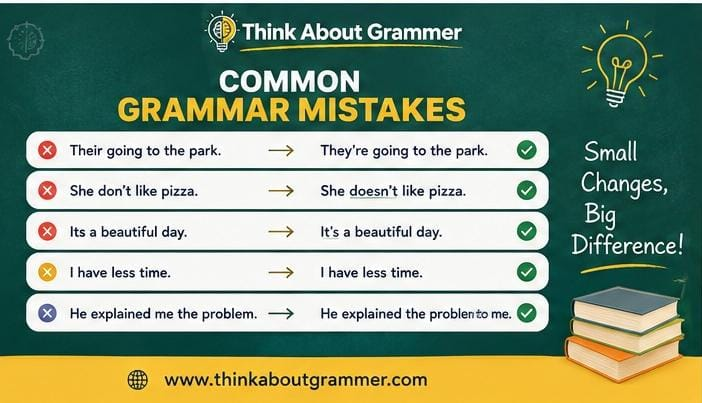
Some errors appear frequently in everyday English. Learning these patterns can make grammar correction much easier. If you are preparing for the SAT, our guide to SAT Grammar Rules can help you understand these common grammar patterns.
Their, There, and They’re
These words sound similar but have different meanings.
- Their = possession
- There = a place or introduces something
- They’re = they are
Examples:
Incorrect: Their going to the park.
Correct: They’re going to the park.
Incorrect: The books are over they’re.
Correct: The books are over there.
Correct: Their books are on the table.
Your and You’re
Your shows possession.
You’re means you are.
Incorrect: Your going to enjoy this movie.
Correct: You’re going to enjoy this movie.
A simple test is to replace you’re with you are.
If the sentence still makes sense, you’re is probably correct.
Its and It’s
Its indicates possession.
It’s means it is or it has.
Incorrect: The company changed it’s policy.
Correct: The company changed its policy.
Correct: It’s a useful tool.
Then and Than
Use than when making comparisons.
Correct: My car is faster than yours.
Use then when discussing time or sequence.
Correct: We ate dinner and then watched a movie.
Affect and Effect
These two words can be confusing.
Affect is commonly used as a verb meaning to influence.
Example: Lack of sleep can affect your concentration.
Effect is commonly used as a noun meaning a result.
Example: Lack of sleep can have a negative effect on concentration.
There are exceptions, but this distinction works in many everyday situations.
Punctuation Can Change a Sentence
Grammar correction is not only about words. Punctuation matters too.
Commas
A comma can separate parts of a sentence and improve readability.
Less clear: After dinner we went for a walk.
Clearer: After dinner, we went for a walk.
Commas are also useful when separating items in a series:
Correct: We bought apples, oranges, bananas, and grapes.
Apostrophes
Apostrophes are commonly used for contractions and possession.
Examples:
- do not → don’t
- cannot → can’t
- Sarah’s book
- the students’ classroom
Be careful not to use an apostrophe simply to make a regular plural.
Incorrect: I bought three apple’s.
Correct: I bought three apples.
Sentence Fragments
A sentence fragment does not express a complete thought.
Fragment: Although I was tired.
The reader expects more information.
Complete: Although I was tired, I finished my homework.
Fragments can sometimes be intentional in creative writing, but formal writing generally benefits from complete sentences.
Run-On Sentences
A run-on sentence incorrectly joins two or more independent clauses.
Incorrect: I finished my homework I went outside.
You can fix it in several ways:
Correct: I finished my homework, and I went outside.
Correct: I finished my homework. I went outside.
Correct: After I finished my homework, I went outside.
The best option depends on the relationship between the ideas.
Commonly Misused Words
Sometimes a sentence is grammatically structured but uses the wrong word.
Fewer vs. Less
Use fewer with countable things.
Correct: There are fewer students today.
Use less with quantities that are not normally counted individually.
Correct: I need less water.
Much vs. Many
Use many with countable nouns.
Correct: She has many books.
Use much with uncountable nouns.
Correct: We don’t have much time.
Who vs. Whom
In everyday English, who is much more common, while whom is mainly used in formal contexts.
Who generally functions as the subject:
Who called you?
Whom can function as an object:
Whom did you invite?
A useful modern approach is to prioritize clarity and natural usage rather than forcing whom into every formal sentence.
Incorrect vs. Correct Grammar Examples
Here are some quick examples you can use for practice:
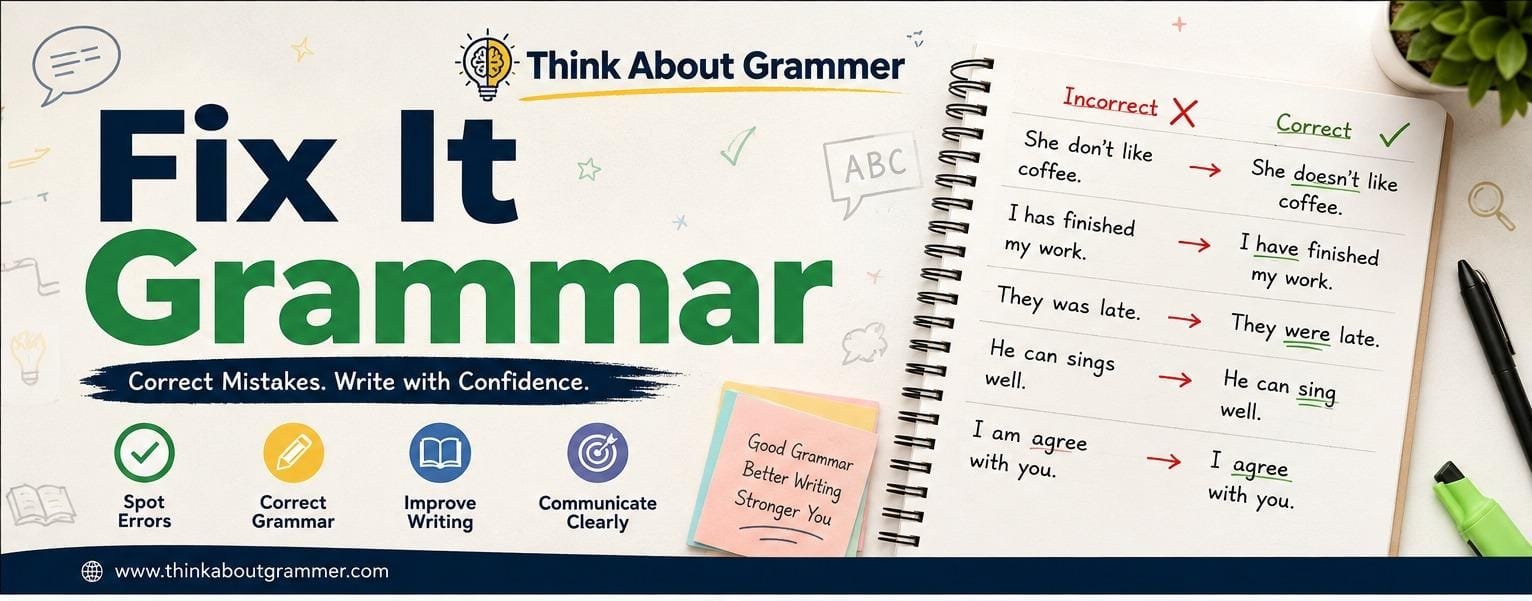
| Incorrect | Correct |
| She don’t like coffee. | She doesn’t like coffee. |
| I has finished my work. | I have finished my work. |
| They was late. | They were late. |
| He can sings well. | He can sing well. |
| We discussed about the problem. | We discussed the problem. |
| I am agree with you. | I agree with you. |
| She is married with a doctor. | She is married to a doctor. |
| He explained me the problem. | He explained the problem to me. |
| I did not went there. | I did not go there. |
| She is good in mathematics. | She is good at mathematics. |
These examples show why grammar correction requires more than simply checking spelling.
How to Make a Correct Sentence Sound More Natural
A sentence can be grammatically acceptable but still sound awkward.
For example:
Awkward: I very much like this new book.
More natural: I really like this new book.
Another example:
Awkward: Please give me an information.
Natural: Please give me some information.
Grammar and natural English are closely connected, but they are not exactly the same thing. A strong editor considers grammar, word choice, sentence flow, and context together.
How to Fix Grammar in Your Own Writing
Use this quick editing checklist whenever you finish writing.
- Read the text slowly.
- Check every sentence for a clear subject and verb.
- Check subject-verb agreement.
- Check verb tense.
- Look for missing or unnecessary articles.
- Check pronouns for clarity.
- Review punctuation.
- Look for sentence fragments.
- Break up long or confusing sentences.
- Read the final version aloud.
Reading aloud can help you notice sentences that feel difficult to follow, especially when you are editing longer pieces of writing.
Should You Use a Grammar Checker?
Grammar-checking tools can be useful, especially when reviewing a long document. They can help identify possible spelling, punctuation, agreement, and sentence-structure problems.
However, a grammar tool should not replace your own judgment.
A suggestion may be technically possible but unsuitable for the context. Always consider:
- What are you trying to say?
- Who will read it?
- Is the suggested correction accurate?
- Does the revised sentence preserve your meaning?
- Does it sound natural?
The best approach is to use automated suggestions as a second layer of review rather than blindly accepting every change.
How to Fix Grammar Without Changing Your Meaning
One important rule of editing is correct the mistake without accidentally changing the message.
Consider:
Original: I didn’t mean that he was responsible.
A careless rewrite could produce:
He was not responsible.
These sentences can communicate different ideas. The first discusses what the speaker intended to mean; the second directly states that he was not responsible.
Good grammar correction preserves the writer’s intended meaning.
A Simple Grammar-Fixing Formula
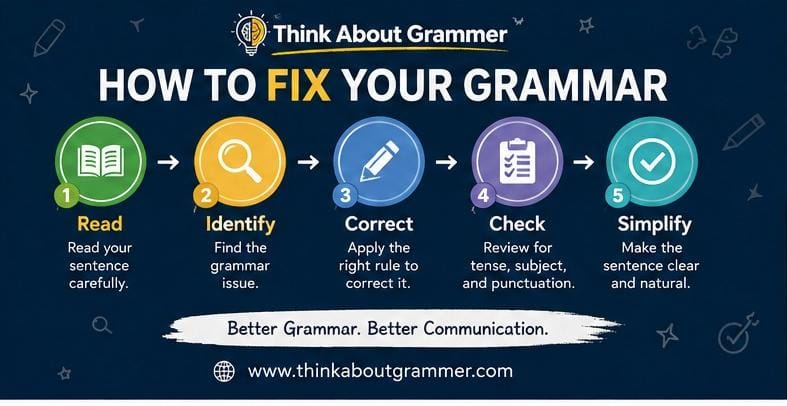
When you are unsure how to correct a sentence, use this five-step formula:
Read → Identify → Correct → Check → Simplify
Read
Understand the whole sentence.
Identify
Find the specific problem.
Correct
Change only what needs to be changed.
Check
Make sure grammar, punctuation, and meaning are correct.
Simplify
If the sentence is unnecessarily complicated, make it easier to understand.
For example:
Original: She don’t know where is the office.
Identify: There are problems with subject-verb agreement and word order.
Correct: She doesn’t know where the office is.
The corrected sentence is both grammatical and natural.
Final Grammar Checklist
Before publishing or submitting your writing, ask yourself:
- Is every sentence complete?
- Do subjects and verbs agree?
- Are verb tenses consistent?
- Are pronouns clear?
- Are articles used correctly?
- Are commonly confused words correct?
- Is punctuation appropriate?
- Are there unnecessary words?
- Can any sentence be made clearer?
- Does the final version preserve the intended meaning?
If you can answer yes to these questions, your writing will already be much stronger.
Frequently Asked Questions
What does “fix it grammar” mean?
“Fix it grammar” generally means correcting grammar, punctuation, word choice, or sentence structure so that a sentence is accurate and clear.
How can I fix my grammar quickly?
Read the sentence carefully, identify the subject and verb, check agreement and tense, review punctuation, and then read the corrected version again.
What is the easiest grammar mistake to fix?
Basic errors involving subject-verb agreement, common contractions, punctuation, and commonly confused words are often among the easiest to identify and correct.
Can a grammar checker fix every mistake?
No. Grammar checkers can identify many potential problems, but they may miss context, intended meaning, or stylistic issues.
How do I know if a sentence is grammatically correct?
Check its sentence structure, subject-verb agreement, verb tense, word choice, punctuation, and overall meaning. Reading it aloud can also reveal awkward construction.
What is the difference between grammar and spelling?
Grammar concerns how words are arranged and used in sentences, while spelling concerns whether individual words are written correctly.
Can a sentence be grammatically correct but sound unnatural?
Yes. A sentence may follow grammatical rules but still use unusual wording or an unnatural structure. Good editing considers both correctness and natural expression.
Should I rewrite an entire sentence to fix one grammar mistake?
Usually, no. First try to correct the specific error while preserving the original meaning. Rewrite more extensively only when the sentence remains unclear or awkward.
Conclusion
Knowing how to fix it grammar problems is less about memorizing every English rule and more about developing a reliable editing process. Start by finding the subject and verb, check agreement and tense, review punctuation and word choice, and make sure the final sentence communicates the intended meaning.
The most useful habit is to slow down and examine each sentence rather than automatically changing words. With regular practice, common grammar mistakes become easier to recognize, and your writing becomes clearer, more natural, and more confident.