

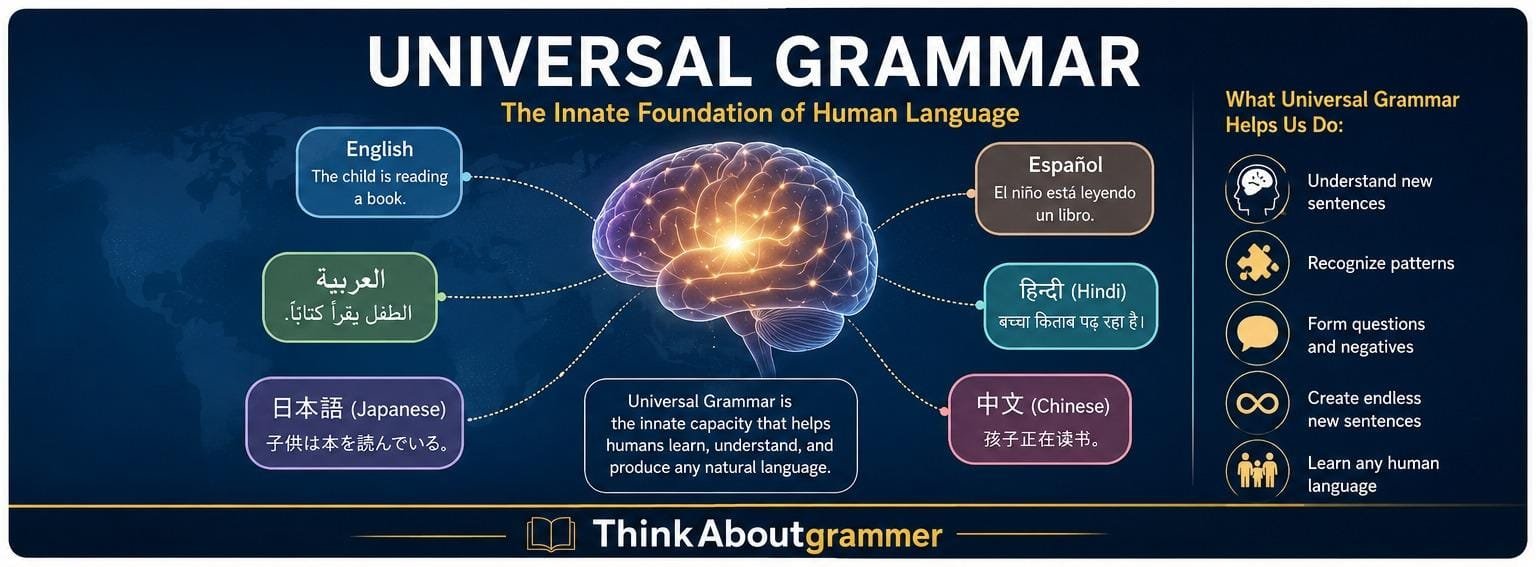
Language seems incredibly diverse. English uses one set of rules, Japanese another, Arabic has its own grammatical patterns, and languages spoken by small communities can work very differently from major world languages.
- What Is Universal Grammar?
- Who Developed the Theory of Universal Grammar?
- Universal Grammar vs. Grammar Rules
- Why Is Universal Grammar Important?
- The Language Acquisition Problem
- What Does “Poverty of the Stimulus” Mean?
- Universal Grammar and Children
- Does Universal Grammar Say Every Language Is the Same?
- What Are Principles and Parameters?
- Examples Used in Discussions of Universal Grammar
- What Is Generative Grammar?
- Universal Grammar and Language Learning
- Is Universal Grammar Proven?
- Arguments Supporting Universal Grammar
- Arguments Against or Challenges to Universal Grammar
- Universal Grammar vs. Usage-Based Approaches
- Why Linguists Compare Different Languages
- Universal Grammar and Syntax
- Universal Grammar and Semantics
- Universal Grammar and Phonology
- Common Misunderstandings About Universal Grammar
- Misunderstanding 1: Every Language Has the Same Grammar
- Misunderstanding 2: Universal Grammar Is a School Grammar Book
- Misunderstanding 3: Chomsky Proved Every Detail of UG
- Misunderstanding 4: Universal Grammar Means Children Do Not Need Exposure to Language
- How Universal Grammar Can Help You Understand Language
- Why Universal Grammar Still Matters
- How to Remember the Concept
- Conclusion: Understanding Universal Grammar
Yet linguists have long asked a fascinating question: Could there be something about grammar that all humans share?
This question is at the heart of universal grammar, a theory most closely associated with linguist Noam Chomsky. The basic idea is that humans may possess an innate capacity that helps them acquire language and understand grammatical structures.
But universal grammar is not simply a list of rules that every language follows. It is a much more complex idea involving human cognition, language acquisition, and the possible structures underlying different languages.
In this guide, we will explain what universal grammar means, where the theory came from, how it relates to language acquisition, what examples linguists have studied, and why the idea remains controversial.
What Is Universal Grammar?
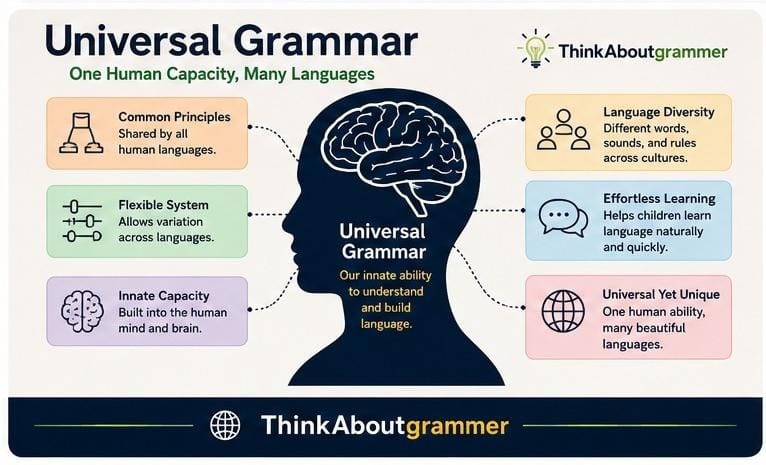
Universal grammar (UG) is a linguistic theory proposing that humans may have an innate capacity or set of constraints that influences how they learn and represent language.
The concept is strongly associated with Noam Chomsky, who argued that children acquire language with remarkable speed despite not receiving explicit instruction about every grammatical rule.
The important point is that universal grammar does not mean that every language has identical grammar.
Before going deeper into universal grammar, it helps to understand the basic concept of what is grammar and how grammar gives structure to language.
Instead, the theory asks whether human languages share underlying properties because the human brain has certain built-in constraints on how language can be represented.
For example, languages differ in:
- Word order
- Verb systems
- Pronunciation
- Case marking
- Agreement
- Sentence structure
- Use of articles
- Grammatical gender
- Question formation
A language can therefore look very different from another while potentially sharing deeper structural principles.
A Simple Definition
In simple terms:
Universal grammar is the idea that humans may have an innate linguistic capacity that places constraints on how natural languages can be learned and structured.
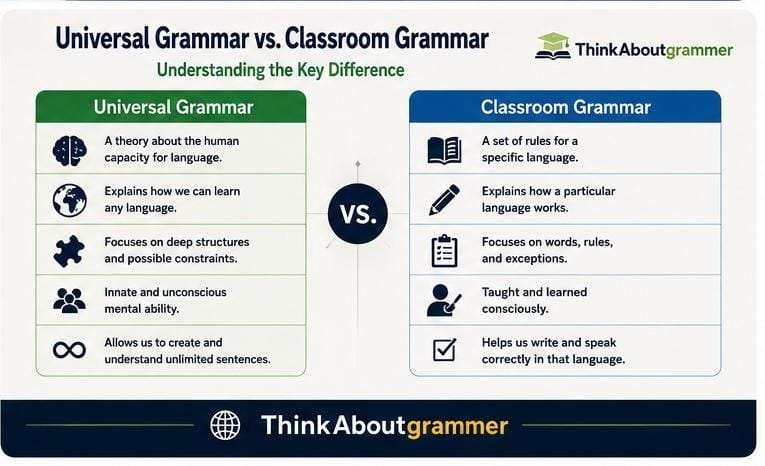
This idea is mainly concerned with human language as a cognitive system, rather than with the grammar rules taught in a classroom.
Who Developed the Theory of Universal Grammar?
The modern theory of universal grammar is primarily associated with Noam Chomsky, whose work transformed the study of language during the twentieth century.
Chomsky challenged approaches that treated language mainly as a collection of learned habits. He emphasized the mental structures involved in producing and understanding sentences.
His work contributed to the development of generative grammar, a family of theories concerned with how speakers can produce and understand an enormous number of sentences from a finite system of linguistic knowledge.
The term “universal grammar” became associated with the proposed principles and constraints underlying this human linguistic capacity.
However, it is important to understand that Chomsky’s theories changed substantially over time. Different stages of his work proposed different ways of describing the relationship between universal principles and individual languages.
Universal Grammar vs. Grammar Rules
One common misunderstanding is that universal grammar means a universal textbook of grammar.
It does not.
Consider these two sentences:
English:
The child opened the door.
Japanese:
The child opened the door.
The basic meaning can be expressed similarly, but the grammatical structures used to express it differ. Japanese generally uses a different basic word-order pattern from English.
This does not necessarily contradict universal grammar.
UG is concerned with possible underlying properties of human language, not with requiring every language to use the same visible sentence patterns.
Classroom Grammar Is Different
When an English teacher explains:
“Put an adjective before the noun.”
that is a rule describing English usage.
Universal grammar, by contrast, asks a broader question:
“What properties of the human mind make it possible for people to acquire a language in the first place?”
That distinction is essential.
Why Is Universal Grammar Important?
Universal grammar became influential because it offered one possible explanation for a major puzzle in language acquisition.
Children do not normally learn language by memorizing every possible sentence.
Instead, they rapidly develop the ability to:
- Create sentences they have never heard before
- Recognize grammatical patterns
- Understand relationships between words
- Form questions
- Negate statements
- Produce increasingly complex sentences
For example, a child who learns:
The dog is sleeping.
can eventually produce:
The small dog that lives next door is sleeping outside.
The child has not memorized every possible sentence. They have developed a system that allows them to construct new sentences.
This creative aspect of language became an important part of generative linguistic theory.
The Language Acquisition Problem
One of the central arguments historically associated with universal grammar concerns the problem of language acquisition.
Children receive imperfect and incomplete linguistic input. Adults may make mistakes, sentences may be interrupted, and children are not explicitly taught every grammatical possibility.
Nevertheless, children typically develop sophisticated grammatical knowledge.
This raises a question:
How do children determine which grammatical structures are possible?
Chomsky and other generative linguists argued that the answer may involve more than imitation and general learning alone.
The proposed innate component of language could help narrow the possibilities that a child must consider.
This argument is sometimes discussed in connection with the poverty of the stimulus.
What Does “Poverty of the Stimulus” Mean?
The phrase poverty of the stimulus refers to the idea that the linguistic input available to children may not contain enough direct information to explain all aspects of the grammatical knowledge they eventually acquire through experience alone.
Imagine a child hearing thousands of sentences.
Those sentences provide useful information, but they do not explicitly say:
- Which sentence structures are impossible
- Why certain word combinations are unacceptable
- Which grammatical relationships apply in unfamiliar sentences
The question is therefore how children arrive at such knowledge.
Supporters of UG have argued that innate linguistic constraints may help solve this problem.
However, the poverty-of-the-stimulus argument is heavily debated. Other researchers have proposed that general learning abilities, patterns in language input, memory, statistical learning, social interaction, and other factors can contribute substantially to language acquisition.
Universal Grammar and Children
One reason universal grammar has attracted so much attention is the speed and consistency of childhood language development.
Children are not usually given formal grammar lessons before they can speak.
They hear language from people around them and gradually develop an internal system.
For example, an English-speaking child might eventually produce:
She walked home.
rather than simply repeating sentences previously heard.
They can also make errors that reveal that they are actively constructing grammatical rules.
Example of Rule Formation
A child might say:
I goed there.
The standard adult form is:
I went there.
Although “goed” is incorrect in standard English, it is interesting from a language-development perspective. The child appears to have recognized a pattern involving regular past-tense formation and applied it to an irregular verb.
This illustrates that children are not merely copying adults word for word.
Does Universal Grammar Say Every Language Is the Same?
No.
This is probably the most important misconception to avoid.
Languages vary enormously.
For example, languages may differ in whether they:
- Commonly place verbs before or after objects
- Mark nouns for grammatical case
- Use articles
- Mark grammatical gender
- Require subjects to be explicitly stated
- Use extensive verb inflection
- Place adjectives before or after nouns
These differences are central to linguistic diversity.
Universal grammar, in its traditional form, attempts to explain how such diversity can exist within a human language capacity.
One way to think about it is:
Human language ability → possible structural constraints → individual language systems
The exact nature of those constraints is where much of the theoretical debate lies.
What Are Principles and Parameters?
An important concept in earlier versions of generative theory is the principles-and-parameters approach.
The basic idea was that human languages could share certain general principles while differing according to particular settings, or parameters.
A simplified analogy is a computer system with common basic architecture but different configuration settings.
For example:
- Shared architecture: possible properties of human language
- Different settings: properties that distinguish one language from another
This framework was influential because it attempted to explain both linguistic universality and linguistic variation.
However, the details of parameter theory have been revised and debated considerably within linguistics.
Examples Used in Discussions of Universal Grammar
There is no single simple example that proves universal grammar. Instead, linguists have examined many properties of language when considering whether humans share deep grammatical constraints.
1. Sentence Structure
Compare:
The boy kicked the ball.
and:
The ball was kicked by the boy.
These sentences express a related event but organize grammatical relationships differently.
The ability to understand relationships such as who performs an action and what receives it is an important part of syntax.
2. Questions
English can transform a statement into a question:
Maria is coming.
becomes:
Is Maria coming?
Children learn how questions work without memorizing every possible question.
Different languages form questions in different ways, making cross-linguistic comparison particularly important.
3. Negation
English uses words such as not:
She is not ready.
Other languages use different grammatical mechanisms.
The surface form varies, but negation is a widespread linguistic function.
4. Recursion
Language can often place structures inside other structures.
For example:
I know [that she thinks [that he left]].
This ability to build larger structures from smaller ones has played an important role in theories of syntax.
However, claims about recursion as a universal property have also generated significant debate, especially when different languages and definitions are considered.
What Is Generative Grammar?
To understand universal grammar, it helps to understand generative grammar.
Generative grammar studies the formal system that allows speakers to generate and understand sentences.
The word “generate” does not simply mean “create sentences from nothing.” If you want to explore the formal representation of sentence structures, context-free grammar By comparing unrelated languages, linguists can ask provides another useful way to understand how grammatical rules can describe the organization of language.
A speaker may understand a sentence they have never previously encountered.
For example:
The blue bicycle beside the old wooden fence belongs to my neighbor.
You probably do not need to have memorized that exact sentence to understand it.
You combine familiar words and grammatical structures to interpret it.
Generative approaches attempt to explain this underlying linguistic competence.
Universal Grammar and Language Learning
A major question is whether language learning is primarily:
- A specialized biological capacity
- A general learning process
- A combination of specialized and general cognitive abilities
The traditional UG position gives significant importance to an innate linguistic component.
Other approaches emphasize mechanisms such as:
- Pattern recognition
- Statistical learning
- Memory
- Social interaction
- Frequency of linguistic forms
- Cognitive development
- Communication and meaning
Modern research does not necessarily fit neatly into a simple “nature versus nurture” division.
Language development can involve both biological capacities and extensive experience.
Is Universal Grammar Proven?
There is no simple scientific consensus that universal grammar, understood as a specific innate system of grammatical principles, has been conclusively proven.
This distinction matters.
There is broad agreement that humans have remarkable biological and cognitive capacities for language. But exactly what is innate, how language-specific those capacities are, and what kinds of grammatical constraints they impose remain subjects of debate.
Some linguists have defended versions of generative theory, while others have proposed alternative explanations based on learning, cognition, usage, interaction, or typological evidence.
Therefore, it is more accurate to describe universal grammar as an influential theoretical framework and research hypothesis rather than an unquestioned fact.
Arguments Supporting Universal Grammar
Supporters of UG have historically pointed to several observations.
Rapid Language Development
Children acquire complex linguistic abilities without needing explicit instruction for every grammatical structure.
Productivity
Speakers can create and understand sentences they have never encountered before.
Structured Errors
Children’s grammatical mistakes can suggest that they are forming abstract rules rather than simply copying speech.
Cross-Linguistic Patterns
Languages are extraordinarily diverse, but researchers have identified recurring structural patterns across languages.
Supporters argue that these observations may be easier to explain if humans possess some language-specific cognitive architecture.
Arguments Against or Challenges to Universal Grammar
Universal grammar has also faced strong criticism.
Language Diversity
The world’s languages display substantial variation. Critics question whether proposed universal grammatical principles are sufficiently broad, specific, or empirically supported.
General Learning Abilities
Some researchers argue that children can learn grammatical patterns using general cognitive mechanisms rather than a specialized grammatical system.
Importance of Input
Children receive more linguistic information than the classic “poverty of the stimulus” argument may suggest, particularly when researchers consider conversation, repetition, context, frequency, and social interaction.
Difficulty Testing the Theory
Some versions of UG make claims that can be difficult to test independently of assumptions built into the theoretical framework.
These criticisms do not mean that biology is irrelevant to language. Rather, they challenge particular explanations of how biological and cognitive factors contribute to grammar.
Universal Grammar vs. Usage-Based Approaches
One useful way to understand the debate is to compare generative and usage-based perspectives.
| Universal Grammar Perspective | Usage-Based Perspective |
|---|---|
| Gives an important role to innate linguistic structure | Emphasizes learning from language use |
| Focuses strongly on abstract grammatical structure | Focuses on patterns emerging from usage |
| Treats language as a specialized cognitive system | Connects language with broader cognitive abilities |
| Investigates constraints on possible grammars | Examines frequency, meaning, interaction, and experience |
| Associated strongly with generative linguistics | Associated with cognitive and functional approaches |
This table is a simplification. Neither category represents one single theory, and researchers within each tradition disagree about many details.
Why Linguists Compare Different Languages
Cross-linguistic research is essential when studying universal grammar.
If researchers study only English, it is easy to mistake features of English for features of human language generally.
For example, English commonly uses:
Subject + Verb + Object
as in:
The student reads the book.
But other languages use different word-order patterns or allow more flexibility.
By comparing unrelated languages, linguists can ask:
- Which properties occur repeatedly?
- Which properties are rare?
- Which differences are systematic?
- Are there restrictions on what languages can do?
- Can those restrictions be explained by human cognition?
This is why linguistic typology is highly relevant to debates about universals.
Looking at individual languages makes these differences easier to see. For example, studying Turkish grammar can show how a specific language organizes words, endings, and grammatical relationships in its own way.
Universal Grammar and Syntax
Syntax is the area of grammar concerned with how words combine into phrases and sentences.
Universal grammar has traditionally been particularly associated with syntax.
Consider:
The teacher praised the student.
The sentence contains relationships between:
- The teacher
- Praised
- The student
Changing the arrangement can change the grammatical relationships:
The student praised the teacher.
The same words appear, but their grammatical roles have changed.
Understanding such relationships is one of the central concerns of syntactic theory.
Universal Grammar and Semantics
Syntax is not the entire language system.
Semantics concerns meaning.
For example:
The cat chased the mouse.
has a different meaning from:
The mouse chased the cat.
The words are almost identical, but their grammatical arrangement affects interpretation.
The relationship between syntax and meaning is therefore another important area of linguistic research.
Universal Grammar and Phonology
Language also involves sound.
Phonology studies the organization and patterns of sounds in languages.
English, Spanish, Arabic, Mandarin, and other languages have different sound systems.
A theory of human language must therefore account not only for sentence structure but also for the broader relationship between linguistic form and human cognition.
Universal grammar has historically focused heavily on syntax, but the broader study of language includes:
- Phonetics
- Phonology
- Morphology
- Syntax
- Semantics
- Pragmatics
Common Misunderstandings About Universal Grammar
Misunderstanding 1: Every Language Has the Same Grammar
Incorrect idea: All languages follow identical grammatical rules.
Reality: Languages differ substantially in their grammatical systems.
Misunderstanding 2: Universal Grammar Is a School Grammar Book
Incorrect idea: UG tells you whether to use a comma or semicolon.
Reality: Universal grammar is a theoretical idea about the human capacity for language.
Misunderstanding 3: Chomsky Proved Every Detail of UG
Incorrect idea: Every claim associated with universal grammar is scientifically settled.
Reality: Different versions of the theory have been proposed, criticized, modified, and debated.
Misunderstanding 4: Universal Grammar Means Children Do Not Need Exposure to Language
Incorrect idea: Children can acquire language without hearing or interacting with language.
Reality: Exposure and experience are fundamental to language development. The theoretical question concerns how biological capacities and linguistic experience interact.
How Universal Grammar Can Help You Understand Language
Even if you are not studying linguistics, the concept can change the way you think about grammar.
Instead of seeing grammar as a collection of arbitrary rules, you can begin to view language as a structured system.
When learning a new language, ask:
- How are sentences organized?
- How are grammatical relationships expressed?
- How are questions formed?
- How is negation expressed?
- How are verbs changed?
- Does word order matter?
- Does the language mark case or gender?
- Which patterns are similar to languages you already know?
These questions make language learning more analytical and can help you notice patterns rather than memorize isolated examples.
Why Universal Grammar Still Matters
Whether one fully accepts traditional versions of universal grammar or not, the theory has had an enormous influence on modern discussions of language.
It encouraged researchers to ask deeper questions about:
- The human mind
- Language acquisition
- The relationship between biology and language
- Sentence structure
- Cross-linguistic similarities
- The limits of possible languages
The debate has also helped connect linguistics with psychology, cognitive science, neuroscience, philosophy, and computer science.
In that sense, universal grammar is important not simply because everyone agrees with it, but because it helped establish major questions about what it means to know a language.
How to Remember the Concept
A simple way to remember universal grammar is:
Universal grammar = a theory about the human capacity for language, not a universal set of classroom grammar rules.
Keep three ideas in mind:
- Universal: concerned with properties potentially shared across human languages
- Grammar: concerned with the structure of language
- Innate capacity: proposes that aspects of language ability may be part of human cognitive or biological endowment
That gives you a useful starting point without reducing a complex theory to an oversimplified definition.
Frequently Asked Questions About Universal Grammar
What is universal grammar in simple terms?
Universal grammar is a theory that humans may have an innate linguistic capacity that helps shape how they acquire and represent language. It does not mean every language has identical grammar.
Who is associated with universal grammar?
The theory is most strongly associated with Noam Chomsky, particularly through his work on generative grammar and theories of language acquisition.
Is universal grammar the same as English grammar?
No. English grammar describes how English works. Universal grammar is a theoretical concept concerning the possible underlying properties of human language and language acquisition.
Does universal grammar mean all languages are the same?
No. Languages can differ dramatically in vocabulary, word order, sound systems, morphology, and grammatical structures. The theory concerns possible underlying constraints rather than identical surface rules.
Is universal grammar scientifically proven?
Specific versions of universal grammar remain debated. There is substantial evidence that humans have specialized capacities for language, but researchers disagree about exactly what is innate and whether a language-specific grammatical system is necessary to explain language acquisition.
What is the poverty of the stimulus?
The poverty-of-the-stimulus argument concerns the idea that children’s linguistic input may not provide enough explicit information to account for all the grammatical knowledge they acquire. It has been an important argument in generative linguistics but remains controversial.
Why is universal grammar important in linguistics?
It provides a framework for investigating how humans acquire language, why children develop complex grammatical knowledge, and whether natural languages share deeper structural constraints.
Can universal grammar help me learn a language?
Indirectly, yes. Studying ideas associated with universal grammar can help you think about sentence structure and grammatical patterns. However, learning a language still requires substantial exposure, practice, vocabulary development, and interaction with the language.
Conclusion: Understanding Universal Grammar
Universal grammar is one of the most influential and debated ideas in modern linguistics. Associated primarily with Noam Chomsky, it asks a fundamental question: How are humans able to acquire such complex language systems?
The theory does not claim that every language has the same vocabulary or grammatical rules. Instead, it explores whether humans possess innate constraints or capacities that influence what natural languages can look like and how they are learned.
The debate is far from simple. Generative linguists have emphasized innate structure, while other approaches highlight learning, language experience, cognition, usage, and social interaction.
For anyone interested in grammar, language learning, or linguistics, the most useful takeaway is this: grammar is more than a collection of rules. It is part of a complex human system for organizing and communicating meaning.