

Introduction
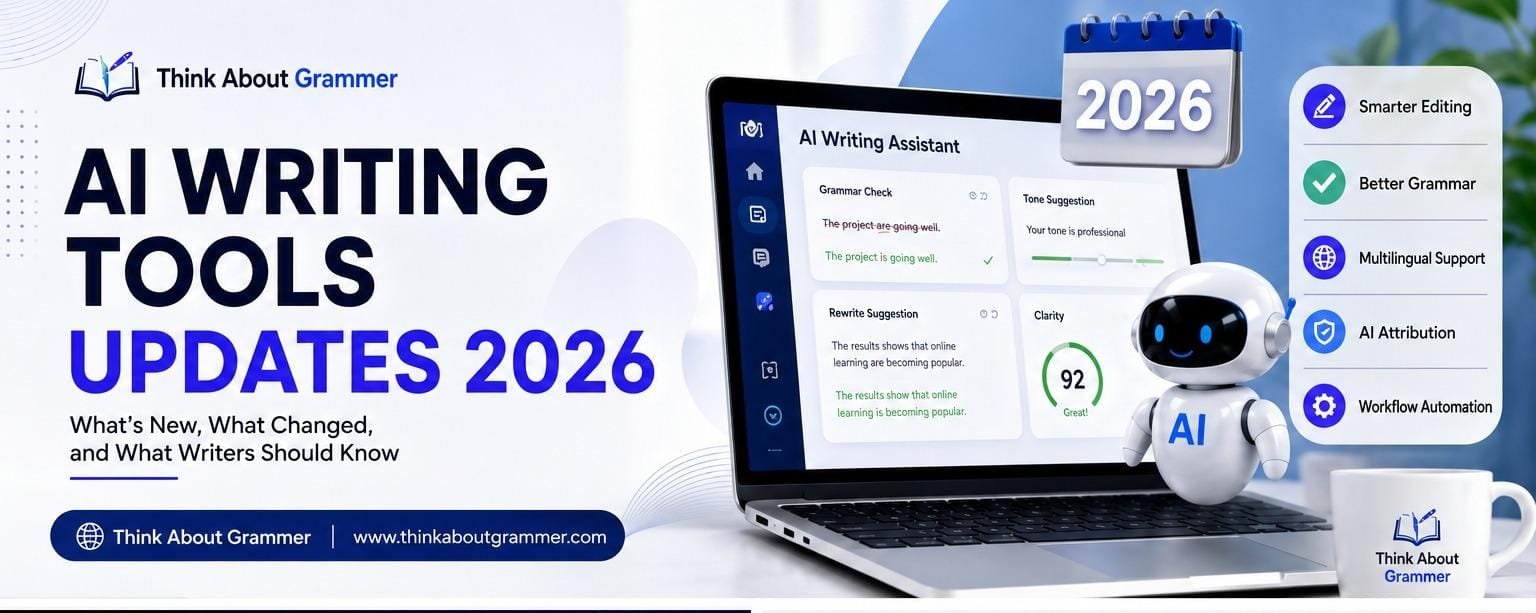
The world of AI writing tools is changing quickly in 2026. What used to be a simple choice between a grammar checker and an AI text generator has become a much broader category covering research, rewriting, translation, content planning, citations, collaboration, and AI-assisted workflows.
- Introduction
- What Are AI Writing Tools?
- AI Writing Tools Updates 2026: The Biggest Changes
- AI Writing Assistants Are Becoming More Comprehensive
- Grammar and Tone Improvements Are Still Central
- Multilingual Writing Is Getting More Practical
- AI Writing Tools Are Moving Into Complete Workflows
- AI Writing and Research Are Becoming More Connected
- AI Authorship and Attribution Are Becoming Bigger Issues
- AI Writing Tools Are Becoming More Specialized
- What Should Writers Look for in an AI Writing Tool?
- 1. Context Awareness
- 2. Editing Quality
- 3. Grammar Accuracy
- 4. Tone Control
- 5. Language Support
- 6. Integrations
- 7. Transparency
- Common Mistakes When Using AI Writing Tools
- Mistake 1: Accepting Every Suggestion
- Mistake 2: Removing Your Own Voice
- Mistake 3: Trusting AI With Unverified Facts
- Mistake 4: Focusing Only on AI Detection
- Mistake 5: Ignoring Usage Policies
- How to Use AI Writing Tools More Effectively in 2026
- Step 1: Start With Your Own Goal
- Step 2: Provide Useful Context
- Step 3: Review the Suggestion
- Step 4: Add Human Judgment
- Step 5: Fact-Check Important Claims
- Step 6: Perform a Final Grammar Review
- What Do the 2026 Updates Mean for Students?
- What Do the Updates Mean for Bloggers and Content Writers?
- Are AI Writing Tools Replacing Human Writers?
- What Is Likely to Matter Most Through the Rest of 2026?
- Better Personalization
- More Specialized Workflows
- Stronger Transparency
- More Multilingual Capabilities
- Greater Integration
- A Simple 2026 Checklist for Choosing a Writing Tool
- Conclusion
That makes ai writing tools updates 2026 an important topic for writers, students, marketers, editors, and businesses that rely on these tools. The biggest change is not simply that AI can write more text. Modern writing assistants are increasingly designed to understand context, improve existing drafts, work across applications, and support complete content workflows.
Industry data reflects how quickly the category has expanded. G2 reported 1,227 AI writing assistant products in June 2026, compared with 68 in 2024.
So, what has actually changed in 2026? Which developments matter, and how should writers adapt?
Let’s break down the most important updates.
What Are AI Writing Tools?
AI writing tools are software applications that use artificial intelligence to help people create, edit, organize, or improve written content.
Depending on the product, an AI writing assistant may help with:
- Grammar and spelling
- Sentence rewriting
- Tone adjustment
- Content generation
- Summarization
- Translation
- Research
- Outlining
- Citations and formatting
- Marketing copy
- Email writing
- Long-form content
- Collaborative editing
For example, instead of simply correcting:
She don’t understand the instructions.
A writing assistant may suggest:
She doesn’t understand the instructions.
More advanced tools can also recognize the broader purpose of a passage and suggest a clearer or more appropriate version.
AI Writing Tools Updates 2026: The Biggest Changes
The most important 2026 developments can be grouped into several major trends.
| Update | What it means for writers |
|---|---|
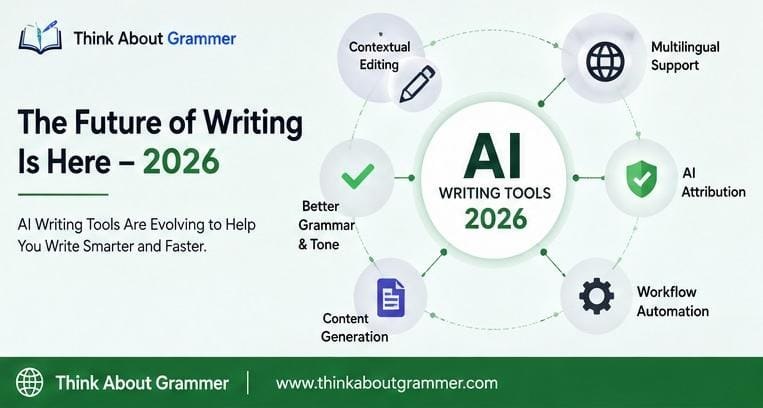
| Better contextual editing | Suggestions can better match the surrounding text |
| More content generation | Tools can move beyond corrections into drafting |
| Multilingual support | Writing and editing are becoming more accessible across languages |
| Research integration | Some tools increasingly connect writing with research workflows |
| AI attribution | Some platforms now provide greater visibility into AI involvement |
| Workflow automation | Writing assistants increasingly connect multiple tasks |
| Specialized tools | Products are becoming more focused on particular writing needs |
These changes show that AI writing software is moving from isolated text correction toward broader writing assistance.
AI Writing Assistants Are Becoming More Comprehensive
One of the clearest trends in 2026 is the expansion of what a writing assistant can do.
Earlier tools were often associated with basic proofreading. Today, many platforms combine several functions in one environment, reflecting the broader writing revolution taking place across modern content creation.
A writer might start with an outline, develop a draft, rewrite individual paragraphs, adjust the tone, check grammar, summarize research, and prepare the final version without constantly switching applications.
G2’s 2026 data shows that grammar correction and tone refinement remain important use cases, while content generation and meeting summaries have also become prominent capabilities.
From Grammar Checking to Contextual Editing
Consider this sentence:
The company launched a new product, it became popular quickly.
A basic grammar checker may identify the comma splice.
A more contextual assistant could suggest:
The company launched a new product, and it quickly became popular.
Or:
After the company launched its new product, demand increased rapidly.
The second type of suggestion is more useful because it considers readability and meaning rather than simply identifying an error.
Grammar and Tone Improvements Are Still Central
However, understanding grammar yourself is still important. If you’re preparing for standardized tests, learning core rules through resources such as SAT Grammar Rules can help you recognize why a sentence is correct or incorrect.
A good writing assistant can help identify:
- Subject-verb agreement problems
- Incorrect punctuation
- Spelling mistakes
- Awkward phrasing
- Redundant words
- Sentence fragments
- Inconsistent capitalization
- Unclear sentence construction
For example:
Incorrect:
The results shows that online learning are becoming popular.
Correct:
The results show that online learning is becoming popular.
But grammar correction is only part of modern editing.
Tone Has Become More Important
The same idea can be expressed differently depending on the audience.
Too casual:
Hey, just wanted to let you know that we can’t do the meeting today.
Professional:
I wanted to let you know that we need to reschedule today’s meeting.
An AI writing assistant can help identify these differences and offer alternatives.
Multilingual Writing Is Getting More Practical
Language support is another important area of development.
Modern writing tools increasingly provide grammar suggestions, rewriting, and translation across multiple languages. Grammarly’s 2026 release notes, for example, document multilingual suggestions and translation features, alongside continuing improvements to its applications and browser extensions.
This matters for:
- International businesses
- Multilingual students
- Freelance writers
- Translators
- Global marketing teams
- People learning another language
The goal is not simply translating individual words. Good multilingual writing requires attention to grammar, tone, context, and natural expression.
AI Writing Tools Are Moving Into Complete Workflows
Another major 2026 trend is the movement from standalone writing assistance toward workflow support.
Instead of asking:
“Can this tool write an article?”
Users increasingly want to know:
“Can this tool help me complete the entire writing process?”
That process might look like this:
- Research the topic.
- Identify the target audience.
- Create an outline.
- Draft the content.
- Improve sentence structure.
- Check grammar.
- Adjust tone.
- Add citations where appropriate.
- Review the final draft.
- Prepare the content for publication.
Email writing is another practical part of this workflow. AI tools can help improve professional communication, but writers should still understand tone, structure, and common grammar rules. Our guide to Professional Email Grammar Rules can help with that.
Not every tool performs all of these tasks equally well, but the direction of the market is clear: writing software is becoming increasingly workflow-oriented.
AI Writing and Research Are Becoming More Connected
Research is one area where writers need to remain particularly careful.
AI can help organize information, summarize material, and identify useful topics. However, generated text should not automatically be treated as verified information.
A useful workflow is:
Research → Verify → Write → Edit → Fact-check
For example, if an AI assistant provides a statistic, the writer should check the original source before publishing it.
This is especially important for:
- Medical information
- Financial information
- Legal topics
- Academic writing
- Current events
- Product specifications
AI can accelerate research, but responsibility for the published material still belongs to the human writer or publisher.
AI Authorship and Attribution Are Becoming Bigger Issues
One of the more notable developments in 2026 is greater attention to how AI contributes to written work.
Grammarly’s Authorship updates introduced more detailed attribution capabilities intended to provide visibility into how AI is used during the writing process.
This reflects a broader question:
Who wrote the content, and how was AI involved?
That question matters differently depending on the situation.
For example, a marketing team may openly use AI for brainstorming and editing. An academic institution may have specific rules about acceptable AI assistance. A publication may have its own editorial policy.
Recent events have also shown that AI-use policies are not merely theoretical. The Financial Times issued a clarification in August 2026 after disclosing AI use in the preparation of a column and noting that this conflicted with its editorial code.
The practical lesson is simple: check the rules that apply to your work before using AI.
AI Writing Tools Are Becoming More Specialized
The growing number of products does not mean every tool is designed for the same user.
Different categories now serve different purposes.
| Writer’s need | Suitable type of tool |
| Grammar | Grammar assistant |
| General drafting | General AI assistant |
| Marketing | Marketing-focused writing platform |
| Fiction | Creative-writing assistant |
| Research | Research-focused AI tool |
| Academic work | Academic writing and citation tools |
| Workspace writing | Document-based AI assistant |
| SEO content | SEO-focused writing platform |
The 2026 market includes both broad-purpose assistants and highly specialized products. G2’s June 2026 analysis also highlights Grammarly, Notion, Gemini, Microsoft Copilot, and Canva among highly ranked AI writing assistants.
What Should Writers Look for in an AI Writing Tool?
Choosing a tool simply because it generates impressive paragraphs can be a mistake.
Instead, evaluate the features that actually match your workflow.
1. Context Awareness
Can the tool understand the surrounding paragraph rather than treating every sentence independently?
2. Editing Quality
Does it improve clarity without destroying your original meaning?
3. Grammar Accuracy
Can it identify common grammatical problems while avoiding unnecessary changes?
4. Tone Control
Can you make writing more formal, friendly, concise, persuasive, or academic when appropriate?
5. Language Support
If you write in multiple languages, check which languages and features are actually supported.
6. Integrations
A tool becomes more useful when it works where you already write, such as a browser, document editor, or workplace application.
7. Transparency
If attribution or AI-use disclosure matters to you, look for features that show how AI was involved.
Common Mistakes When Using AI Writing Tools
AI writing software can save time, but careless use can create new problems.
Mistake 1: Accepting Every Suggestion
An AI suggestion is not automatically the best suggestion.
Original:
The project was delayed because the team needed additional testing.
An assistant might rewrite it in several ways, but the original may already be perfectly clear.
Better approach: Change text only when the suggestion genuinely improves it.
Mistake 2: Removing Your Own Voice
If every paragraph is rewritten by an AI tool, your content can start sounding generic.
Keep your own:
- Opinions
- Examples
- Experiences
- Explanations
- Vocabulary
- Brand voice
Use AI as an editor or assistant rather than automatically replacing your entire writing style.
Mistake 3: Trusting AI With Unverified Facts
A grammatically perfect sentence can still contain an incorrect fact.
Always verify important claims using reliable sources.
Mistake 4: Focusing Only on AI Detection
Trying to make every sentence “undetectable” misses the bigger goal.
The better objective is to create content that is:
- Accurate
- Original
- Useful
- Clearly written
- Appropriate for its audience
- Properly reviewed
Mistake 5: Ignoring Usage Policies
Schools, publishers, employers, and clients may have different rules about AI-assisted writing.
Always follow the relevant policy instead of assuming that every form of AI assistance is acceptable.
How to Use AI Writing Tools More Effectively in 2026
A simple human-first workflow can produce much better results.
Step 1: Start With Your Own Goal
Before opening an AI tool, decide what you want to communicate.
Step 2: Provide Useful Context
Instead of:
“Rewrite this.”
Try:
“Rewrite this paragraph for a professional audience while preserving the original meaning and keeping the tone friendly.”
Specific instructions usually produce more useful results.
Step 3: Review the Suggestion
Read the output carefully.
Ask:
- Is the meaning still correct?
- Does it sound natural?
- Is the grammar actually better?
- Did the tool remove an important detail?
- Does it sound appropriate for the audience?
Step 4: Add Human Judgment
AI can suggest wording, but you decide what belongs in the final version.
Step 5: Fact-Check Important Claims
Especially when the content includes statistics, names, dates, research, or technical information.
Step 6: Perform a Final Grammar Review
Even AI-assisted content deserves a final human edit.
What Do the 2026 Updates Mean for Students?
Students can use writing tools for legitimate learning support, depending on their school’s or institution’s rules.
Useful applications include:
- Understanding grammar
- Improving sentence clarity
- Brainstorming ideas
- Creating study questions
- Translating difficult passages
- Learning how to structure an essay
- Identifying unclear wording
However, students should understand the difference between learning with AI and simply submitting AI-generated work.
For example, asking why a sentence is grammatically incorrect can help develop writing skills. Automatically replacing an entire assignment does not provide the same learning benefit and may violate academic rules.
What Do the Updates Mean for Bloggers and Content Writers?
For bloggers, the biggest opportunity is efficiency.
AI can help with:
- Topic brainstorming
- Content outlines
- Headline variations
- Editing
- Summarization
- Meta descriptions
- Grammar checking
- Content repurposing
But efficient publishing should not become mass production of shallow content.
A strong article still needs a clear purpose, useful information, accurate facts, and meaningful editorial input.
Are AI Writing Tools Replacing Human Writers?
Not completely.
The more realistic development is collaboration.
AI is particularly useful for repetitive tasks such as generating alternatives, checking grammar, summarizing information, and organizing ideas.
Humans remain important for:
- Judgment
- Original perspectives
- Fact verification
- Editorial decisions
- Emotional nuance
- Context
- Ethical decisions
- Audience understanding
The strongest workflow is often not human versus AI, but human plus AI.
What Is Likely to Matter Most Through the Rest of 2026?
Based on the direction of current products, several areas deserve attention.
Better Personalization
Writing assistants are likely to become more useful when they understand a user’s preferred tone, vocabulary, and writing conventions.
More Specialized Workflows
Instead of one tool trying to do everything, users may increasingly choose tools built around specific jobs.
Stronger Transparency
As AI-assisted writing becomes more common, knowing how AI contributed to a document may become increasingly important in education, publishing, and professional environments.
More Multilingual Capabilities
Language support is likely to remain a major area of development as writing tools expand internationally.
Greater Integration
The most convenient writing assistant may increasingly be the one available directly inside the applications where people already work.
A Simple 2026 Checklist for Choosing a Writing Tool
Before committing to a tool, ask yourself:
- Does it solve my actual writing problem?
- Is its grammar correction reliable?
- Can it preserve my intended meaning?
- Does it support my language?
- Does it fit my existing workflow?
- Does it provide useful editing rather than unnecessary rewriting?
- Are its AI-use and privacy policies appropriate for my needs?
- Does the price make sense for how often I will use it?
The best AI writing tool is not necessarily the one with the longest feature list. It is the one that makes your particular writing process better.
Frequently Asked Questions
What are the biggest AI writing tools updates in 2026?
The biggest changes include stronger contextual editing, broader content-generation features, multilingual capabilities, workflow integration, and greater attention to AI attribution.
Are AI writing tools better at grammar in 2026?
Many have become more capable at grammar, tone, formatting, and contextual editing, although human review is still valuable. G2’s 2026 data identifies Grammarly and Microsoft Copilot as leading performers for grammar checking among the products it evaluated.
Can AI writing tools write complete articles?
Yes, many tools can generate complete drafts, but writers should still provide direction, verify facts, edit the output, and add original value.
Are AI writing tools useful for students?
They can be useful for learning grammar, brainstorming, revising drafts, and understanding writing techniques, provided their use follows the relevant academic rules.
Should bloggers use AI writing tools?
Yes, when they genuinely improve the workflow, particularly for research organization, outlining, editing, and content refinement rather than simply producing large quantities of unedited text.
Do AI writing tools replace grammar knowledge?
No. They can identify and explain many errors, but understanding grammar yourself helps you judge whether a suggested correction is appropriate.
How should I choose an AI writing assistant in 2026?
Choose based on your specific needs, such as grammar, research, marketing, academic writing, multilingual editing, or general drafting, rather than choosing solely by popularity.
Conclusion
The ai writing tools updates 2026 landscape is much broader than simple AI text generation. Writing assistants are becoming more contextual, multilingual, specialized, and connected to complete writing workflows.
At the same time, the most valuable skill remains human judgment.
Use AI to brainstorm, organize, edit, explain, and accelerate your work—but continue to check facts, protect your voice, understand grammar, and follow the rules that apply to your writing.
The best approach in 2026 is not to let an AI tool write everything for you. It is to use the technology intelligently while keeping the human writer firmly in control.