

Learning grammar can sometimes feel like memorizing an endless list of rules. For teachers, the challenge is even bigger: students often enter the same classroom with very different grammar skills, while there is limited time for teaching, practice, writing, and feedback.
- What Is Grammar Flip?
- How Does Grammar Flip Work?
- 1. Diagnose Existing Knowledge
- 2. Learn the Grammar Concept
- 3. Practice the Skill
- 4. Apply Grammar in Writing
- 5. Review and Evaluate
- What Does Grammar Flip Teach?
- Parts of Speech
- Parts of the Sentence
- Mechanics and Usage
- Grammar Flip Features
- Instructional Video Lessons
- Practice Exercises With Feedback
- Writing Activities
- Progress Reports
- Writing Portals
- Review Games and Virtual Badges
- Grammar Flip for Teachers
- Grammar Flip for Students
- Grammar Flip for Homeschooling
- Is Grammar Flip Suitable for Different Skill Levels?
- How to Use Grammar Flip Effectively
- Common Grammar Mistakes Students Should Watch For
- Subject-Verb Agreement
- Sentence Fragment
- Comma Splice
- Confusing “Their” and “They’re”
- Misplaced Modifier
- Grammar Flip Pricing
- Does Grammar Flip Offer a Free Trial?
- Grammar Flip vs. Traditional Grammar Worksheets
- What Are the Main Benefits of Grammar Flip?
- 1. Structured Curriculum
- 2. Multiple Learning Formats
- 3. Individual Progress Monitoring
- 4. Writing Application
- 5. Flexible Classroom Use
- What Should You Consider Before Using Grammar Flip?
- Conclusion
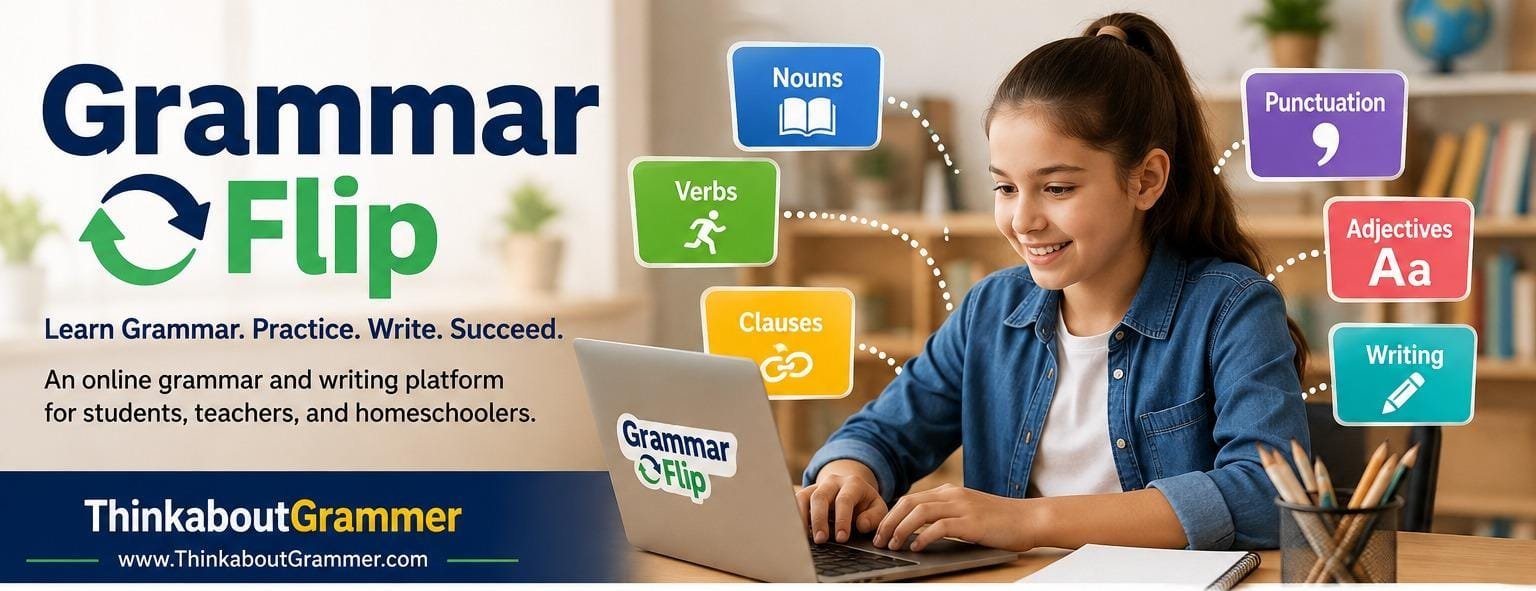
Grammar Flip is an online grammar and writing program designed to address that problem. It combines instructional lessons, practice exercises, writing activities, assessments, progress tracking, and review tools in one platform. The program is designed primarily for upper-elementary, middle school, and high school learners, and it can be used in traditional, blended, or flipped classroom settings. Before exploring Grammar Flip in detail, it helps to understand what grammar is and why grammar skills are important for clear and effective communication.
But what exactly is Grammar Flip, how does it work, what does it teach, and is it suitable for teachers, students, or homeschool families?
This guide answers those questions and explains what you should know before deciding whether Grammar Flip fits your learning or teaching needs.
What Is Grammar Flip?
Grammar Flip is an online grammar and writing curriculum created to help students learn English grammar at an individualized pace.
Instead of relying only on a teacher explaining a rule to an entire class, the platform combines several stages of learning. Students can first identify what they already know, learn a concept through instructional content, practice it, and then apply it in writing. Teachers can monitor progress and use the results to identify areas where individual students need additional support.
The platform covers grammar from foundational concepts to more advanced sentence construction, mechanics, and usage. Its curriculum currently lists 86 targeted lessons across parts of speech, parts of sentences, and mechanics and usage.
Who Is Grammar Flip Designed For?
Grammar Flip is particularly aimed at:
- English language arts teachers
- Upper-elementary students
- Middle school students
- High school students
- Homeschool families
- Schools and districts
- Teachers using blended or flipped learning
It can also supplement an existing English curriculum rather than necessarily replacing every other resource a teacher uses. The company specifically describes the platform as compatible with traditional, flipped, and blended classroom models.
How Does Grammar Flip Work?
The basic idea is straightforward: diagnose, learn, practice, apply, and review.
This approach matters because knowing a grammar definition is not the same as being able to use that rule correctly in real writing.
Grammar Flip’s instructional method starts by identifying student needs and then moves through different types of learning activities.
1. Diagnose Existing Knowledge
A diagnostic assessment can help identify which grammar concepts a student already understands and which areas need more attention.
For example, a student might understand nouns and basic verbs but struggle with:
- Subject-verb agreement
- Comma usage
- Clauses
- Misplaced modifiers
- Complex sentences
Instead of spending equal time on every topic, a teacher can use assessment information to decide where instruction should be focused.
2. Learn the Grammar Concept
Students can learn through different instructional formats, including video lessons, slideshows, definition cards, images, and music videos. The platform provides both longer and shorter video lessons as well as grammar-in-context content.
This variety is useful because students do not all learn in exactly the same way.
3. Practice the Skill
After instruction, students complete practice exercises.
The platform provides immediate feedback during practice, helping students recognize whether they understand the concept or need another explanation.
For example, consider subject-verb agreement:
Incorrect:
The group of students are ready.
Correct:
The group of students is ready.
The important part is not simply memorizing the answer. Students need to understand that group is the subject in this sentence, not students.
4. Apply Grammar in Writing
Grammar becomes much more useful when students can apply it to their own writing.
Grammar Flip includes writing application activities and teacher writing portals, allowing students to use grammar concepts in actual written work rather than treating every lesson as a multiple-choice exercise.
5. Review and Evaluate
Review activities and post-evaluations provide another opportunity to reinforce the concept and check progress.
This creates a learning cycle rather than a one-time lesson.
What Does Grammar Flip Teach?
One of the strongest aspects of Grammar Flip is the breadth of its grammar curriculum.
Its lessons are organized into three broad areas:
- Parts of speech
- Parts of sentences
- Mechanics and usage
Let’s look at each area.
Parts of Speech
Parts of speech provide the foundation for understanding how words function within sentences.
Grammar Flip includes lessons involving nouns, verbs, pronouns, adjectives, conjunctions, and related concepts.
Nouns
A noun names a person, place, thing, or idea.
Examples:
- teacher
- city
- computer
- happiness
- ocean
Example sentence:
The teacher explained the lesson.
Here, teacher is the noun.
Verbs
Verbs communicate actions, states, or conditions.
Examples:
- run
- think
- write
- is
- become
Example:
Maya writes every morning.
The word writes is the verb.
Pronouns
Pronouns replace nouns to avoid unnecessary repetition.
Example:
Sarah finished Sarah’s homework because Sarah wanted to study.
This sounds repetitive.
A better version is:
Sarah finished her homework because she wanted to study.
The pronouns her and she make the sentence smoother.
Adjectives and Other Modifiers
Adjectives provide information about nouns.
Example:
The enormous tree blocked the window.
The adjective enormous describes the tree.
Understanding these basic categories makes more advanced sentence analysis easier.
Parts of the Sentence
Knowing what individual words are is only part of grammar. Students also need to understand how words and groups of words work together.
Grammar Flip’s curriculum includes subjects, predicates, objects, phrases, clauses, sentence types, and several related concepts.
Subjects and Predicates
Consider:
The young athlete trained every afternoon.
Subject: The young athlete
Predicate: trained every afternoon
The subject tells us who or what the sentence is about, while the predicate provides information about that subject.
Direct Objects
A direct object receives the action of a verb.
Example:
Liam opened the window.
Here:
- Liam = subject
- opened = verb
- window = direct object
Ask, “Opened what?” The answer is the window.
Phrases and Clauses
Grammar Flip also covers phrases and clauses, including independent and dependent clauses.
Compare:
I finished my homework.
This is an independent clause because it can stand alone.
Now consider:
Because I finished my homework
It contains an idea but does not form a complete sentence by itself.
A complete sentence could be:
Because I finished my homework, I watched a movie.
Understanding the difference helps students avoid sentence fragments and other construction problems. To learn more about coordinating conjunctions and how FANBOYS grammar helps connect ideas, see our detailed guide to FANBOYS grammar.
Mechanics and Usage
Grammar isn’t only about identifying nouns and verbs. Good writing also depends on punctuation, capitalization, sentence structure, and correct word usage.
Grammar Flip includes lessons covering areas such as:
- Capitalization
- Commas
- Apostrophes
- Hyphens
- Quotation marks
- Semicolons
- Colons
- Subject-verb agreement
- Commonly confused words
- Run-on sentences
- Comma splices
- Sentence fragments
- Parallel construction
- Misplaced modifiers
- Active and passive voice
Example: Run-On Sentence
Incorrect:
I finished my project I submitted it before lunch.
Two complete thoughts have been pushed together without appropriate punctuation.
Correct:
I finished my project, and I submitted it before lunch.
Or:
I finished my project. I submitted it before lunch.
The correct solution depends on the intended relationship between the ideas.
Grammar Flip Features
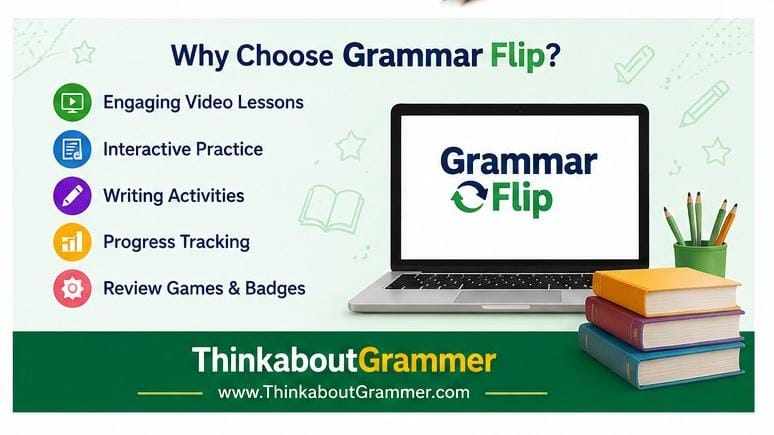
Grammar Flip combines instruction, practice, writing, assessment, and progress monitoring rather than offering only isolated grammar quizzes.
Instructional Video Lessons
Students can watch lessons explaining grammar and writing concepts. Videos can be paused, replayed, or reviewed when necessary.
This can be especially useful for students who need more than one explanation.
Practice Exercises With Feedback
Practice activities give students opportunities to work with the rule instead of simply reading about it.
Immediate feedback can help students identify mistakes while the lesson is still fresh.
Writing Activities
The writing component helps connect grammar instruction with practical communication.
For instance, after studying adjectives, students can write descriptive sentences. After learning about sentence structure, they can experiment with compound or complex sentences.
Progress Reports
Teachers can use progress reports to monitor individual students and identify patterns across a class. The platform describes these reports as color-coded and downloadable.
Writing Portals
Writing portals give teachers access to student writing and tools for providing feedback.
Review Games and Virtual Badges
Grammar Flip also includes interactive review activities and virtual badges intended to make practice more engaging.
Grammar Flip for Teachers
Teachers often have to solve two problems at once: teaching the material and figuring out which students need help.
Grammar Flip is designed to reduce some of that workload by providing instructional materials, assessments, practice exercises, writing activities, and progress monitoring in one system.
Why Teachers May Find It Useful
A teacher can use Grammar Flip to:
- Assess students before instruction
- Assign targeted lessons
- Provide independent practice
- Review student writing
- Monitor individual progress
- Identify students who need additional help
- Use review activities before evaluation
This can be particularly useful in classrooms where students have significantly different grammar abilities.
Grammar Flip for Students
For students, the biggest advantage is the ability to work through concepts in a structured sequence.
Suppose one student already understands nouns but struggles with clauses. Another student might need more help with punctuation.
A single whole-class lesson may not perfectly match both students’ needs. An individualized approach can allow each learner to spend more time where it is actually necessary.
Students can also revisit instructional content instead of assuming they understood everything after one explanation.
Grammar Flip for Homeschooling
Grammar Flip also offers a homeschool plan designed for families.
According to the current official pricing information, the homeschool plan provides access to the platform’s instructional, assessment, writing, progress-monitoring, and review features for one parent account and up to five student accounts. The listed price is $39.99 per year.
This makes the platform worth considering for parents who want a structured grammar curriculum rather than collecting separate worksheets, videos, quizzes, and writing exercises.
Is Grammar Flip Suitable for Different Skill Levels?
Grammar Flip is designed for a relatively broad school-age range, from upper elementary through high school.
However, “suitable for the grade level” does not automatically mean that every lesson will be equally useful for every student.
A better approach is to use diagnostic information and student performance to determine where instruction should begin.
For example:
| Student Need | Possible Focus |
|---|---|
| Basic word categories | Parts of speech |
| Sentence construction | Subjects and predicates |
| Better sentence variety | Compound and complex sentences |
| Punctuation problems | Commas, semicolons, colons |
| Frequent grammar errors | Targeted practice |
| Weak writing application | Writing activities |
| Need for reinforcement | Review and assessments |
How to Use Grammar Flip Effectively
Grammar Flip is designed to help students understand and practice English grammar. Before using an online grammar platform,
Simply assigning an online grammar lesson does not guarantee that students will master the concept.
The most effective use is to connect instruction with practice and actual writing.
Start With What Students Know
Use assessment information to avoid teaching concepts students have already mastered repeatedly.
Focus on One Skill at a Time
Grammar becomes easier to manage when students have a clear objective.
Instead of saying:
“Improve your grammar.”
Set a specific goal:
“Use commas correctly after introductory phrases.”
That gives students something concrete to practice.
Move From Rules to Writing
After students learn a rule, ask them to create their own examples.
For instance, after learning about compound sentences:
The rain stopped, and the children went outside.
Then ask students to create two or three original examples.
Review Mistakes
Mistakes can reveal what a student does not yet understand. For additional practice with identifying and correcting grammar mistakes, see our detailed guide to Fix It Grammar Understanding the difference helps students avoid sentence fragments and other construction problems.
If a student repeatedly writes:
She don’t like coffee.
The issue isn’t just one incorrect word. The student may need additional practice with subject-verb agreement and the use of auxiliary verbs.
Common Grammar Mistakes Students Should Watch For
Grammar platforms are most useful when students understand why mistakes happen.
Here are several common examples.
Subject-Verb Agreement
Incorrect:
The students in my class likes reading.
Correct:
The students in my class like reading.
The subject is students, which is plural.
Sentence Fragment
Incorrect:
Because the weather was cold.
Correct:
Because the weather was cold, we stayed inside.
The first example leaves the reader waiting for the main idea.
Comma Splice
Incorrect:
I wanted to go outside, it started raining.
Correct:
I wanted to go outside, but it started raining.
Or:
I wanted to go outside. It started raining.
Confusing “Their” and “They’re”
Incorrect:
They’re books are on the table.
Correct:
Their books are on the table.
They’re means they are.
Their shows possession.
Misplaced Modifier
Unclear:
Walking through the park, the trees looked beautiful.
The sentence makes it sound as though the trees were walking.
Better:
Walking through the park, I thought the trees looked beautiful.
The person doing the walking is now clear.
Grammar Flip Pricing
Pricing can change, so it is worth checking the official pricing page before purchasing.
At the time of writing, Grammar Flip lists different plans for individual teachers, homeschool families, and schools or districts.
For individual teacher plans, the current pricing page lists plans based on the number of student seats. The displayed annual options include:
| Student Seats | Listed Annual Price |
| Up to 25 | $49.99/year |
| Up to 50 | $69.99/year |
| Up to 75 | $89.99/year |
| Up to 100 | $99.99/year |
| Up to 125 | $124.99/year |
| Up to 150 | $149.99/year |
The platform also offers a free trial, while larger school or district arrangements can be handled through custom quotes.
Because pricing and plan details can change, prospective users should verify the latest information directly before subscribing.
Does Grammar Flip Offer a Free Trial?
Yes. Grammar Flip currently promotes a 30-day free trial and says users can begin with a free grammar diagnostic assessment.
A trial can be useful because the most important question isn’t simply whether the platform has many features. It is whether its teaching approach fits the particular students and classroom.
Grammar Flip vs. Traditional Grammar Worksheets
Traditional worksheets still have a place in education, but they have limitations.
A worksheet might give students ten questions about commas. Grammar Flip can combine instruction, practice, feedback, writing application, and progress monitoring within the same learning environment.
That doesn’t necessarily mean digital learning is always better. A teacher may still want students to write by hand, discuss examples in class, or complete offline exercises.
The strongest approach may be a combination of methods.
What Are the Main Benefits of Grammar Flip?
Grammar Flip’s feature set makes it particularly useful in situations where individualized instruction and teacher monitoring are important.
1. Structured Curriculum
The platform provides a defined sequence of grammar topics instead of requiring teachers to build everything from scratch.
2. Multiple Learning Formats
Video, slides, images, definition cards, practice, writing, and review activities give students several ways to encounter a concept.
3. Individual Progress Monitoring
Teachers can see where students are progressing and where additional support may be needed.
4. Writing Application
Students have opportunities to use grammar in actual writing rather than treating grammar as an isolated subject.
5. Flexible Classroom Use
The platform is designed to work with traditional, flipped, and blended learning environments.
What Should You Consider Before Using Grammar Flip?
No educational platform is automatically the perfect fit for every classroom.
Before choosing Grammar Flip, consider:
- The age and skill level of your students
- Whether students have reliable access to the required technology
- Whether your curriculum already includes grammar instruction
- How much independent work your students can handle
- Whether your teaching style fits a digital learning model
- Whether the available writing and assessment tools meet your needs
- Current subscription pricing
The best way to evaluate the platform is to use its trial and compare the experience with your actual learning objectives.
Frequently Asked Questions About Grammar Flip
What is Grammar Flip used for?
Grammar Flip is used to teach and practice English grammar and writing. It combines instructional content, exercises, assessments, writing activities, review tools, and progress monitoring.
What grades is Grammar Flip designed for?
Grammar Flip is designed primarily for upper-elementary, middle school, and high school learners. It can be used in traditional, blended, or flipped classroom environments.
Does Grammar Flip include writing activities?
Yes. Writing application activities are included so students can apply grammar concepts to actual writing. Teachers can also use writing portals to review student work.
Does Grammar Flip provide assessments?
Yes. The platform includes diagnostic assessments, pre-tests, practice exercises, and post-evaluation assessments.
Is Grammar Flip useful for homeschool students?
Yes. Grammar Flip offers a dedicated homeschool plan with access for one parent account and up to five student accounts.
Does Grammar Flip offer a free trial?
Yes. Grammar Flip currently advertises a 30-day free trial for users who want to explore the platform.
How many grammar lessons does Grammar Flip have?
The current curriculum page lists 86 targeted grammar lessons covering parts of speech, parts of sentences, and mechanics and usage.
Can Grammar Flip replace a teacher?
Not really. Grammar Flip can automate or organize parts of instruction, practice, assessment, and progress monitoring, but teacher judgment remains important—especially when students need explanation, discussion, encouragement, or personalized writing feedback.
Conclusion
Grammar Flip takes a structured approach to grammar education by connecting assessment, instruction, practice, writing, review, and progress monitoring. Its curriculum covers everything from basic parts of speech to more advanced sentence structures, punctuation, usage, and writing mechanics.
For teachers, the platform can provide a centralized way to identify student needs and monitor progress. For students, it offers multiple ways to learn and practice grammar. Homeschool families can also use its dedicated curriculum and student accounts.
The key takeaway is simple: grammar is easier to master when students don’t just memorize rules—they learn the concept, practice it, and then use it in real writing. That learning cycle is at the heart of the Grammar Flip approach.