

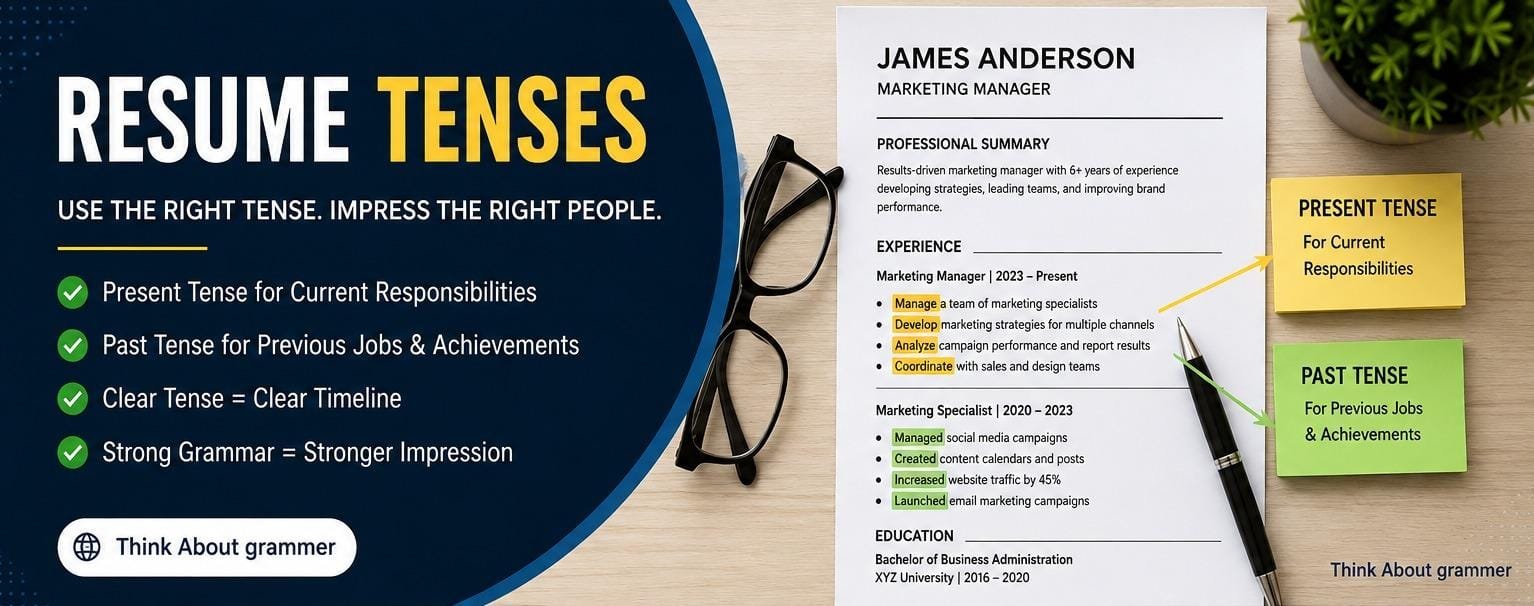
Writing a strong resume is not only about choosing impressive skills and describing your experience. Grammar matters too, especially when it comes to verb tenses.
- Why Do Resume Tenses Matter?
- Should a Resume Be Written in Past or Present Tense?
- Resume Tenses for Your Current Job
- Resume Tenses for Previous Jobs
- What Tense Should You Use for Resume Bullet Points?
- Present Tense vs. Past Tense on a Resume
- What About Resume Tenses in the Professional Summary?
- What Tense Should You Use for Career Achievements?
- Should You Use Future Tense on a Resume?
- What About the Present Perfect Tense?
- How to Handle Ongoing Projects
- How to Handle a Current Job With Mixed Tenses
- Common Resume Tense Mistakes
- 1. Using Present Tense for Every Job
- 2. Switching Tenses Randomly
- 3. Using “-ing” Forms Everywhere
- 4. Confusing Responsibilities With Achievements
- Do Resume Tenses Affect ATS?
- A Practical Resume Tense Checklist
- Useful Resume Action Verbs by Tense
- Should Education Use Resume Tenses?
- How to Edit Resume Tenses Efficiently
- Step 1: Highlight Every Action Verb
- Step 2: Identify the Job Status
- Step 3: Check the Action
- Step 4: Standardize Similar Bullets
- Step 5: Read the Section as a Timeline
- Resume Tenses: A Quick Reference Guide
- Conclusion
One of the most common resume-writing questions is: Should I use past tense or present tense on my resume? The answer depends mainly on whether the job, responsibility, or achievement is current or completed.
Using the right resume tenses makes your experience easier to understand and helps recruiters quickly see what you do now, what you did previously, and what you accomplished in each role.
The good news is that you usually do not need complicated grammar. With a few simple rules, you can make your resume consistent, professional, and much easier to read.
Why Do Resume Tenses Matter?
Verb tense tells the reader when an action happened.
Compare these two examples:
- Managed a team of five marketing specialists.
- Manage a team of five marketing specialists.
The first suggests a completed responsibility, while the second suggests that managing the team is part of your current role.
This distinction becomes especially important when a recruiter is reviewing your resume quickly. Clear verb tenses help establish a timeline without requiring additional explanation.
Good grammar is especially important in professional communication, whether you are writing a resume or following professional grammar rules Common Resume Tense Mistakes for workplace emails:
- Current responsibilities
- Previous responsibilities
- Completed projects
- Ongoing work
- Past achievements
- Skills that remain relevant today
Should a Resume Be Written in Past or Present Tense?
There is no single tense that should be used throughout every resume.
The general rule is:
Use present tense for ongoing responsibilities and past tense for completed work.
For example, if you currently work as a marketing specialist:
Present tense:
- Manage social media campaigns.
- Create monthly content calendars.
- Analyze campaign performance.
- Coordinate with the design team.
For a previous position:
Past tense:
- Managed social media campaigns.
- Created monthly content calendars.
- Analyzed campaign performance.
- Coordinated with the design team.
This approach gives your resume a natural timeline.
Resume Tenses for Your Current Job
Your current position is usually written primarily in present tense because you are still performing those responsibilities.
Use Present Tense for Ongoing Responsibilities
Consider a current position such as:
Digital Marketing Specialist | 2024–Present
You might write:
- Develop SEO strategies for multiple websites.
- Manage content calendars and editorial schedules.
- Monitor organic search performance.
- Create keyword research reports.
- Collaborate with writers and designers.
These activities are happening now, so present tense is appropriate.
Use Past Tense for Completed Achievements
There is an important exception.
A current job can contain accomplishments that have already been completed. In that case, past tense can be appropriate.
For example:
- Increased organic traffic by 45% within one year.
- Successfully launched a new content strategy.
- Reduced reporting time by 30%.
The position is current, but those specific achievements are completed events.
Therefore, a current job can legitimately contain both present and past tense.
Resume Tenses for Previous Jobs
For previous positions, use past tense.
Suppose you worked as a content writer from 2021 to 2024.
Good examples include:
- Wrote more than 100 SEO-focused articles.
- Developed content strategies for business websites.
- Increased organic traffic through targeted content.
- Collaborated with editors and marketing teams.
- Researched keywords and analyzed search intent.
Because the employment period has ended, past tense keeps the timeline clear.
Incorrect vs. Correct Examples
| Incorrect | Correct |
|---|---|
| Manage a team of writers. | Managed a team of writers. |
| Create SEO strategies. | Created SEO strategies. |
| Develop content plans. | Developed content plans. |
| Analyze campaign results. | Analyzed campaign results. |
The corrected versions clearly indicate that these responsibilities belonged to a previous position.
What Tense Should You Use for Resume Bullet Points?
Most resume bullet points begin with action verbs, so tense consistency is particularly important.
For a current position, you might use:
- Manage
- Lead
- Develop
- Create
- Coordinate
- Analyze
- Oversee
- Support
For a previous position:
- Managed
- Led
- Developed
- Created
- Coordinated
- Analyzed
- Oversaw
- Supported
Notice that the underlying action remains the same. Only the tense changes.
Present Tense vs. Past Tense on a Resume
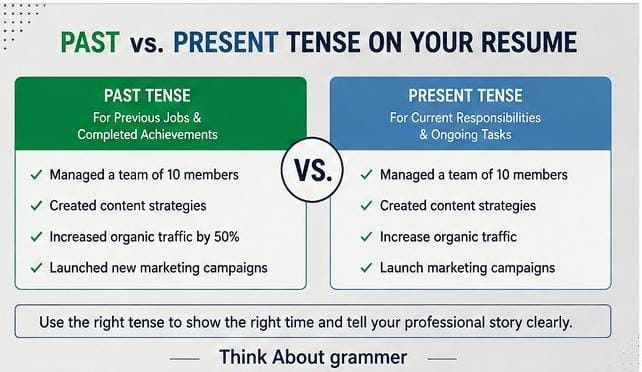
A simple comparison can make the rule easier to remember.
| Situation | Recommended Tense | Example |
| Current responsibility | Present | Manage client accounts |
| Current ongoing task | Present | Develop marketing campaigns |
| Completed achievement in current job | Past | Increased sales by 25% |
| Previous responsibility | Past | Managed client accounts |
| Completed project | Past | Launched a new website |
| Previous job achievement | Past | Reduced costs by 15% |
| General skill | Usually present | Analyze performance data |
The key is not to choose one tense for your entire resume. Choose the tense based on whether the action is ongoing or completed.
What About Resume Tenses in the Professional Summary?
Your professional summary can use present tense when describing who you are and what you currently do.
For example:
Digital marketing specialist with five years of experience developing SEO strategies, managing content campaigns, and analyzing organic search performance.
Here, present participles such as developing, managing, and analyzing describe your professional capabilities and experience.
You can also use past tense when highlighting a specific previous accomplishment:
Digital marketing specialist with five years of experience who increased organic traffic by 45% through data-driven SEO strategies.
Both structures can work as long as the grammar is clear.
What Tense Should You Use for Career Achievements?
Completed achievements generally belong in past tense, even when they appear under your current position.
For example:
- Increased website traffic by 50%.
- Generated 1,000 qualified leads.
- Reduced customer response time by 20%.
- Launched a successful email campaign.
These describe results that occurred and were completed.
Avoid changing the tense simply because the job itself is current.
Example
Weak:
- Increase website traffic by 50%.
If the increase has already happened, this wording can sound like a responsibility or goal rather than a completed achievement.
Stronger:
- Increased website traffic by 50% through targeted SEO campaigns.
The second version clearly communicates a result.
Should You Use Future Tense on a Resume?
In most cases, avoid future tense on a resume.
A resume is primarily a record of your current skills, experience, responsibilities, and achievements. It is not normally a place to describe what you plan to do in a future job.
For example, avoid:
I will manage the company’s social media campaigns.
Instead, describe what you have already done:
Managed social media campaigns across multiple platforms.
If you are discussing a current responsibility, use present tense:
Manage social media campaigns across multiple platforms.
Future tense may occasionally appear in very specific contexts, but it is generally unnecessary in standard resume experience sections.
What About the Present Perfect Tense?
The present perfect tense can sometimes be useful, but it should not become the default tense for resume bullet points.
Present perfect combines has/have + past participle.
Examples:
- Have managed international projects.
- Have developed marketing strategies.
- Have worked with cross-functional teams.
This construction can work when describing experience that connects the past with the present, particularly in a professional summary.
However, resume bullet points are usually stronger and more direct when they begin with action verbs.
Instead of:
Have managed a team of 10 employees.
You could write:
Managed a team of 10 employees.
Or, for a current responsibility:
Manage a team of 10 employees.
How to Handle Ongoing Projects
Ongoing projects require special attention.
If you are currently working on a project, use present tense for the continuing activity.
For example:
- Lead the development of a new customer portal.
- Manage the website redesign project.
- Coordinate the implementation of a new CRM system.
Once the project is completed, the wording can change to past tense:
- Led the development of a new customer portal.
- Managed the website redesign project.
- Coordinated the implementation of a new CRM system.
This simple change makes the timeline much clearer.
How to Handle a Current Job With Mixed Tenses
Using both present and past tense in a current position is not automatically a grammar mistake.
For example:
Marketing Manager | 2023–Present
- Lead a team of six marketing specialists.
- Develop quarterly campaign strategies.
- Monitor campaign performance.
- Increased qualified leads by 35% in 2025.
- Launched a new email automation system.
This works because the first three bullets describe ongoing responsibilities, while the last two describe completed accomplishments.
A Simple Rule
Ask yourself:
“Is this something I still do?”
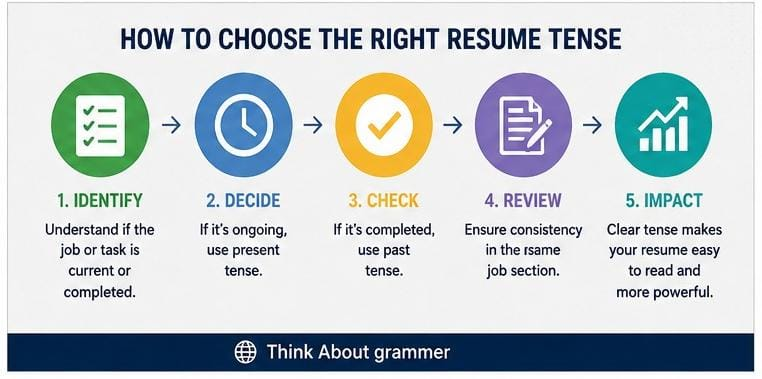
If yes, present tense is usually appropriate.
Then ask:
“Is this a result or event that has already happened?”
If yes, past tense is usually appropriate.
Common Resume Tense Mistakes
Even strong resumes can contain small tense problems. Before submitting your resume, it is worth reviewing your writing carefully and learning how to fix common grammar mistakes that can affect clarity and professionalism.
1. Using Present Tense for Every Job
Some candidates use present tense throughout their entire resume:
- Manage customer accounts.
- Create reports.
- Lead project teams.
- Develop marketing campaigns.
If these bullets describe previous jobs, the tense is misleading.
Better:
- Managed customer accounts.
- Created reports.
- Led project teams.
- Developed marketing campaigns.
2. Switching Tenses Randomly
Another common problem is inconsistent tense within the same group of bullets.
For example:
- Manage client accounts.
- Created monthly reports.
- Coordinate team meetings.
- Analyzed performance data.
Unless there is a clear reason for the tense changes, this looks inconsistent.
A cleaner version for a former position would be:
- Managed client accounts.
- Created monthly reports.
- Coordinated team meetings.
- Analyzed performance data.
3. Using “-ing” Forms Everywhere
Resume writers sometimes use phrases such as:
- Managing social media campaigns
- Creating content strategies
- Analyzing performance
- Developing reports
These are grammatically possible, but they can make bullet points less direct when used without a strong grammatical structure.
Instead, action verbs are usually more effective:
- Managed social media campaigns.
- Created content strategies.
- Analyzed performance.
- Developed reports.
4. Confusing Responsibilities With Achievements
Responsibilities and achievements do not always use the same wording.
Compare:
Responsibility:
Manage paid advertising campaigns.
Achievement:
Increased conversion rates by 28% through optimized advertising campaigns.
The first describes ongoing work. The second describes a completed result.
Do Resume Tenses Affect ATS?
Applicant tracking systems, commonly called ATS, primarily analyze resume content to identify relevant information such as skills, experience, education, and keywords.
There is no need to distort your grammar simply to satisfy an ATS.
Instead, focus on:
- Clear job titles
- Relevant keywords
- Specific skills
- Strong action verbs
- Measurable achievements
- Consistent formatting
- Easy-to-understand language
Good grammar helps human readers, while clear terminology helps make your experience understandable to both people and software.
A Practical Resume Tense Checklist
Before submitting your resume, review every experience section using this checklist:
- Is your current job written mainly in present tense?
- Are previous jobs written in past tense?
- Are completed achievements written in past tense?
- Are ongoing responsibilities written in present tense?
- Have you avoided unnecessary future tense?
- Are action verbs consistent within each position?
- Have you checked irregular past-tense verbs?
- Do your tense changes have a clear reason?
- Have you avoided unnecessary “I,” “me,” and “my”?
- Does the entire resume read naturally when spoken aloud?
Useful Resume Action Verbs by Tense
Using strong action verbs can make your experience more precise.
| Present Tense | Past Tense |
| Lead | Led |
| Manage | Managed |
| Build | Built |
| Create | Created |
| Write | Wrote |
| Develop | Developed |
| Analyze | Analyzed |
| Coordinate | Coordinated |
| Improve | Improved |
| Design | Designed |
| Drive | Drove |
| Grow | Grew |
| Implement | Implemented |
| Organize | Organized |
| Oversee | Oversaw |
Pay special attention to irregular verbs such as lead → led, write → wrote, build → built, drive → drove, and grow → grew.
Should Education Use Resume Tenses?
Education sections normally do not require many verb tenses because they are usually presented as factual entries.
For example:
Bachelor of Business Administration
XYZ University | 2022–2026
If you are describing academic projects or achievements, tense depends on whether the activity is ongoing or completed.
Current project:
- Develop a marketing strategy for a local business.
Completed project:
- Developed a marketing strategy for a local business.
The same principle applies: choose the tense according to the action’s timeline.
How to Edit Resume Tenses Efficiently
You do not need to rewrite your entire resume from scratch.
Try this five-step method:
Step 1: Highlight Every Action Verb
Look at every experience bullet and identify the main verb.
Step 2: Identify the Job Status
Ask whether the position is:
- Current
- Previous
- Ongoing contract
- Completed internship
- Completed project
Step 3: Check the Action
Determine whether the specific action is ongoing or completed.
Step 4: Standardize Similar Bullets
If several bullets describe the same type of work, make their tense consistent unless there is a meaningful reason to change it.
Step 5: Read the Section as a Timeline
After editing, read the entire experience section. The tense should make it easy to understand what you currently do and what you did previously.
Resume Tenses: A Quick Reference Guide
Here is the easiest way to remember the rules:
| Resume Content | Best Choice |
| Current responsibilities | Present tense |
| Previous responsibilities | Past tense |
| Completed achievements | Past tense |
| Ongoing projects | Present tense |
| Completed projects | Past tense |
| Career summary | Present or present participle, depending on sentence |
| Future plans | Usually avoid |
| General professional abilities | Usually present tense |
Frequently Asked Questions About Resume Tenses
Should my entire resume be in past tense?
No. Use present tense for ongoing responsibilities and past tense for completed work and previous positions.
Should my current job use present tense?
Generally, yes. Current responsibilities are normally written in present tense, while completed achievements within that job can use past tense.
Should previous jobs always use past tense?
Usually, yes. Past tense clearly indicates that the responsibilities and achievements belong to a previous position.
Can I use both present and past tense in the same job?
Yes. A current position can contain present-tense responsibilities and past-tense accomplishments.
Should I use future tense on my resume?
Usually not. A resume focuses on your current qualifications and previous experience rather than what you intend to do in a future position.
Is present perfect tense acceptable on a resume?
Yes, particularly in a professional summary when describing experience that remains relevant, but simple action verbs are often more direct in experience bullet points.
Should resume bullet points start with verbs?
Yes. Starting bullets with strong action verbs such as “managed,” “developed,” “led,” or “created” makes your experience concise and easy to scan.
What is the easiest way to choose the right resume tense?
Ask whether you still perform the action. If you do, use present tense; if the action is completed or belongs to a previous role, use past tense.
Conclusion
Understanding resume tenses does not have to be complicated. The most useful rule is straightforward: use present tense for work you currently perform and past tense for completed responsibilities, achievements, and previous jobs.
Remember that a current position can contain both tenses. Your ongoing responsibilities can remain in present tense, while completed achievements can use past tense.
Before sending your resume, review every action verb and ask whether it accurately reflects the timeline. A few careful grammar adjustments can make your experience clearer, more precise, and more professional. For broader guidance on improving clarity and structure, explore these effective writing strategies.