

Introduction
Many people find writing difficult because they start putting words on a page without a clear plan. They may have good ideas but struggle with organization, grammar, sentence flow, or making their message understandable. The solution is not simply writing more; it is following a structured writing process that helps turn ideas into clear and effective content.
- Introduction
- What Is the Writing Process?
- Why Is the Writing Process Important?
- Stages of the Writing Process
- Prewriting and Planning
- Research and Gathering Information
- Drafting the First Version
- Revising and Improving Content
- Editing for Grammar and Language Accuracy
- Proofreading the Final Version
- How Grammar Improves the Writing Process
- Common Mistakes in the Writing Process
- Starting Without a Plan
- Trying to Create a Perfect First Draft
- Ignoring the Target Audience
- Using Complicated Language
- Practical Ways to Improve Your Writing Process
- Read More Often
- Practice Regularly
- Ask for Feedback
- Keep Notes of Ideas
- Use Writing Tools Carefully
- Conclusion
The writing process is a series of steps that guides writers from the first idea to the final polished piece. Whether you are creating an essay, blog article, business report, academic assignment, or professional email, understanding each stage of writing can help you produce stronger results.
This guide explains the major stages of the writing process, how grammar fits into each step, common mistakes to avoid, and practical techniques to improve your writing skills.
What Is the Writing Process?
The writing process is a systematic approach writers follow to create, improve, and finalize written work. Instead of trying to produce a perfect piece immediately, writers develop their ideas gradually through planning, drafting, reviewing, and editing.
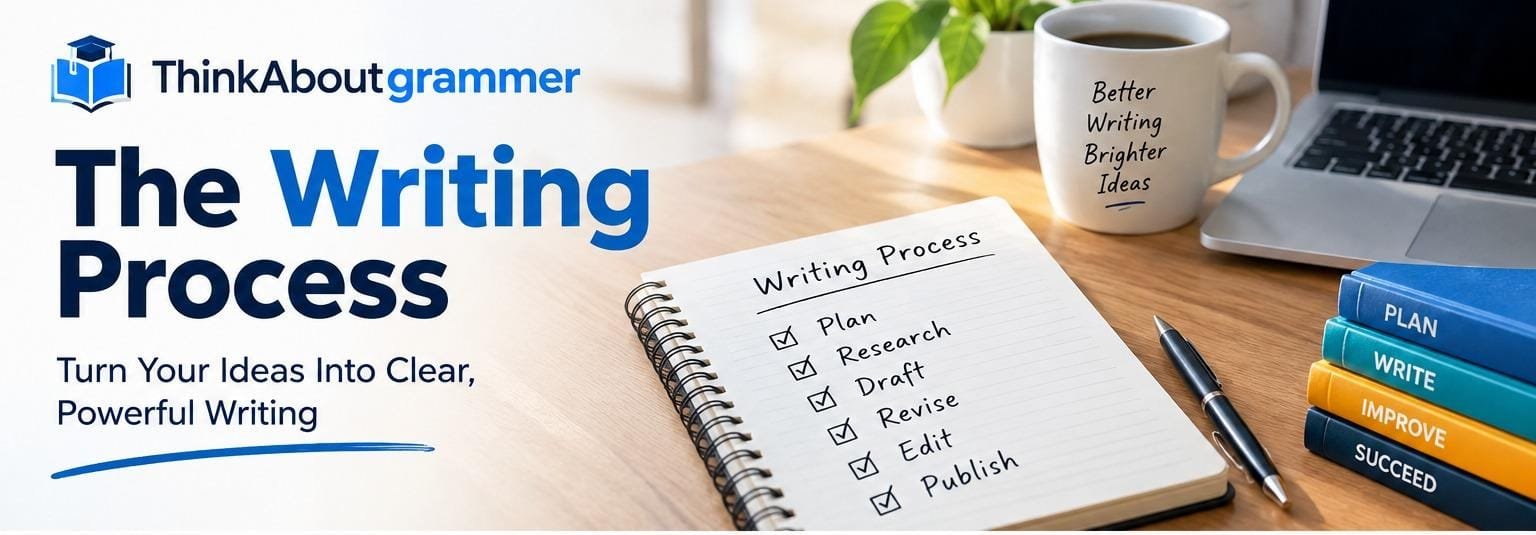
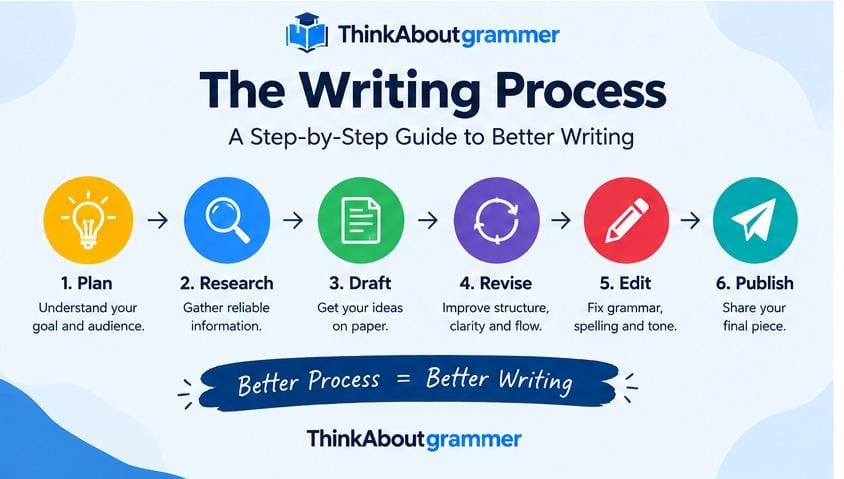
The main stages of the writing process include:
- Prewriting and planning
- Research and idea development
- Drafting
- Revising
- Editing
- Proofreading
- Publishing or sharing
Each stage has a different purpose. Skipping one or more steps can result in unclear ideas, weak organization, and avoidable mistakes.
Why Is the Writing Process Important?
Writing is not just about arranging words into sentences. Effective writing requires planning, critical thinking, and continuous improvement.
A proper writing process helps writers:
- Organize ideas logically
- Create content with a clear purpose
- Understand their audience
- Improve sentence clarity
- Reduce grammar errors
- Strengthen arguments
- Develop a consistent writing style
For example, a student writing an assignment does not usually begin with the final answer. They research the topic, create an outline, write a draft, review their work, and make improvements before submission.
Good writing is created through development, not through a single attempt.
Stages of the Writing Process
Prewriting and Planning
Prewriting is the first stage where writers prepare their ideas before creating the actual content.
At this stage, writers decide:
- What they want to write about
- Who will read the content
- What information is necessary
- What structure the writing should follow
Planning prevents confusion and helps maintain focus.
Brainstorming Ideas
Brainstorming allows writers to collect thoughts freely before organizing them.
For example:
Topic: Benefits of Exercise
Possible ideas:
- Improves physical health
- Reduces stress
- Increases energy
- Supports mental well-being
- Builds discipline
After brainstorming, these ideas can be arranged into a logical structure.
Creating an Outline
An outline works as a roadmap for writing. It helps writers understand what information should appear in each section.
Example:
Topic: Importance of Reading
Introduction
- Explain the role of reading in personal development
Body
- Improves vocabulary
- Expands knowledge
- Develops critical thinking
Conclusion
- Summarize the benefits of reading
A clear outline saves time and improves the flow of writing.
Research and Gathering Information
Research is an important part of the writing process, especially for informative, academic, or professional content.
Good research helps writers:
- Provide accurate information
- Support claims with evidence
- Understand different viewpoints
- Add valuable examples
When researching, focus on reliable sources and avoid including information that does not support your main purpose.
Tips for Effective Research
- Identify the main questions your content should answer
- Use trustworthy sources
- Take organized notes
- Compare different perspectives
- Record important facts and examples
Research should improve your writing, not make it unnecessarily complicated.
Drafting the First Version
Drafting is the stage where ideas are transformed into written content.
The first draft does not need to be perfect. The main goal is to express your thoughts clearly and create a complete version.
During drafting:
- Follow your outline
- Write naturally
- Focus on ideas first
- Avoid excessive self-editing
Many beginners make the mistake of trying to correct every sentence while writing the first draft. This interrupts creativity and slows progress.
Example of a Weak Draft
Technology is useful because people use it and it helps many things in daily life.
This sentence is too general and lacks detail.
Improved Version
Technology has improved daily life by making communication faster, increasing access to information, and helping people complete tasks more efficiently.
The improved sentence communicates specific ideas clearly.
Revising and Improving Content
Revision is one of the most important stages of the writing process. It focuses on improving the quality, structure, and meaning of your writing.
Revision involves checking:
- Are my ideas clear?
- Is the information organized properly?
- Does each paragraph support the main topic?
- Are examples useful?
- Is anything unnecessary?
During revision, writers often:
- Add missing details
- Remove repeated information
- Rearrange paragraphs
- Improve transitions
- Strengthen explanations
Example Before Revision
Social media has many users. It is useful. It also has problems.
Example After Revision
Social media has transformed communication by helping people connect instantly. However, excessive use can create challenges related to privacy, productivity, and mental well-being.
The revised version provides better explanation and stronger communication.
Editing for Grammar and Language Accuracy
Editing focuses on correcting language problems and improving sentence quality.
Important areas to review include:
- Grammar
- Spelling
- Punctuation
- Word choice
- Sentence structure
Understanding the basics of grammar helps writers create clearer sentences and communicate their ideas more effectively. Learn more about What Is Grammar to build a stronger foundation for better writing.
Common Grammar Mistakes
| Incorrect | Correct |
|---|---|
| He go to work daily. | He goes to work daily. |
| Their is a mistake. | There is a mistake. |
| She have completed the task. | She has completed the task. |
| I did not went there. | I did not go there. |
Small grammar improvements can make writing more professional and easier to understand.
Proofreading the Final Version
Proofreading is the final quality check before publishing or submitting your work.
During proofreading, check:
- Spelling mistakes
- Missing punctuation
- Formatting problems
- Typographical errors
- Sentence readability
A useful method is reading your writing aloud. This helps identify sentences that sound unnatural or unclear.
How Grammar Improves the Writing Process
Grammar provides the foundation for clear communication. However, grammar should support writing rather than prevent creativity. Along with grammar, choosing the right words plays an important role in effective writing. Improving your vocabulary can help you express ideas more clearly and make your content more engaging.
Writers should focus on ideas first and refine grammar during editing.
Sentence Structure
Clear sentences usually express one main idea.
Incorrect:
The book was helpful it explained many important concepts.
Correct:
The book was helpful because it explained many important concepts.
Verb Tense Consistency
Using consistent verb tenses improves readability.
Incorrect:
She studied English and improves her writing skills.
Correct:
She studied English and improved her writing skills.
Active and Passive Voice
Active voice often creates stronger and clearer sentences.
Passive:
The project was completed by the team.
Active:
The team completed the project.
Both forms are correct, but active voice is often more direct.
Common Mistakes in the Writing Process
Starting Without a Plan
Writing immediately without preparation can create disorganized content.
Solution: Spend a few minutes creating an outline before drafting.
Trying to Create a Perfect First Draft
Many writers waste time correcting small mistakes during their first attempt.
Solution: Write freely first, then improve your work during revision and editing.
Ignoring the Target Audience
Content becomes less effective when writers do not consider their readers.
Solution: Adjust your language, examples, and tone according to your audience.
Using Complicated Language
Complex vocabulary does not always make writing better.
Example:
Unclear:
Utilize appropriate methodologies to facilitate improvement.
Clear:
Use effective methods to improve results.
Simple and clear writing is often more powerful.
Practical Ways to Improve Your Writing Process
Read More Often
Reading helps you learn:
- Sentence patterns
- Vocabulary
- Writing styles
- Different ways of explaining ideas
Practice Regularly
Writing improves through consistent practice. Even short daily writing exercises can develop confidence and skill.
Ask for Feedback
Feedback helps identify weaknesses that you may not notice yourself.
Keep Notes of Ideas
Maintaining a notebook or digital document for ideas makes future writing easier.
Use Writing Tools Carefully
Grammar and spelling tools can help identify errors, but writers should understand why corrections are suggested.
Frequently Asked Questions About the Writing Process
What are the main stages of the writing process?
The main stages include planning, research, drafting, revising, editing, proofreading, and publishing.
Why is the writing process important?
The writing process helps writers organize ideas, improve clarity, reduce mistakes, and create more effective communication.
Is the writing process the same for every type of writing?
No. Different types of writing may require different approaches, but the basic stages remain similar.
What is the difference between revising and editing?
Revision improves ideas, organization, and overall structure. Editing focuses on grammar, spelling, punctuation, and sentence accuracy.
Should writers edit while creating the first draft?
It is usually better to focus on completing the draft first. Editing too early can slow creativity and interrupt the flow of ideas.
How can beginners improve their writing skills?
Beginners can improve by reading regularly, practicing writing, learning grammar rules, and following a structured writing process.
How long does the writing process take?
The time depends on the type and length of the content. A short article may take hours, while a detailed report may require days or weeks.
Conclusion
The writing process helps writers transform simple ideas into clear, organized, and meaningful content. By planning carefully, drafting confidently, revising thoughtfully, and editing accurately, anyone can improve their writing ability.
This process is especially valuable for online writers who create articles, blogs, and digital content. Learning professional content writing techniques can help writers produce more useful and audience-focused material.
Writing is not about creating a perfect first draft. It is about developing ideas step by step until the final version communicates the message effectively.