

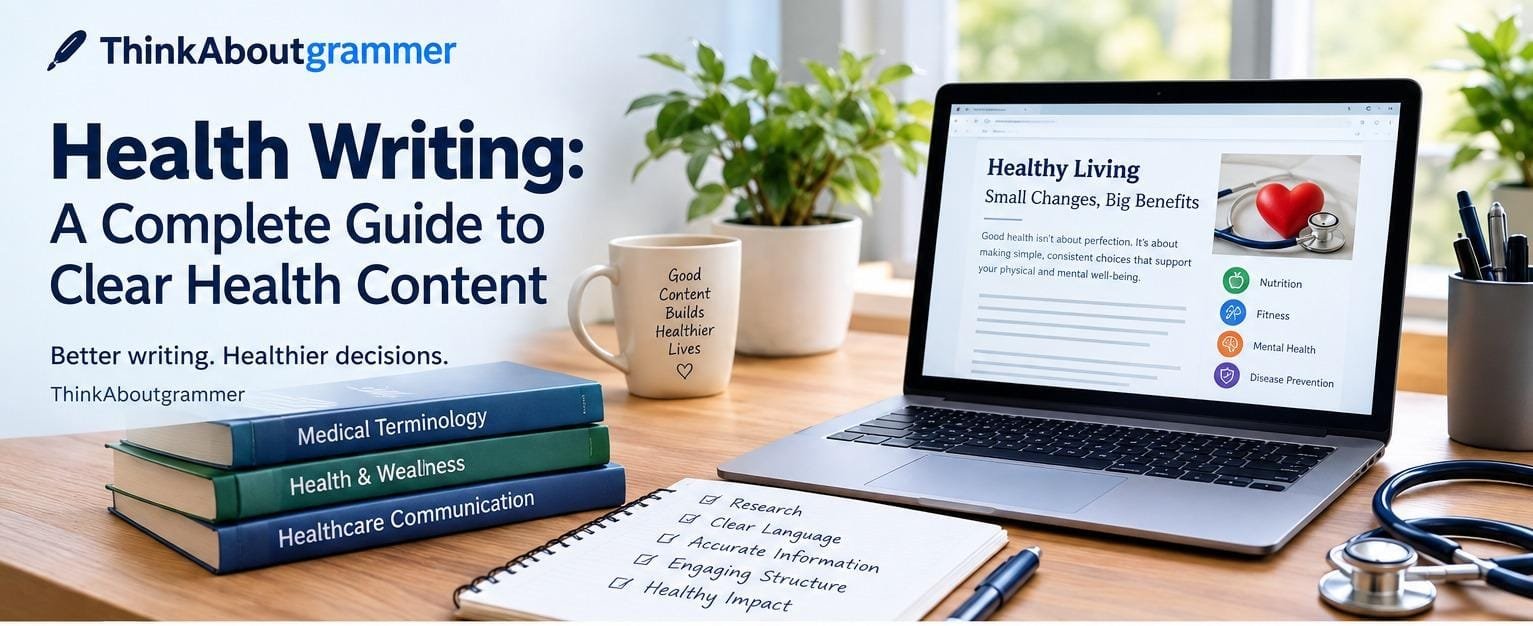
Health writing is more than putting medical information into sentences. It is the art of explaining health, wellness, medicine, and healthcare topics in a way that readers can understand, trust, and use responsibly.
- What Is Health Writing?
- Why Does Health Writing Require Special Care?
- What Makes Good Health Writing?
- How to Plan a Health Writing Article
- How to Structure Health Writing
- Use Plain Language in Health Writing
- Grammar Rules That Matter in Health Writing
- Active Voice vs. Passive Voice in Health Writing
- Avoid Overstating Health Claims
- Distinguish Correlation From Causation
- How to Write Health Information for General Readers
- Common Health Writing Mistakes
- 1. Using Too Much Medical Jargon
- 2. Making Unsupported Promises
- 3. Writing Extremely Long Sentences
- 4. Repeating the Same Point
- 5. Using Fear to Attract Clicks
- 6. Giving Individualized Medical Advice Without Enough Information
- Incorrect vs. Correct Health Writing Examples
- How to Make Health Writing More Engaging
- Research Is an Essential Part of Health Writing
- How to Write Health Headlines
- How SEO Fits Into Health Writing
- How to Use the Keyword “Health Writing” Naturally
- A Simple Health Writing Checklist
- What Is the Difference Between Health Writing and Medical Writing?
- Conclusion
A health article may discuss symptoms, treatments, nutrition, fitness, mental well-being, medical research, or everyday healthy habits. Whatever the subject, the writing needs to be especially clear because readers may use the information to make decisions about their health.
That creates a unique challenge for health writers: How do you make complex information simple without making it inaccurate?
The answer is a combination of careful research, strong grammar, plain language, logical organization, and responsible communication. For a broader introduction to grammar, see our guide on What Is Grammar.
This guide explains the fundamentals of health writing, including how to structure an article, simplify medical terminology, avoid common grammar mistakes, use examples effectively, and create content that puts the reader first.
What Is Health Writing?
Health writing is written communication about health-related subjects. It can be created for websites, hospitals, healthcare organizations, magazines, medical publications, educational resources, wellness brands, or general audiences.
Health writing is also a specialized form of content writing, where clarity and audience needs play an important role.
Health writing can include:
- Health and wellness articles
- Medical blog posts
- Patient education materials
- Healthcare website content
- Nutrition articles
- Fitness content
- Medical news
- Public health information
- Research summaries
- Healthcare newsletters
- Medication and treatment information
- Health-related social media content
Some health content can also overlap with technical communication. Learn more in our guide to What Is Technical Writing.
The intended audience can vary significantly.
A medical researcher may understand terms such as “cardiovascular risk” or “glycemic response,” while a general reader may need those concepts explained in everyday language.
Good health writing adapts to the reader.
Why Does Health Writing Require Special Care?
Health information is different from many other forms of online content because misunderstanding a sentence can have more serious consequences.
For example:
Unclear:
Patients should monitor their symptoms regularly and seek appropriate intervention when necessary.
The sentence sounds professional, but “regularly,” “appropriate intervention,” and “when necessary” are vague.
Clearer:
Keep track of changes in your symptoms. If they become severe, suddenly worsen, or concern you, contact a qualified healthcare professional.
The second version gives readers a clearer idea of what the writer means without pretending to provide a personal diagnosis.
Good health writing therefore needs three qualities:
- Accuracy — Information should be supported by reliable evidence.
- Clarity — Readers should understand the message without unnecessary jargon.
- Responsibility — The content should not exaggerate, mislead, or present general information as individualized medical advice.
What Makes Good Health Writing?
Strong health writing is not simply about using medical vocabulary. In fact, excessive technical language can make an article harder to understand.
A useful health article should generally be:
- Accurate
- Clear
- Well organized
- Evidence-aware
- Reader-focused
- Grammatically correct
- Specific where appropriate
- Careful with medical claims
- Appropriate for its intended audience
Consider these two sentences.
Less effective:
Hypertension is a cardiovascular pathology characterized by elevated arterial pressure.
More reader-friendly:
Hypertension, commonly called high blood pressure, occurs when blood pressure remains higher than the healthy range over time.
The second sentence introduces the medical term while immediately explaining it.
That is an important principle in health writing: introduce complexity only when it helps the reader.
How to Plan a Health Writing Article
Before writing the first paragraph, determine what the reader actually wants to know.
Someone searching for “health writing” might be asking:
- What is health writing?
- How do I write health content?
- What makes health writing effective?
- How can I simplify medical information?
- What grammar rules matter in health writing?
- How do I write about health responsibly?
- What mistakes should health writers avoid?
- How can I make health content easier to read?
Answering these questions gives your article a clear purpose.
Define the Audience
Ask who will read the content.
For example:
| Audience | Writing approach |
|---|---|
| General readers | Simple language and explanations |
| Patients | Practical, reassuring, understandable information |
| Healthcare professionals | More technical terminology may be appropriate |
| Students | Educational explanations and definitions |
| Parents | Clear guidance with carefully explained terminology |
| Researchers | Detailed evidence and precise terminology |
A sentence written for a medical journal may not work well on a general health blog.
Define the Main Goal
Every article should have a central purpose.
You might want to:
- Explain a health concept
- Educate readers
- Summarize research
- Explain medical terminology
- Answer common questions
- Discuss prevention
- Help readers understand healthcare information
Once the goal is clear, unnecessary information becomes easier to remove.
How to Structure Health Writing
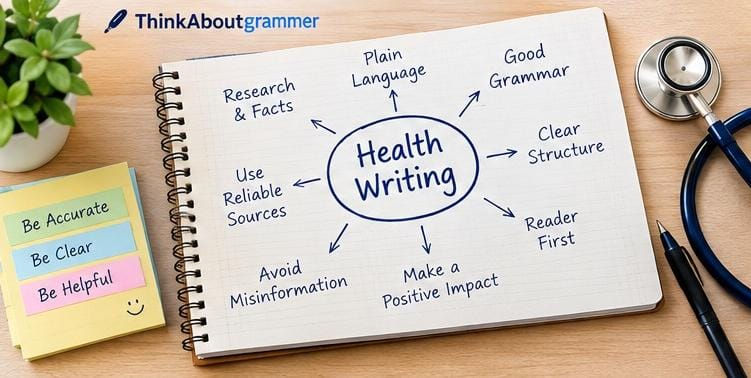
A logical structure helps readers understand complicated information.
A simple structure often looks like this:
- Introduction
- Definition or background
- Main explanation
- Important details
- Practical considerations
- Common mistakes or misconceptions
- Frequently asked questions
- Conclusion
Use headings to separate major ideas.
Use One Main Idea Per Paragraph
Long paragraphs can make health information difficult to follow.
Instead, keep paragraphs focused.
Difficult to follow:
Sleep affects many areas of health, including mood, concentration, physical performance, immune function, and daily energy, and people who do not sleep well may experience difficulties at work or school, although sleep needs vary between individuals and many different factors can influence sleep quality.
Improved:
Sleep affects several aspects of everyday health, including mood, concentration, and energy.
Sleep needs vary from person to person. Factors such as age, lifestyle, environment, and overall health can influence sleep quality.
The information is easier to process because each paragraph has a clear purpose.
Use Plain Language in Health Writing
Plain language does not mean oversimplifying the facts. It means presenting information in a way that ordinary readers can understand.
Compare:
| Technical term | Plain-language alternative |
|---|---|
| Approximately | About |
| Utilize | Use |
| Commence | Begin |
| Demonstrate | Show |
| Individuals | People |
| Subsequently | Later |
| In the event that | If |
| Prior to | Before |
| Sufficient | Enough |
| Adverse effects | Side effects or unwanted effects, when appropriate |
However, do not replace a medical term if doing so changes its meaning.
Explain Medical Terms Instead of Avoiding Them
Sometimes terminology is necessary.
For example:
Inflammation is the body’s response to injury, infection, or other triggers and can involve changes in affected tissues.
This approach teaches the reader rather than assuming they already understand the term.
A useful pattern is:
Medical term + simple definition + context
For example:
Insomnia is a sleep disorder involving persistent difficulty falling asleep, staying asleep, or getting enough restorative sleep.
The exact definition should be appropriate to the topic and supported by authoritative information.
Grammar Rules That Matter in Health Writing
Grammar matters because a small change in wording can change meaning.
Use Precise Subject-Verb Agreement
Incorrect:
The symptoms of dehydration is difficult to recognize.
Correct:
The symptoms of dehydration are difficult to recognize.
The subject is “symptoms,” which is plural.
Keep Pronouns Clear
Avoid sentences where readers cannot tell what a pronoun refers to.
Unclear:
The doctor discussed the medication with the patient because it was causing concern.
What was causing concern—the medication or something else?
Clearer:
The doctor discussed the medication with the patient because the patient was concerned about its possible effects.
Clear pronoun references are especially important in health content.
Avoid Ambiguous Modifiers
Ambiguous:
Patients should take the medication only after eating.
This could mean the medication should be taken immediately after eating, or simply that the patient should not take it on an empty stomach.
When timing matters, write it precisely and follow the authoritative instructions relevant to the medication.
Use Commas Carefully
Commas can change how a sentence is interpreted.
Less clear:
Patients who experience severe symptoms should seek medical attention.
This means only patients with severe symptoms.
Different meaning:
Patients, who experience severe symptoms, should seek medical attention.
The second construction incorrectly suggests that all patients experience severe symptoms.
The first sentence is generally the appropriate construction when identifying a specific group of patients.
Active Voice vs. Passive Voice in Health Writing
Passive voice is not automatically wrong. It is sometimes useful when the action is more important than the person performing it.
Passive:
The samples were analyzed in the laboratory.
Active:
Researchers analyzed the samples in the laboratory.
Both can be grammatically correct.
Active voice is often easier to read because it makes the actor clear.
However, health and scientific writing may legitimately use passive constructions when the researcher or practitioner is not important to the sentence.
The goal is not to eliminate passive voice completely. The goal is to use the clearest construction.
Avoid Overstating Health Claims
Health writers need to distinguish between evidence and certainty.
Words such as:
- Always
- Never
- Guaranteed
- Cure
- Prevents
- Completely eliminates
- Works for everyone
can create problems when the evidence does not support such certainty.
For example:
Overstated:
This food prevents heart disease.
More responsible:
A balanced diet that includes a variety of nutrient-rich foods can support cardiovascular health.
The second statement is more appropriately cautious.
The exact wording should depend on the strength and type of evidence available.
Distinguish Correlation From Causation

One of the most important principles in health writing is avoiding the assumption that two things being associated means one caused the other.
For example:
Researchers found an association between A and B.
does not necessarily mean:
A causes B.
If a study finds that people who regularly do something have a particular health outcome, the writer should not automatically claim that the behavior caused the outcome.
Careful health writing reflects what the evidence actually shows.
How to Write Health Information for General Readers
Imagine that your reader is intelligent but unfamiliar with medical terminology.
You do not need to remove every technical term. Instead, introduce terms naturally.
Start With the Familiar
Instead of opening with a complicated definition, begin with the reader’s problem.
For example:
Feeling tired after a poor night’s sleep is common. But when sleep problems continue, people may wonder what is affecting their sleep and when they should seek professional advice.
The opening creates context before introducing more detailed information.
Explain Why the Information Matters
Readers are more likely to understand information when they know why it matters.
Instead of:
Blood pressure is measured in millimeters of mercury.
You might write:
Blood pressure is commonly recorded in millimeters of mercury (mmHg), which is why blood pressure readings are usually written using two numbers followed by “mmHg.”
The reader receives the definition and its practical context.
Common Health Writing Mistakes
Even well-researched articles can become difficult to read when the writing itself is weak.
1. Using Too Much Medical Jargon
Problem:
The intervention may ameliorate symptomatology in certain populations.
Better:
The treatment may reduce symptoms in some people.
2. Making Unsupported Promises
Avoid presenting a product, treatment, supplement, or lifestyle change as a guaranteed solution unless the evidence genuinely supports the claim.
3. Writing Extremely Long Sentences
Long sentences often contain too many ideas.
Break them into shorter sentences when necessary.
4. Repeating the Same Point
Repeating a health claim in several sections does not make it more convincing. It usually makes the article feel padded.
5. Using Fear to Attract Clicks
Headlines such as “This Common Food Is Secretly Destroying Your Body” may attract attention, but sensational language can undermine trust.
A stronger approach is specific and informative:
How Diet Can Affect Cardiovascular Health
6. Giving Individualized Medical Advice Without Enough Information
General educational content should not pretend to know an individual reader’s diagnosis, medical history, medications, or personal circumstances.
Instead of:
You have a vitamin deficiency.
write:
Certain symptoms can have many possible causes, including nutritional deficiencies. A qualified healthcare professional can help determine the cause.
Incorrect vs. Correct Health Writing Examples
| Less effective | Improved |
|---|---|
| This treatment cures the condition in everyone. | This treatment may help manage the condition for some people. |
| People should never eat carbohydrates. | Carbohydrates are found in many foods, and their role in a person’s diet depends on the overall dietary pattern and individual needs. |
| The medication is dangerous. | The medication can cause side effects, which should be discussed with a healthcare professional. |
| This symptom means you have the disease. | This symptom can occur for several reasons and does not by itself establish a diagnosis. |
| Exercise completely prevents illness. | Regular physical activity can support overall health and may reduce the risk of some health problems. |
The improved versions avoid unnecessary certainty while still giving useful information.
How to Make Health Writing More Engaging
Clear health information does not have to be boring.
You can make an article engaging without using sensational claims.
Use Questions
Questions can introduce topics naturally:
Why does sleep affect concentration?
When should a persistent symptom be discussed with a healthcare professional?
What does a blood pressure reading actually tell you?
Use Short Examples
Examples help readers connect abstract information with everyday situations.
For example:
Imagine a reader sees the term “dehydration” in an article. Instead of assuming they understand it, the writer can explain what the term means and describe common situations in which fluid loss can occur.
Use Comparisons Carefully
A simple analogy can make a difficult concept easier to understand, but it should not distort the science.
For example:
Think of headings as signposts. They show readers where they are and what information comes next.
This analogy explains the purpose of article structure without making a medical comparison.
Research Is an Essential Part of Health Writing
Strong health content begins with reliable information.
Depending on the subject, a writer may need to consult:
- Government health agencies
- Medical institutions
- Peer-reviewed research
- Clinical guidelines
- Professional medical organizations
- Systematic reviews
- Official medication information
- Established academic sources
The source should match the claim.
A broad wellness statement may require a different type of evidence from a statement about the effectiveness or risks of a particular medical treatment.
Check the Date of Your Sources
Health research changes over time.
Before publishing an article, check:
- When the source was published
- Whether newer evidence is available
- Whether recommendations have changed
- Whether the source is still authoritative
- Whether the study actually supports your statement
Do not assume that an old article is still accurate simply because it ranks highly in search results.
How to Write Health Headlines
A good health headline should tell readers what they will learn.
Weak:
You Won’t Believe What This Does to Your Body
Better:
How Sleep Affects Your Energy and Concentration
Weak:
The Ultimate Health Secret
Better:
Practical Ways to Build Healthier Daily Habits
The second examples are clearer, more specific, and less sensational.
How SEO Fits Into Health Writing
Search engine optimization can help useful health content reach the right audience, but SEO should not control the writing.
Start with the reader’s question.
Then naturally incorporate relevant terms.
For an article about health writing, related terms may include:
- Medical writing
- Healthcare content
- Health communication
- Medical content writing
- Health education
- Patient education
- Wellness writing
- Medical terminology
- Plain language
- Health content strategy
Do not repeat the same keyword in every paragraph.
Instead, use related terminology where it naturally improves clarity.
How to Use the Keyword “Health Writing” Naturally
The primary keyword should appear in important locations without making the article sound unnatural.
Good placements include:
- Title
- Introduction
- One or more relevant headings
- Body content
- Conclusion
- SEO title
- Meta description
- URL slug
For example:
Effective health writing combines accurate information with clear language and reader-focused organization.
This uses the keyword naturally because it contributes meaning to the sentence.
A Simple Health Writing Checklist
Before publishing an article, review it against this checklist.
Accuracy
- Are the main claims supported?
- Did you distinguish evidence from opinion?
- Did you avoid unsupported medical promises?
- Are statistics and dates accurate?
- Did you check whether newer evidence exists?
Grammar
- Do subjects and verbs agree?
- Are pronouns clear?
- Are commas used correctly?
- Are sentences easy to follow?
- Have unnecessary words been removed?
Readability
- Are paragraphs reasonably short?
- Are headings descriptive?
- Have technical terms been explained?
- Are examples useful?
- Can a general reader understand the main message?
Responsibility
- Have you avoided unnecessary fear?
- Have you avoided guaranteeing outcomes?
- Have you avoided presenting general information as an individual diagnosis?
- Are recommendations appropriately qualified?
What Is the Difference Between Health Writing and Medical Writing?
Health writing and medical writing overlap, but they are not identical.
Health writing is a broad category that can cover everyday wellness, nutrition, fitness, public health, healthcare, and general medical information.
Medical writing often involves more specialized content, such as clinical research, regulatory documents, scientific publications, medical education, or technical healthcare materials.
A simple way to think about the difference is:
Health writing often translates health information for a broader audience, while medical writing may communicate highly specialized scientific or clinical information.
The audience and purpose determine the appropriate level of detail.
Frequently Asked Questions About Health Writing
What is health writing?
Health writing is the creation of written content about health, medicine, wellness, healthcare, nutrition, fitness, or related subjects. Effective health writing combines accuracy, clarity, appropriate terminology, and responsible communication.
How do I become better at health writing?
Start by improving three areas: research, writing, and health literacy. Learn how to evaluate reliable sources, explain technical concepts in plain language, structure articles logically, and edit your work for accuracy and grammar.
Why is grammar important in health writing?
Grammar improves clarity and precision. A poorly structured sentence can make health information confusing or change its intended meaning. Clear grammar helps readers understand important information correctly.
Should health writers use medical terminology?
Yes, when terminology is necessary, but unfamiliar terms should usually be explained. The goal is not to remove medical language completely; it is to make important terminology understandable to the intended audience.
How long should a health article be?
There is no universal ideal length. An article should be long enough to answer the reader’s question thoroughly without adding unnecessary information. Search intent and usefulness are more important than reaching an arbitrary word count.
Can health writing be conversational?
Yes. A conversational style can make complex information easier to understand. However, the tone should remain accurate, respectful, and appropriate for the seriousness of the subject.
What are the biggest mistakes in health writing?
Common mistakes include using excessive jargon, making unsupported claims, confusing correlation with causation, relying on outdated information, writing unclear sentences, and using sensational language to attract clicks.
How can I make health content easier to read?
Use short paragraphs, descriptive headings, plain language, clear examples, active voice where appropriate, and logical transitions. Introduce technical terms only when they add value and explain them when readers may not know them.
Conclusion
Effective health writing is a balance between information and communication. A writer needs to understand the subject, research it carefully, explain it clearly, and recognize the responsibility that comes with publishing health-related information.
The best approach is simple: write for the reader, not for the medical dictionary or the search engine.
Use accurate sources, explain unfamiliar terminology, avoid exaggerated claims, check your grammar, and organize information so readers can find what they need.
When health information is both trustworthy and easy to understand, good writing becomes more than a communication skill—it becomes a useful tool for health education.