


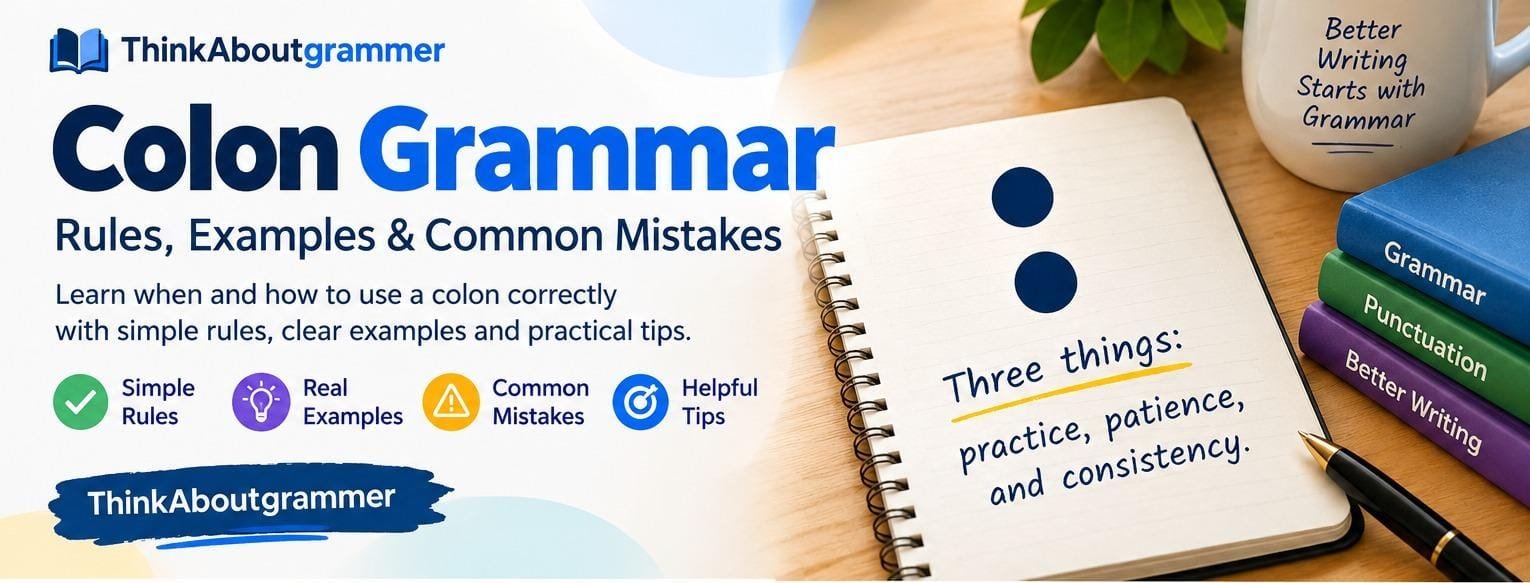
A colon is a small punctuation mark that can make a big difference in how a sentence reads. Written as two vertically aligned dots (:), a colon tells the reader that something important is about to follow—such as an explanation, example, list, or clarification.
- What Is a Colon in Grammar?
- When Should You Use a Colon?
- Colon Grammar for Introducing a List
- Using a Colon to Introduce an Explanation
- Using a Colon Before an Example
- Colon Grammar and Quotations
- Can You Use a Colon Between Two Complete Sentences?
- Should the Word After a Colon Be Capitalized?
- When the Following Material Is a List
- When the Following Material Is a Complete Sentence
- When Introducing a Formal Quotation
- Colon Grammar in Titles and Headings
- Using Colons With “For Example”
- Colon vs. Comma
- Colon vs. Semicolon
- Colon vs. Dash
- Common Colon Grammar Mistakes
- Mistake 1: Using a Colon After an Incomplete Sentence
- Mistake 2: Using a Colon After “Including”
- Mistake 3: Using a Colon Between a Subject and Its Verb
- Mistake 4: Overusing Colons
- Can a Colon Introduce a Single Word?
- Can a Colon Introduce a Phrase?
- Can a Colon Introduce Multiple Sentences?
- Colons in Formal Writing
- Colons in Informal Writing
- A Simple Test for Using a Colon
- Step 1: Look at the Words Before the Colon
- Step 2: Examine What Comes After It
- Step 3: Remove the Colon
- Step 4: Check for Existing Introducers
- Colon Grammar Examples: Correct vs. Incorrect
- Advanced Uses of the Colon
- A Practical Checklist for Colon Use
- Quick Colon Grammar Rules to Remember
- Conclusion: Mastering Colon Grammar
But when should you actually use one?
Many writers understand that colons can introduce lists, yet colon grammar goes beyond that. A colon can connect a complete statement to an explanation, introduce examples, highlight a conclusion, or create emphasis. At the same time, using a colon where it does not belong can make an otherwise correct sentence grammatically awkward.
This guide explains colon grammar in simple terms. If you are still building your grammar foundation, our guide on what is grammar is a helpful place to start. You will learn the major rules, see incorrect and correct examples, understand when capitalization is appropriate, and discover common mistakes to avoid.
What Is a Colon in Grammar?
A colon (:) is a punctuation mark used to introduce information that is closely connected to what comes before it.
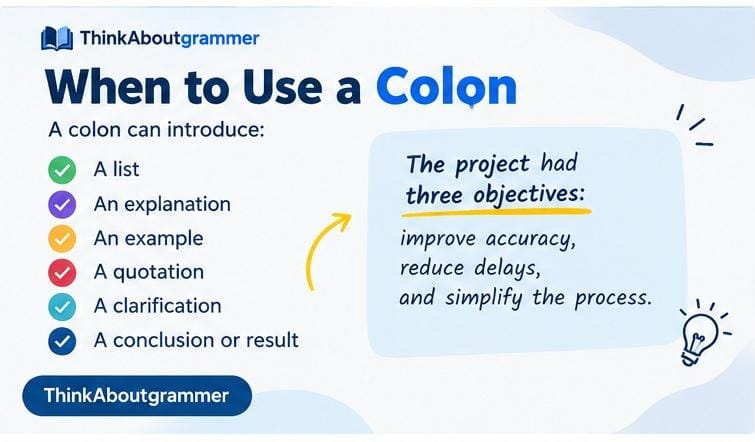
The information after a colon might be:
- A list
- An explanation
- An example
- A quotation
- A clarification
- A conclusion or result
For example:
She packed everything she needed: a notebook, two pens, and a water bottle.
The words before the colon form a complete thought, while the information after it explains what “everything” includes.
A useful way to think about a colon is:
“Here is what I mean.”
When Should You Use a Colon?
There are several common situations in which a colon is grammatically appropriate.
The most important ones are:
- Introducing a list
- Introducing an explanation
- Introducing an example
- Introducing a quotation
- Connecting a statement with a closely related clarification
- Adding emphasis in certain styles of writing
Let’s examine each use carefully.
Colon Grammar for Introducing a List
One of the most familiar uses of a colon is introducing a list.
Use a Colon After a Complete Sentence
The words before the colon should generally be able to stand alone as a complete sentence.
Correct:
We need three things: paper, pencils, and folders.
The first part—”We need three things”—is grammatically complete.
Incorrect List Introduction
A common mistake is putting a colon directly after a verb or preposition when the sentence does not need one.
Incorrect:
We need: paper, pencils, and folders.
Correct:
We need paper, pencils, and folders.
Why? The verb “need” already connects directly to the list. The colon interrupts the grammatical structure unnecessarily.
More Examples
Correct:
The recipe requires four ingredients: flour, eggs, milk, and sugar.
Correct:
She bought several things for school: notebooks, pens, folders, and a calculator.
Incorrect:
The four ingredients are: flour, eggs, milk, and sugar.
Better:
The four ingredients are flour, eggs, milk, and sugar.
Or:
The recipe requires four ingredients: flour, eggs, milk, and sugar.
Using a Colon to Introduce an Explanation
A colon can introduce an explanation of the statement that comes before it.
For example:
There was one problem: nobody knew where the key was.
The second part explains the “one problem.”
Other examples include:
I knew what I had to do: apologize.
She had a simple reason for leaving: she was exhausted.
The situation became clear: the project needed more time.
In each case, the information after the colon expands or explains the first part.
Using a Colon Before an Example
Colons can also introduce examples.
For instance:
Some fruits are particularly high in vitamin C: oranges, strawberries, and kiwi.
The list provides examples of the category mentioned before the colon.
You can also use phrases such as “the following” before a colon:
Remember the following rule: always check your work before submitting it.
Or:
Consider this example: the sentence contains two independent clauses.
Colon Grammar and Quotations
A colon can introduce a quotation when the material before the quotation forms a complete sentence.
For example:
The teacher gave the class one important instruction: “Read the question carefully.”
Another example:
The article ends with a simple message: “Small improvements can make a big difference.”
Whether the first word of the quotation is capitalized depends on the quotation’s grammatical and stylistic context.
For a complete sentence presented as a direct quotation, capitalization is normally appropriate.
Can You Use a Colon Between Two Complete Sentences?
Yes, but the relationship between the sentences matters.
A colon can connect two independent clauses when the second clause explains, illustrates, or expands the first.
For example:
She had one goal: she wanted to finish the project before Friday.
The second clause explains the first.
Another example:
There was only one reasonable option: we had to start again.
The colon creates a clear connection between the statement and its explanation.
Colon vs. Semicolon
This is where writers sometimes become confused.
A semicolon generally connects closely related independent clauses:
The weather changed quickly; we went home.
A colon signals that the second part explains, illustrates, or expands the first:
The weather changed quickly: heavy rain began within minutes.
The punctuation depends on the relationship between the ideas. Learning about full stop punctuation can also help you understand how different punctuation marks affect sentence structure and meaning.
Should the Word After a Colon Be Capitalized?
This question has a slightly more complicated answer because capitalization rules vary by style and situation.
When the Following Material Is a List
Usually, the first word of an ordinary list is not capitalized unless it is a proper noun.
She visited three cities: London, Paris, and Rome.
“London,” “Paris,” and “Rome” are capitalized because they are proper nouns, not because they follow a colon.
When the Following Material Is a Complete Sentence
Different style guides handle this differently.
For example:
He finally understood the problem: The instructions were unclear.
Some styles capitalize the first word when the material after the colon is a complete sentence. Other styles may use lowercase.
The safest approach is to follow the style guide required for your writing.
When Introducing a Formal Quotation
If the quotation is a complete sentence, its first word is generally capitalized:
The speaker offered this advice: “Always ask questions when something is unclear.”
Colon Grammar in Titles and Headings
Colons are common in titles because they separate a main idea from a more specific explanation.
For example:
Colon Grammar: A Complete Guide
Healthy Study Habits: Tips for Students
Grammar Basics: Understanding Punctuation
The part before the colon gives the broad topic, while the part after it provides additional information.
In titles, capitalization follows the style being used.
Using Colons With “For Example”
A colon can introduce examples after a complete statement.
Correct:
Several punctuation marks are commonly used in English: for example, commas, semicolons, and colons.
However, this construction can sometimes feel awkward.
A more natural version might be:
Several punctuation marks are commonly used in English, such as commas, semicolons, and colons.
Or:
Several punctuation marks are commonly used in English. For example, commas and semicolons are common.
The colon is optional depending on how the sentence is structured.
Colon vs. Comma
A comma is generally weaker than a colon.
Compare:
She brought everything she needed, including a notebook and pen.
with:
She brought everything she needed: a notebook, pen, and calculator.
The colon gives stronger emphasis to what follows.
A Common Mistake
Do not automatically replace every comma with a colon.
Incorrect:
My favorite subjects are: English and history.
Correct:
My favorite subjects are English and history.
The phrase “My favorite subjects are” is not a complete sentence by itself, so the colon is unnecessary.
Colon vs. Semicolon
Although they look similar, colons and semicolons perform different jobs.
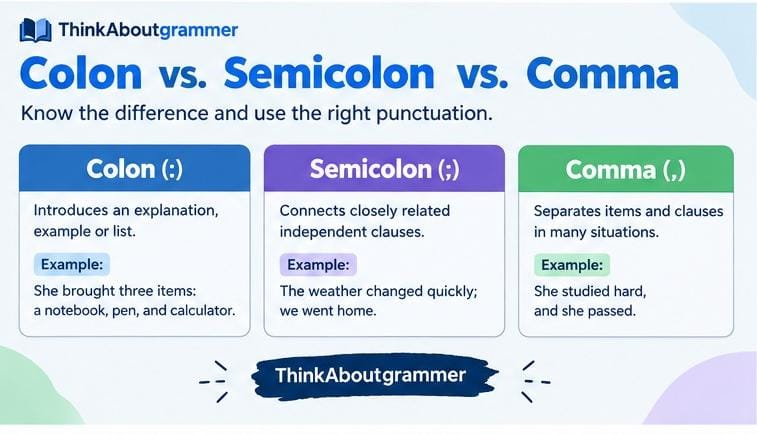
| Punctuation | Main Function | Example |
|---|---|---|
| Colon (:) | Introduces an explanation, example, or list | She brought three items: a pen, book, and notebook. |
| Semicolon (;) | Connects closely related independent clauses | She studied hard; she wanted to pass. |
| Comma (,) | Separates elements and clauses in many sentence structures | She studied hard, and she passed. |
A simple memory trick is:
Colon = “Here comes an explanation.”
Semicolon = “These two sentences are closely connected.”
Colon vs. Dash
A colon and an em dash can sometimes introduce similar information, but they create different effects. Another useful punctuation topic to explore is ellipses in grammar, which explains how three dots can affect pauses, omissions, and tone in writing.
Compare:
There was one thing he wanted: an answer.
There was one thing he wanted—an answer.
The colon feels more formal and structured. The dash tends to create stronger emphasis or a more conversational effect.
For academic and professional writing, a colon is often a clear choice when introducing an explanation.
Common Colon Grammar Mistakes
Knowing what not to do is just as useful as knowing the rules.
Mistake 1: Using a Colon After an Incomplete Sentence
Incorrect:
My favorite hobbies are: reading, drawing, and cycling.
Correct:
My favorite hobbies are reading, drawing, and cycling.
Or:
I have three favorite hobbies: reading, drawing, and cycling.
The second version works because the words before the colon form a complete statement.
Mistake 2: Using a Colon After “Including”
Incorrect:
Several sports are popular, including: football, tennis, and basketball.
Correct:
Several sports are popular, including football, tennis, and basketball.
“Including” already introduces the examples, so the colon is unnecessary.
Mistake 3: Using a Colon Between a Subject and Its Verb
Incorrect:
The main reasons for the change are: cost and efficiency.
Correct:
The main reasons for the change are cost and efficiency.
A colon should not separate a subject from its verb.
Mistake 4: Overusing Colons
A colon can be useful, but too many can make writing feel mechanical.
Compare:
There were three problems: the schedule was late: the budget was limited: and the team was understaffed.
This is difficult to read.
A clearer version is:
There were three problems: the schedule was late, the budget was limited, and the team was understaffed.
Good punctuation should make relationships between ideas clearer, not more complicated.
Can a Colon Introduce a Single Word?
Yes.
A colon does not require a long list.
For example:
There was only one answer: yes.
Or:
She wanted one thing: peace.
The material after the colon can be a single word, phrase, sentence, or list, as long as the grammatical relationship works.
Can a Colon Introduce a Phrase?
Yes.
For example:
He had only one priority: finishing the assignment.
The phrase “finishing the assignment” explains what his priority was.
Another example:
She followed one simple rule: never give up.
Can a Colon Introduce Multiple Sentences?
In some forms of writing, yes.
For example:
The instructions were simple: First, read the question. Next, identify the key information. Finally, write your answer.
Here, the colon introduces a series of related instructions.
However, if the material after the colon becomes lengthy, consider whether separate sentences or a numbered list would make the information easier to read.
Colons in Formal Writing
Colons are especially useful in academic, professional, and informational writing because they create clear relationships between ideas.
For example:
The study reached an important conclusion: regular practice improves familiarity with complex tasks.
Or:
The report identified three priorities: accuracy, efficiency, and consistency.
The punctuation helps the reader immediately understand that the second part develops the first.
Colons in Informal Writing
Colons can also appear in informal writing, although the style may be more relaxed.
For example:
Here’s the problem: we don’t have enough time.
The good news: everything is ready.
In casual writing, sentence fragments sometimes appear after a colon for emphasis. Whether this is appropriate depends on the tone and context.
A Simple Test for Using a Colon
When you’re unsure whether a colon belongs in a sentence, try this method:
Step 1: Look at the Words Before the Colon
Ask:
Can this part stand alone as a complete sentence?
If the answer is no, a colon is often unnecessary.
Step 2: Examine What Comes After It
Ask:
Does the second part explain, illustrate, identify, or expand the first part?
If yes, a colon may be appropriate.
Step 3: Remove the Colon
Read the sentence without the colon.
If the sentence works perfectly without it, decide whether the colon adds useful emphasis or clarity.
Step 4: Check for Existing Introducers
Look for words such as:
- including
- such as
- because
- for example
- are
- is
- consists of
Sometimes these words already perform the job you were planning to give the colon.
Colon Grammar Examples: Correct vs. Incorrect
Here are several examples to make the rules easier to remember.
| Incorrect | Correct |
|---|---|
| I bought: apples and oranges. | I bought apples and oranges. |
| I bought two fruits: apples and oranges. | I bought two fruits: apples and oranges. |
| The options are: A, B, and C. | The options are A, B, and C. |
| She had one goal: to improve. | She had one goal: to improve. |
| He brought several tools: a hammer, a screwdriver, and pliers. | He brought several tools: a hammer, a screwdriver, and pliers. |
| Including: books and notebooks, the bag was heavy. | Including books and notebooks, the bag was heavy. |
The key pattern is simple: avoid placing a colon where it unnecessarily breaks the grammatical structure of the sentence.
Advanced Uses of the Colon
Once you understand the basic rules, you can use colons more deliberately.
Introducing a Conclusion
A colon can introduce a conclusion that follows naturally from the previous statement.
The evidence was clear: the plan needed to change.
Creating Emphasis
A colon can draw attention to a particularly important word or phrase.
She knew exactly what she wanted: freedom.
Introducing a Definition
A colon can introduce a definition or clarification.
There is one important distinction: accuracy is not the same as clarity.
Introducing a Series of Statements
A colon can introduce several related points.
The project had three objectives: improve accuracy, reduce delays, and simplify the process.
A Practical Checklist for Colon Use
Before using a colon, ask yourself these questions:
- Is the material before the colon grammatically complete?
- Does what follows explain, identify, illustrate, or expand the previous idea?
- Am I introducing a list or series?
- Could another word already introduce the information?
- Would the sentence be clearer without the colon?
- Am I following the capitalization and style rules required for my type of writing?
If the colon passes these checks, it is probably being used effectively.
Quick Colon Grammar Rules to Remember
If you only remember a few rules, remember these:
- Use a colon to introduce a list after a complete statement.
- Use a colon to introduce an explanation or clarification.
- Use a colon to introduce an example or quotation when appropriate.
- Do not put a colon directly after a verb or preposition when it unnecessarily interrupts the sentence.
- Do not separate a subject from its verb with a colon.
- Capitalization after a colon depends on the material that follows and the style guide being used.
- Avoid using too many colons in the same passage.
- Choose a colon because it clarifies the relationship between ideas, not simply because a list follows.
Frequently Asked Questions About Colon Grammar
What is the main purpose of a colon?
The main purpose of a colon is to signal that additional information is coming. This information may explain, illustrate, identify, or expand what came before it.
Can you use a colon before a list?
Yes. A colon can introduce a list when the words before it form a complete grammatical statement.
Example:
Bring these items: a notebook, pen, and calculator.
Should you capitalize after a colon?
Not always. Capitalization depends on what follows and the style guide being used. A normal list generally does not require capitalization, while a complete sentence or formal quotation may be capitalized depending on the style.
Can a colon replace a semicolon?
Not automatically. A colon and semicolon have different functions. A colon generally introduces or explains information, while a semicolon connects closely related independent clauses.
Can a colon be used before one word?
Yes. A colon can introduce a single word when that word explains or identifies the preceding statement.
Example:
There was only one choice: wait.
Is it wrong to use a colon after “are”?
Usually, yes, when the colon simply separates “are” from the information that completes the sentence.
Incorrect:
The colors are: red, blue, and green.
Correct:
The colors are red, blue, and green.
But you can restructure the sentence:
There are three colors: red, blue, and green.
What is the easiest way to remember colon grammar?
Think of a colon as saying:
“Here is what I mean.”
If the information after the colon explains, identifies, or illustrates what came before it, the colon may be appropriate.
What is the difference between a colon and a comma?
A colon usually introduces information that expands on a preceding statement. A comma has many functions, including separating items in a series and joining certain sentence elements.
Conclusion: Mastering Colon Grammar
Understanding colon grammar becomes much easier once you focus on the relationship between the two parts of a sentence.
Use a colon when you want to introduce a list, explanation, example, quotation, clarification, or other information that directly develops the preceding statement. Most importantly, avoid inserting a colon simply because a list appears later in the sentence.
The most useful rule to remember is simple: the material before a colon should generally form a complete thought, and the material after it should meaningfully explain or expand that thought.
With regular practice, colons become less of a punctuation problem and more of a useful tool for making your writing organized, precise, and easy to follow.