

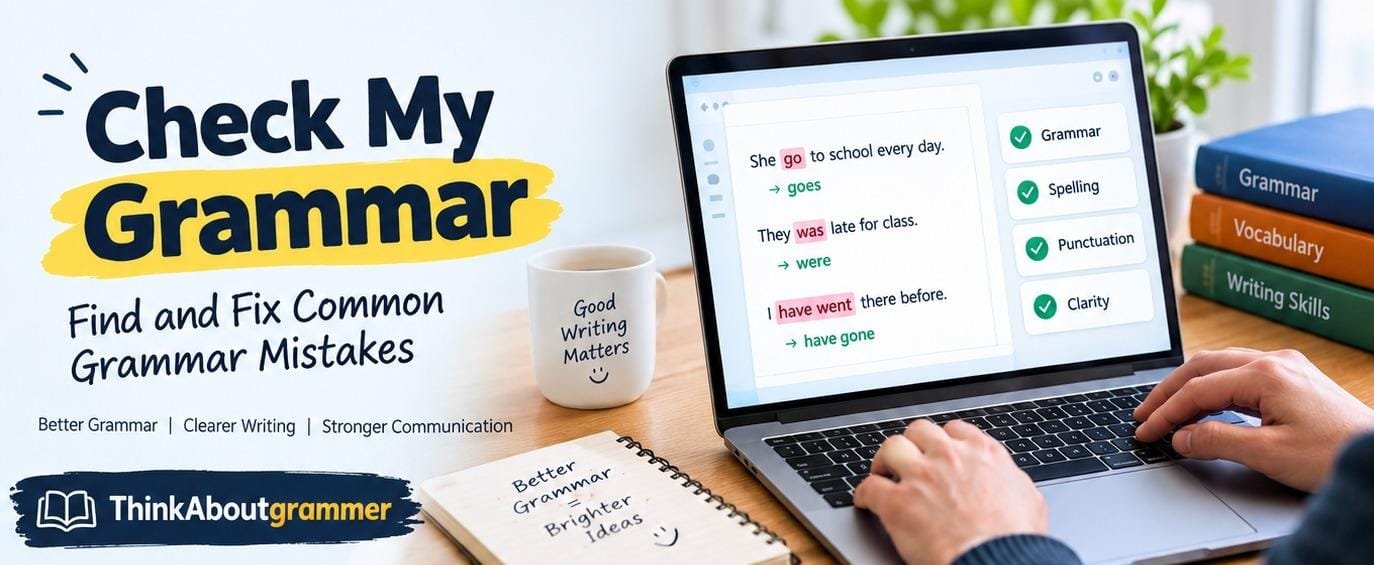
If you have ever written an email, essay, assignment, blog post, or important message and wondered, “Can you check my grammar?”, you are not alone. Even strong writers make grammar mistakes, especially when writing quickly.
- What Does “Check My Grammar” Mean?
- Why Should You Check Your Grammar?
- How to Check My Grammar Step by Step
- 1. Read the Complete Sentence
- 2. Check the Subject and Verb
- 3. Check Verb Tenses
- 4. Look for Missing Words
- 5. Check Pronouns
- Common Grammar Mistakes to Watch For
- Grammar vs. Spelling: What Is the Difference?
- How to Check Grammar in an Essay
- How to Check Grammar in an Email
- Should You Use a Grammar Checker?
- How to Check My Grammar Without a Tool
- Incorrect vs. Correct Grammar Examples
- When Is a Sentence Grammatically Correct but Still Weak?
- A Simple Grammar-Checking Checklist
- Conclusion
Checking grammar is more than finding spelling errors. Good proofreading can reveal problems with sentence structure, verb tense, punctuation, subject-verb agreement, word choice, and clarity.
This guide explains how to check my grammar effectively, what mistakes to look for, and how to improve your writing step by step.
What Does “Check My Grammar” Mean?
When someone asks to check their grammar, they usually want their writing reviewed for mistakes and improved where necessary.
If you want to understand the basics first, learn more about What Is Grammar and how grammar shapes clear writing.
A grammar check may look for:
- Incorrect verb forms
- Subject-verb agreement errors
- Sentence fragments
- Run-on sentences
- Incorrect punctuation
- Confusing sentence structure
- Incorrect word usage
- Pronoun errors
- Tense inconsistencies
- Spelling mistakes
- Missing or unnecessary words
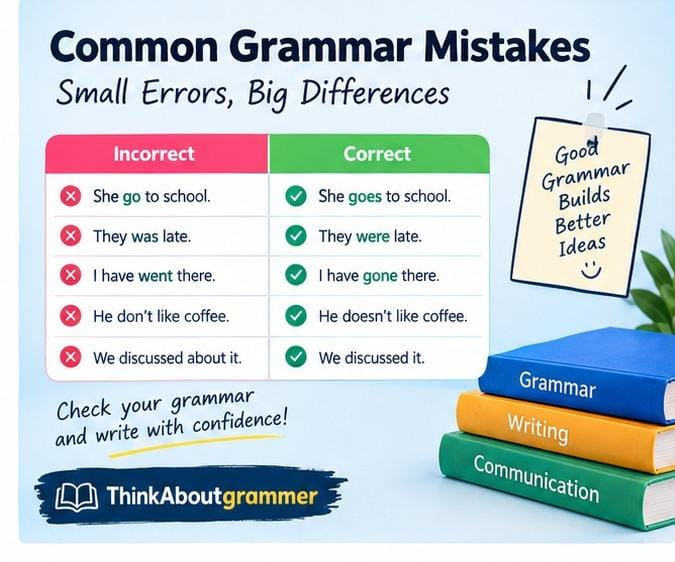
For example:
| Incorrect | Correct |
|---|---|
| She go to school every day. | She goes to school every day. |
| They was late for class. | They were late for class. |
| I have went there before. | I have gone there before. |
| He don’t like coffee. | He doesn’t like coffee. |
| We discussed about the problem. | We discussed the problem. |
A useful grammar check should explain why something is incorrect instead of simply changing the sentence.
Why Should You Check Your Grammar?
Grammar affects how clearly your ideas are understood. A small mistake can sometimes make a sentence confusing or change its meaning.
Correct grammar is particularly important in:
- Academic writing
- Professional emails
- Resumes and cover letters
- Business communication
- Blog articles
- Reports
- Social media posts
- Applications and formal documents
Good grammar also makes your writing easier to read. Readers can focus on your ideas instead of stopping to interpret awkward or incorrect sentences.
How to Check My Grammar Step by Step
You do not need to correct everything at once. A simple proofreading process can make grammar checking much easier.
1. Read the Complete Sentence
Start by reading each sentence from beginning to end.
Do not immediately focus on individual words. First ask:
Does the sentence make sense?
For example:
Although the weather was bad.
This is not a complete sentence because it begins with “although” but does not finish the thought.
A better version is:
Although the weather was bad, we continued our trip.
2. Check the Subject and Verb
The subject and verb should agree in number.
Incorrect:
The students studies every evening.
Correct:
The students study every evening.
Incorrect:
My brother play football.
Correct:
My brother plays football.
A useful question is:
Who or what is doing the action?
Then make sure the verb matches that subject.
3. Check Verb Tenses
Make sure your verbs use the correct tense and remain consistent when the context requires it.
Incorrect:
Yesterday, I go to the market and buy some fruit.
Correct:
Yesterday, I went to the market and bought some fruit.
For a completed action in the past, the past tense is generally needed.
4. Look for Missing Words
Sometimes a sentence sounds almost correct but is missing an important word.
Incorrect:
She interested in photography.
Correct:
She is interested in photography.
Reading your writing slowly can help you notice these omissions.
5. Check Pronouns
Pronouns should clearly refer to the correct person or thing.
Unclear:
Sarah told Maria that she needed more time.
Who needed more time—Sarah or Maria?
A clearer version might be:
Sarah told Maria that Sarah needed more time.
Or:
Sarah told Maria, “I need more time.”
Clarity matters just as much as grammatical correctness.
Grammar-checking tools can also make proofreading easier. If you want to explore one popular option, check our guide to QuillBot Grammar.
Common Grammar Mistakes to Watch For
Some errors appear frequently in everyday English writing.
Subject-Verb Agreement
Incorrect:
The list of items are on the desk.
Correct:
The list of items is on the desk.
The subject is list, not items, so the singular verb “is” is appropriate.
Their, There, and They’re
These words sound similar but have different meanings.
- Their = belonging to them
- There = a place or introduces something
- They’re = they are
Examples:
Their house is near the school.
The books are over there.
They’re coming tomorrow.
Your and You’re
- Your = belonging to you
- You’re = you are
Incorrect:
Your going to enjoy this book.
Correct:
You’re going to enjoy this book.
Its and It’s
- Its = belonging to it
- It’s = it is or it has
Example:
The company changed its policy.
It’s important to read the instructions.
Affect and Effect
These words can be confusing because both are common in formal writing.
Affect is commonly used as a verb:
Lack of sleep can affect your concentration.
Effect is commonly used as a noun:
Lack of sleep can have an effect on concentration.
The exact choice depends on how the word is being used in the sentence.
Grammar vs. Spelling: What Is the Difference?
Grammar and spelling are related, but they are not the same thing.
Spelling concerns whether a word is written correctly.
Incorrect: recieve
Correct: receive
Grammar concerns how words are structured and used.
Incorrect: She don’t understand.
Correct: She doesn’t understand.
A complete writing review should ideally check both.
How to Check Grammar in an Essay
Essays often contain longer and more complicated sentences, so proofreading them requires extra attention.
Try this process:
- Read the essay once for overall meaning.
- Check each sentence for grammatical errors.
- Check subject-verb agreement.
- Check verb tense consistency.
- Review punctuation.
- Look for repeated words.
- Break up unnecessarily long sentences.
- Read the final version aloud.
Example
Before:
Many students use technology in education and it help them learn faster but sometimes they use it incorrectly which can cause problems.
After:
Many students use technology in education, and it can help them learn more efficiently. However, using technology incorrectly can create problems.
The revised version separates several ideas and makes the relationship between them clearer.
How to Check Grammar in an Email
Professional emails should be clear, polite, and easy to understand.
Before
Hi, I am writing this email because I want to know that when will you send the documents.
After
Hi, I am writing to ask when you will send the documents.
The second version is shorter and more natural.
Before sending an important email, check:
- Greeting
- Sentence structure
- Verb tense
- Punctuation
- Names and dates
- Spelling
- Closing
Should You Use a Grammar Checker?
Grammar-checking software can be useful, particularly when you are proofreading a large amount of text.
It can help identify:
- Basic grammar mistakes
- Spelling errors
- Punctuation problems
- Repeated words
- Some awkward constructions
- Potential clarity issues
If you want to compare different tools, explore our guide to the Best Online Grammar Checkers.
However, automated suggestions should not always be accepted automatically.
A tool may suggest a change that does not fit your intended meaning, writing style, or context. It is better to understand the suggestion before making the change.
How to Check My Grammar Without a Tool
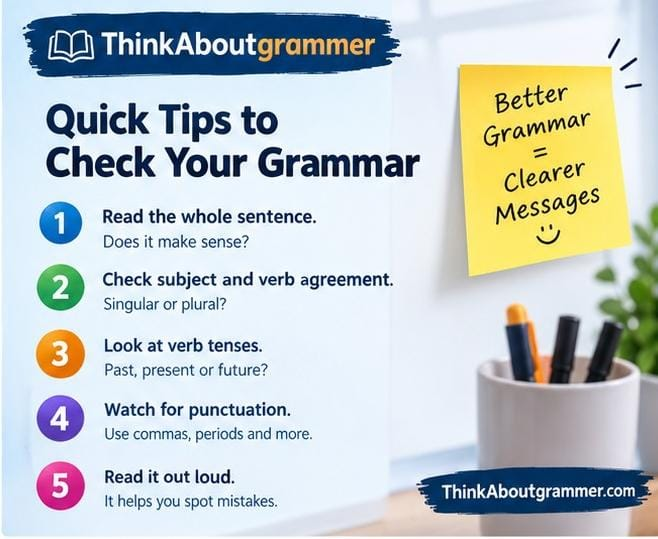
You can also proofread your writing manually.
Read Aloud
Reading aloud can make awkward sentences easier to notice.
Read Backward for Spelling
For spelling-focused proofreading, read sentences from the end toward the beginning. This reduces the tendency to focus on the meaning and can help you notice individual words.
Take a Short Break
If possible, leave your writing for a while before proofreading it. Returning with fresh attention can make mistakes easier to spot.
Check One Problem at a Time
Instead of looking for everything simultaneously, use separate passes:
- First pass: grammar
- Second pass: punctuation
- Third pass: spelling
- Fourth pass: clarity
This makes proofreading less overwhelming.
Incorrect vs. Correct Grammar Examples
Here are several common examples:
| Incorrect | Correct |
|---|---|
| He have a new car. | He has a new car. |
| I didn’t went there. | I didn’t go there. |
| She can sings well. | She can sing well. |
| There is many reasons. | There are many reasons. |
| I am agree with you. | I agree with you. |
| He is good in mathematics. | He is good at mathematics. |
| We need to discuss about this. | We need to discuss this. |
| She explained me the problem. | She explained the problem to me. |
Notice that some errors involve more than one word. Grammar is about the relationship between words within a sentence.
When Is a Sentence Grammatically Correct but Still Weak?
A sentence can be grammatically correct and still be difficult to read.
For example:
Due to the fact that the meeting was postponed, we were in a situation where we had to wait until another date was arranged.
This is grammatically understandable, but it is unnecessarily wordy.
A clearer version is:
Because the meeting was postponed, we had to wait for a new date.
Good writing is not only about avoiding mistakes. It is also about communicating ideas clearly and efficiently.
A Simple Grammar-Checking Checklist
Before submitting or publishing your writing, ask yourself:
- Does every sentence express a complete thought?
- Does each subject agree with its verb?
- Are the verb tenses appropriate?
- Are pronouns clear?
- Are articles such as “a,” “an,” and “the” used correctly?
- Is the punctuation correct?
- Have I confused similar words?
- Are any sentences unnecessarily long?
- Have I repeated the same words too often?
- Does the writing sound natural when read aloud?
If you can answer these questions confidently, your final draft will usually be much stronger.
Frequently Asked Questions
What does “check my grammar” mean?
“Check my grammar” usually means reviewing written English for grammar, punctuation, spelling, sentence structure, word usage, and clarity problems.
Can I check my grammar myself?
Yes. Reading your work slowly, checking subject-verb agreement and verb tenses, and proofreading punctuation can help you find many common mistakes.
What is the best way to check grammar?
A combination of careful proofreading and grammar-checking tools can be useful. Always review suggested corrections yourself to make sure they match your intended meaning.
Does a grammar checker fix spelling mistakes too?
Many grammar checkers also identify common spelling errors, but their features differ. A separate spelling review can still be useful.
Why is my grammar correct but my writing sounds awkward?
Grammar correctness and natural writing are different. A sentence can follow grammatical rules while still being too long, repetitive, formal, or unclear.
How can I improve my grammar?
Read high-quality English regularly, study common grammar rules, write frequently, review your mistakes, and practice rewriting incorrect sentences.
Should I check grammar before or after writing?
It is usually easier to finish your first draft before doing detailed proofreading. Constantly correcting every sentence while drafting can interrupt your ideas and slow your writing.
Can grammar checking improve my writing?
Yes, reviewing recurring mistakes can help you understand your weaknesses and gradually improve sentence structure, word usage, punctuation, and overall clarity.
Conclusion
When you check my grammar, the goal should not be to make every sentence complicated or overly formal. Good grammar should make your ideas easier to understand.
Start with the basics: check sentence completeness, subject-verb agreement, verb tense, pronouns, punctuation, spelling, and clarity. Then read the finished version once more to make sure it sounds natural.
The most useful grammar check is one that does more than correct mistakes—it helps you understand why the correction is needed so you can avoid the same error in your next piece of writing.