

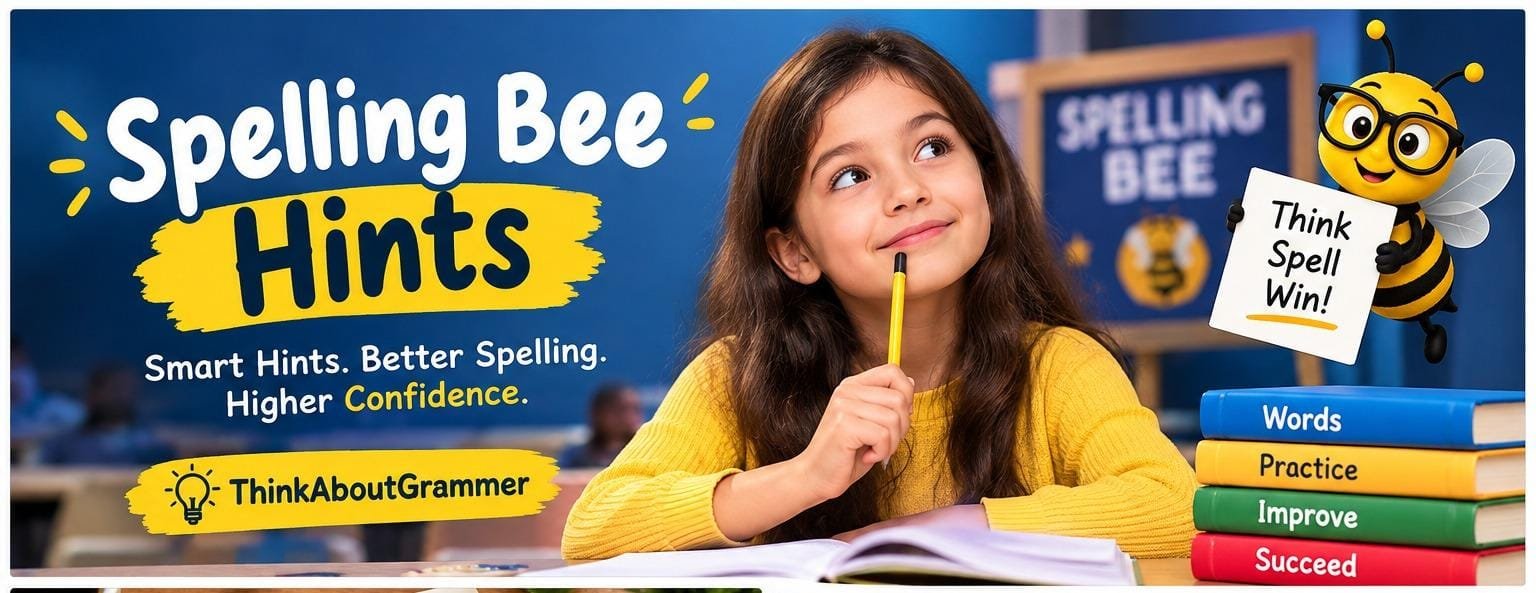
If you are stuck on a Spelling Bee puzzle, the problem is often not your vocabulary. You may simply need a better way to look at the letters.
- What Are Spelling Bee Hints?
- How Does the Spelling Bee Puzzle Work?
- You must use the center letter
- You can reuse letters
- Words generally need at least four letters
- A pangram uses all seven letters
- Best Spelling Bee Hints for Getting Unstuck
- 1. Check the total word count
- 2. Look at word lengths
- Why longer words matter
- 3. Use starting-letter hints
- Search one starting letter at a time
- 4. Try first-two-letter patterns
- 5. Search for common prefixes
- 6. Look for common suffixes
- A useful question
- 7. Hunt for the pangram
- Pangram hints can be gradual
- Spelling Bee Word Patterns Worth Checking
- A Better Way to Use Spelling Bee Hints
- Level 1: No-answer hints
- Level 2: Structural hints
- Level 3: Word-pattern hints
- Level 4: Partial answers
- Level 5: Full answers
- Common Spelling Bee Mistakes
- Mistake 1: Searching randomly
- Mistake 2: Forgetting the center letter
- Mistake 3: Assuming letters cannot repeat
- Mistake 4: Stopping at four-letter words
- Mistake 5: Revealing the pangram too early
- How to Find the Last Few Spelling Bee Words
- Step 1: Check your word count
- Step 2: Check starting letters
- Step 3: Check word lengths
- Step 4: Combine the two clues
- Step 5: Look for word families
- Step 6: Search for the pangram
- Can Spelling Bee Hints Improve Your Vocabulary?
- Spelling Bee Hints vs. Full Answers
- Conclusion
The best spelling bee hints do more than reveal answers. They help you recognize word patterns, spot common endings, find longer words, and work toward the elusive pangram without immediately giving away the puzzle.
This guide explains how to use Spelling Bee hints effectively, how the puzzle works, which word patterns are worth trying, and what to do when you feel completely stuck.
What Are Spelling Bee Hints?
Spelling Bee hints are clues that help you find words in a word puzzle without necessarily revealing the complete answer list.
In the popular New York Times Spelling Bee format, the puzzle contains seven letters arranged in a honeycomb. One letter sits in the center, while six letters surround it. Every accepted word must contain the center letter.
For example, imagine these letters:
A · E · I · L · N · R · T
with T in the center.
You can make words such as:
- LATE
- RATE
- TEAR
- TRAIN
- RETAIN
The important restriction is that every word must contain T.
Good hints can narrow your search by showing things such as:
- Total number of possible words
- Word lengths
- Starting letters
- First two letters
- Number of pangrams
- A clue about the pangram
- Common prefixes or suffixes
This allows you to keep solving instead of immediately looking at the answers.
How Does the Spelling Bee Puzzle Work?
Before using hints, it helps to understand the basic rules.
You must use the center letter
Every valid word must contain the highlighted center letter.
If R is the center letter, a word such as TRAIN could qualify, while PAIN would not.
You can reuse letters
You do not have to use each letter only once.
If the available letters include A, E, R, T, you could potentially make words containing repeated letters, such as:
- TREE
- TREAT
- TEETER
The exact accepted vocabulary depends on the puzzle’s word list.
Words generally need at least four letters
Short combinations are not enough. The standard Spelling Bee format requires words of at least four letters.
A pangram uses all seven letters
One of the most valuable things to look for is a pangram.
A pangram is a word that uses every letter in the puzzle at least once. Finding one can provide a substantial score boost and often helps you discover other words built from the same patterns.
Best Spelling Bee Hints for Getting Unstuck
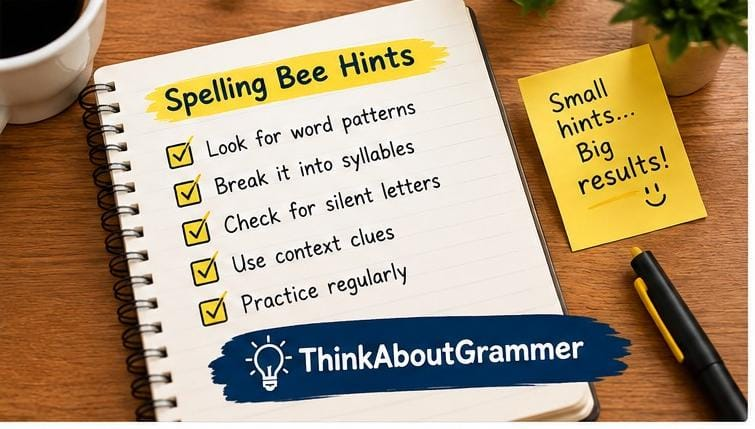
The most useful approach is to reveal hints gradually. Start with the least revealing clue and only move to a stronger hint when necessary.
1. Check the total word count
Suppose you have already found 18 words, and a hint tells you that the puzzle contains 30.
You immediately know there are still 12 words hiding somewhere.
A word count is therefore one of the best non-spoiler Spelling Bee hints because it tells you how much work remains without telling you what the missing words are.
2. Look at word lengths
A word-length breakdown can reveal where your missing answers are.
For example:
| Length | Words to Find |
|---|---|
| 4 letters | 12 |
| 5 letters | 8 |
| 6 letters | 5 |
| 7 letters | 4 |
| 8+ letters | 2 |
If you have already found most of the obvious four-letter words, stop spending most of your time there.
Instead, concentrate on longer combinations.
Why longer words matter
Long words are often easier to overlook because you may stop after finding their shorter versions.
For example:
PAIN → PAINT → PAINTING
When you find one word, ask yourself:
Can I extend this word?
That simple habit can uncover several additional answers.
3. Use starting-letter hints
One of the most powerful Spelling Bee hints is the number of words beginning with each letter.
Imagine your puzzle contains:
| Starting Letter | Number of Words |
|---|---|
| A | 3 |
| B | 1 |
| C | 7 |
| D | 2 |
| S | 9 |
If you have found only two words beginning with C, but the hint says there are seven, you know that section deserves another search.
This is much more useful than randomly trying combinations.
Search one starting letter at a time
Try:
- Every word beginning with A
- Every word beginning with B
- Every word beginning with C
- Continue until you reach the final letter
This turns an open-ended vocabulary challenge into a checklist.
4. Try first-two-letter patterns
If starting-letter hints are not enough, move to the first two letters.
For example:
- BA
- BE
- BI
- BO
- BR
- CA
- CE
- CH
- CO
Suppose you know there are five words beginning with BR.
Instead of thinking about every possible word, concentrate specifically on:
BR + available letters
You might discover several related words depending on the puzzle’s letter set and accepted vocabulary.
This is one of the best techniques when you are close to finishing a puzzle but cannot find the final few words.
5. Search for common prefixes
Prefixes can unlock multiple words from the same letter group.
Look for patterns such as:
- RE-
- UN-
- IN-
- DE-
- EN-
- PRE-
- PRO-
- CON-
- MIS-
For example, if the puzzle allows RE, ask whether you can form words beginning with that combination.
However, do not force a prefix simply because it is common. The center-letter requirement and available letters still determine whether the word can work.
6. Look for common suffixes
Suffixes are equally valuable.
Try endings such as:
- -ING
- -ED
- -ER
- -EST
- -LY
- -TION
- -NESS
- -MENT
For example:
PLAY → PLAYING
or:
RATE → RATING
The important idea is not to assume every familiar suffix will work. Check whether every letter in the resulting word belongs to the hive.
A useful question
Whenever you discover a word, ask:
Can I add a letter or two and create another word?
This is often faster than starting from scratch.
7. Hunt for the pangram
If you have found many words but still cannot reach the top score, look for the pangram.
Remember:
A pangram uses all seven letters in the puzzle at least once.
Instead of randomly rearranging all seven letters, look for familiar word structures that could accommodate the missing letters.
Pangram hints can be gradual
A good hint system might tell you:
- There is one pangram.
- The pangram has eight letters.
- It begins with a particular letter.
- It ends with a particular letter.
- It relates to a particular concept.
Each clue gets you closer without immediately revealing the answer.
That is much more satisfying than seeing the solution immediately.
Spelling Bee Word Patterns Worth Checking
Experienced solvers often search for patterns rather than individual words.
Building a strong vocabulary also makes it easier to recognize unfamiliar word patterns, and practicing with SAT vocabulary words can introduce you to a wider range of useful terms.
Plural forms
If the puzzle permits a plural, check whether a singular noun has a related valid form.
For example:
TREE → TREES
But remember that not every obvious plural is necessarily accepted.
Verb forms
Look for related forms such as:
- WALK
- WALKS
- WALKED
- WALKING
Each resulting word must satisfy the puzzle’s rules and accepted vocabulary.
Repeated letters
Do not assume a word needs to use each available letter once.
Repeated letters can produce useful words:
- LETTER
- BETTER
- TREAT
- NEED
- SEED
depending on the hive.
Double-letter patterns
When appropriate letters are available, test combinations such as:
- LL
- SS
- TT
- EE
- OO
- NN
These patterns are easy to overlook when scanning the honeycomb.
A Better Way to Use Spelling Bee Hints
The biggest mistake is revealing too much information too quickly.
Instead, use a hint ladder.
Level 1: No-answer hints
Start with:
- Total word count
- Total points
- Number of pangrams
- Word-length distribution
These give you direction without revealing vocabulary.
Level 2: Structural hints
Next, check:
- Starting-letter counts
- First-two-letter counts
- Longest word length
- Pangram length
These significantly narrow the search.
Level 3: Word-pattern hints
If you are still stuck, look for:
- Prefixes
- Suffixes
- Word families
- Synonym clues
- Definitions
Level 4: Partial answers
Only after trying the earlier clues should you reveal:
- First letter
- Last letter
- A few internal letters
- A partial word pattern
Level 5: Full answers
Use the complete answer list as a last resort.
This approach gives you help while preserving the actual challenge.
Common Spelling Bee Mistakes
Mistake 1: Searching randomly
Trying random combinations in your head can become exhausting.
Better approach: Work systematically through starting letters and word lengths.
Mistake 2: Forgetting the center letter
You may create a perfectly valid English word that simply does not belong to the puzzle.
Wrong approach: Find a word first and check the center letter afterward.
Better approach: Keep the center letter in mind from the beginning.
Mistake 3: Assuming letters cannot repeat
This can eliminate many possible answers.
Remember that letters can generally be reused.
Mistake 4: Stopping at four-letter words
Four-letter words are usually the easiest to find.
Once you have exhausted them, look for longer versions and related word forms.
Mistake 5: Revealing the pangram too early
Finding the pangram can be satisfying, but revealing it immediately can remove much of the puzzle’s challenge.
Try a pangram hint first.
How to Find the Last Few Spelling Bee Words
The final five or ten words are often harder than the first 20.
At this point, stop relying on inspiration and switch to elimination.
Step 1: Check your word count
Determine how many answers remain.
Step 2: Check starting letters
Compare your discovered words with the available starting-letter counts.
Step 3: Check word lengths
Identify which lengths still have missing words.
Step 4: Combine the two clues
Suppose you need:
- Two words beginning with P
- One must be six letters
- One must be seven letters
Now you have a much smaller search space.
Step 5: Look for word families
If you found one word, test related forms and possible extensions.
Step 6: Search for the pangram
If only one or two answers remain, the pangram may be the missing piece.
Can Spelling Bee Hints Improve Your Vocabulary?
Yes, if you use them as learning tools rather than answer shortcuts. If you want to build a stronger word bank beyond the puzzle, learning how to improve vocabulary can help you recognize unfamiliar words and word patterns more easily.
When you discover an unfamiliar word, do not simply record it. Check:
A Frayer Model vocabulary approach can also help you learn unfamiliar words by connecting each word with its meaning, examples, and related concepts.
- Its definition
- Its pronunciation
- Its part of speech
- Related words
- Common prefixes or suffixes
- How it is used in a sentence
This turns a daily puzzle into practical vocabulary practice.
Spelling Bee Hints vs. Full Answers
There is a big difference between getting a clue and getting the solution.
| Help Type | Spoiler Level | Best For |
|---|---|---|
| Word count | Very low | Knowing how far you are |
| Word lengths | Low | Finding missing categories |
| Starting letters | Low | Narrowing the search |
| First two letters | Medium | Finding specific groups |
| Pangram clue | Medium | End-game solving |
| Partial word | High | When completely stuck |
| Full answer list | Very high | Checking your final result |
If your goal is to improve at Spelling Bee, progressive hints are usually better than immediately checking all answers.
Frequently Asked Questions About Spelling Bee Hints
What is the best Spelling Bee hint?
The best hint depends on how stuck you are. Start with word count and word-length information, then use starting-letter and first-two-letter clues before revealing individual answers.
What is a pangram in Spelling Bee?
A pangram is a word that uses all seven letters in the puzzle at least once. Finding pangrams is an important part of maximizing your score.
Can you reuse letters in Spelling Bee?
Yes. Letters can be used more than once within a word, provided the word follows the puzzle’s rules and contains the required center letter.
How many letters does a Spelling Bee word need?
In the standard New York Times Spelling Bee format, words need at least four letters.
Why can’t I enter a word that is spelled correctly?
Being a correctly spelled English word does not automatically mean it is accepted. The word must meet the puzzle’s rules and be included in its accepted word list.
Should I look for short or long words first?
Short words are usually a good starting point because they help you build your score and recognize useful letter combinations. Once those are exhausted, deliberately search for longer words and word extensions.
How can I find the last few Spelling Bee answers?
Use a systematic approach. Compare your words with the expected starting-letter and word-length counts, then search for missing word families, repeated-letter patterns, and possible pangrams.
Are Spelling Bee hints better than looking at the answers?
If you want to improve your solving ability, yes. Hints preserve part of the challenge while giving you enough information to change your search strategy.
Conclusion
The most effective spelling bee hints do not simply tell you which words to enter. They help you understand where the missing words are hiding.
Start with the center letter, work through word lengths and starting letters, test common prefixes and suffixes, look for word families, and save the pangram hunt for when you need an extra challenge.
If you get stuck, reveal hints progressively rather than jumping straight to the full answer list. The goal is not just to finish one puzzle but to develop a repeatable method that makes the next Spelling Bee easier.