

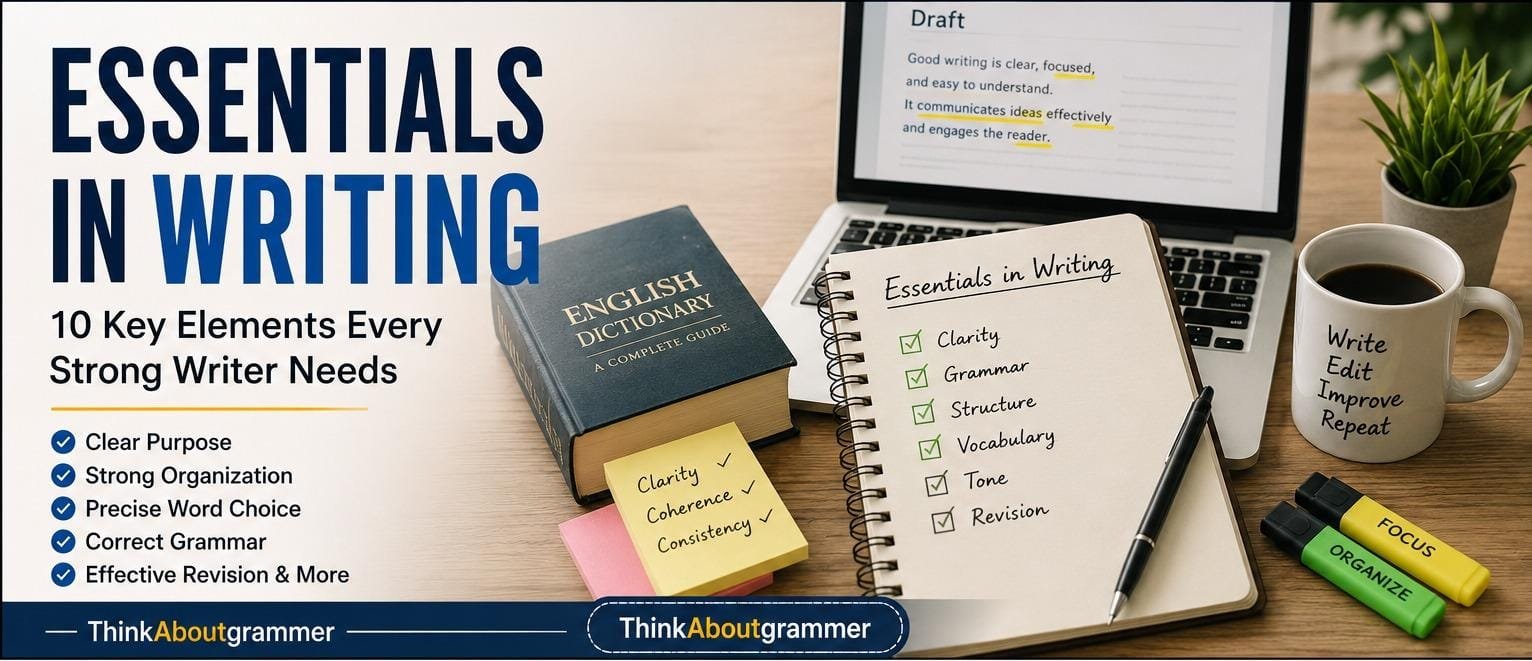
Writing well is not simply about knowing a lot of words or avoiding grammar mistakes. Strong writing communicates an idea clearly, keeps the reader interested, and makes the intended message easy to understand.
- What Are the Essentials in Writing?
- 1. Have a Clear Purpose
- 2. Understand Your Audience
- 3. Develop Clear Ideas
- 4. Organize Your Writing Logically
- 5. Build Coherence and Cohesion
- 6. Use Strong Sentence Structure
- 7. Master Grammar and Punctuation
- 8. Choose Precise Words
- 9. Maintain the Right Tone and Style
- 10. Use Evidence and Examples When Necessary
- 11. Write Strong Introductions
- 12. Create Effective Conclusions
- Common Writing Mistakes to Avoid
- Active Voice vs. Passive Voice
- How to Improve Your Writing Step by Step
- Step 1: Define Your Main Point
- Step 2: Create a Basic Outline
- Step 3: Write the First Draft
- Step 4: Check Organization
- Step 5: Edit for Clarity
- Step 6: Check Grammar
- Step 7: Proofread
- A Practical Writing Checklist
- Why Revision Is One of the Most Important Essentials in Writing
- How Vocabulary and Grammar Work Together
- Essentials in Writing for Different Types of Writing
- 7 Practical Tips for Better Writing
- Conclusion
Whether you are writing a school assignment, blog post, email, essay, report, or professional document, certain essentials in writing make a noticeable difference. These include a clear purpose, strong organization, appropriate word choice, correct grammar, effective sentence structure, coherence, and careful editing.
But what exactly makes writing effective? And how can you apply these principles to your own work?
This guide breaks down the most important elements of good writing, with simple explanations and practical examples you can use immediately.
What Are the Essentials in Writing?
The essentials in writing are the fundamental elements that help a piece of writing communicate its message effectively.
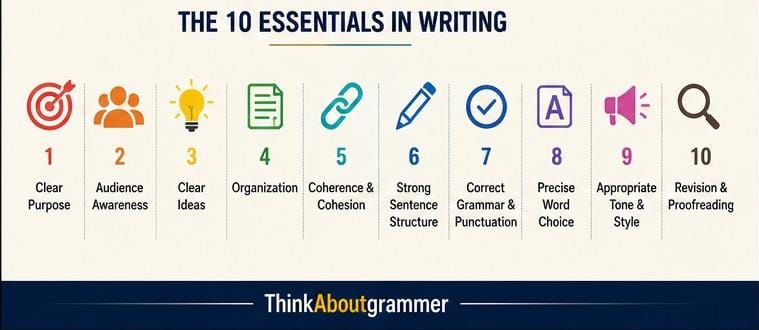
Although different types of writing have different requirements, most successful writing depends on these core principles:
- Purpose
- Audience awareness
- Clear ideas
- Organization
- Coherence and cohesion
- Strong sentence structure
- Correct grammar and punctuation
- Precise word choice
- Appropriate tone and style
- Revision and proofreading
Think of these elements as parts of a building. Good vocabulary may provide attractive decoration, but without a strong structure underneath, the writing will not work well.
1. Have a Clear Purpose
Before writing your first sentence, ask yourself:
“What do I want my reader to understand, feel, or do?”
Your purpose determines almost everything else, including the information you include, your tone, and the way you organize your ideas.
For example, a complaint email and a personal story may discuss the same event, but they have completely different purposes.
Common Writing Purposes
| Purpose | Main Goal | Example |
|---|---|---|
| Inform | Explain something | A guide about renewable energy |
| Persuade | Convince the reader | An argument for recycling |
| Entertain | Engage the reader | A short story |
| Describe | Create a clear picture | A description of a city |
| Explain | Show how or why something happens | A science explanation |
| Instruct | Tell someone how to do something | A recipe or tutorial |
A common mistake is beginning to write without knowing the purpose. This often produces paragraphs that contain interesting information but do not move toward a clear point.
Ask Three Questions Before Writing
Before starting, identify:
- Why am I writing?
- Who will read this?
- What should the reader take away from it?
These questions give your writing direction.
2. Understand Your Audience
Good writing is reader-centered.
You should not communicate with a university professor, a young student, and a potential customer in exactly the same way.
Consider your reader’s:
- Knowledge level
- Expectations
- Age group
- Purpose for reading
- Familiarity with the subject
- Preferred level of detail
For example:
Photosynthesis is the biochemical process through which photoautotrophic organisms convert light energy into chemical energy.
This may be appropriate for an advanced biology discussion, but it is unnecessarily complicated for a beginner.
A simpler explanation could be:
Photosynthesis is the process plants use to turn sunlight, water, and carbon dioxide into energy.
The second version is easier for a general audience because it communicates the central idea without unnecessary technical language.
3. Develop Clear Ideas
One of the most important essentials in writing is clarity.
Readers should not have to guess what you mean.
Compare these sentences:
Unclear:
The changes that were made regarding the project were something that caused problems for the people involved in it.
Clear:
The project changes caused problems for the team.
The second sentence is shorter and more direct while preserving the main idea.
How to Make Ideas Clear
Try to:
- Express one main idea at a time.
- Use specific language.
- Remove unnecessary words.
- Explain unfamiliar concepts.
- Give examples when an idea may be difficult.
- Prefer direct constructions.
Instead of:
There are many students who experience difficulties when they are attempting to manage their time effectively.
Write:
Many students struggle to manage their time.
Clear writing is not necessarily simplistic writing. It means choosing the simplest language that accurately communicates the idea.
4. Organize Your Writing Logically
Even excellent ideas become difficult to follow when they are poorly organized.
Most longer pieces of writing benefit from a basic structure:
Introduction → Main Points → Supporting Details → Conclusion
For an article, for example, you might structure your content like this:
- Introduce the topic.
- Explain the main concept.
- Break the subject into sections.
- Provide examples or evidence.
- Address common problems.
- Give practical advice.
- Summarize the key points.
Use Paragraphs Properly
A paragraph should generally focus on one central idea.
A useful paragraph structure is:
Topic sentence → Explanation → Example → Supporting detail → Transition
For example:
Regular reading can improve vocabulary. When readers encounter unfamiliar words in context, they can often understand how those words function in a sentence. For example, reading articles about science may introduce terms that rarely appear in everyday conversations. Over time, repeated exposure can make those words easier to recognize and use.
The opening sentence establishes the point, while the remaining sentences develop it.
5. Build Coherence and Cohesion
Two related concepts often make writing easier to follow: coherence and cohesion.
What Is Coherence?
Coherence means that your ideas make logical sense together.
Imagine writing a paragraph about exercise and suddenly discussing the history of ancient Rome. Even if both topics are interesting, the paragraph lacks logical unity.
What Is Cohesion?
Cohesion refers to the language devices that connect sentences and ideas.
Useful cohesive devices include:
- However
- Therefore
- For example
- In addition
- As a result
- On the other hand
- Similarly
- In contrast
- For this reason
For example:
Online learning provides flexibility. However, some students find it difficult to remain focused without a traditional classroom environment.
The transition however signals a contrast between the two ideas.
Avoid Overusing Transitions
Transitions are helpful, but adding one to every sentence can make your writing sound mechanical.
Use them when the relationship between ideas needs clarification.
6. Use Strong Sentence Structure
Sentence structure affects both clarity and rhythm.
English commonly uses the basic pattern:
Subject + Verb + Object
Example:
The teacher explained the lesson.
- Subject: The teacher
- Verb: explained
- Object: the lesson
But effective writing uses different sentence structures to avoid monotony.
Simple Sentence
The rain stopped.
Compound Sentence
The rain stopped, and the children went outside.
Complex Sentence
After the rain stopped, the children went outside.
Compound-Complex Sentence
After the rain stopped, the children went outside, and their parents joined them later.
Using different sentence structures can create a natural rhythm and make longer passages easier to read.
7. Master Grammar and Punctuation
Grammar is one of the essential foundations of effective writing. If you are still building your grammar foundation, our guide to what is grammar explains the basic concept and why grammar matters in effective communication.
Grammar helps readers understand relationships between words and ideas. Punctuation helps organize those ideas.
Subject-Verb Agreement
Incorrect:
The list of tasks are long.
Correct:
The list of tasks is long.
The subject is list, not tasks, so the singular verb is is required.
Pronoun Agreement
Incorrect:
Every student should bring their notebook.
This construction is widely used in modern English and is acceptable in many contexts, but in formal writing you may sometimes prefer to restructure the sentence:
All students should bring their notebooks.
This avoids ambiguity while keeping the sentence natural.
Comma Splices
Incorrect:
I finished my homework, I watched television.
Correct:
I finished my homework, and I watched television.
Or:
I finished my homework. Then I watched television.
A comma alone should not normally join two independent clauses.
Apostrophes
Incorrect:
The teachers lounge is upstairs.
Correct:
The teacher’s lounge is upstairs.
The apostrophe shows possession.
8. Choose Precise Words
Strong writing depends on word choice, not simply a large vocabulary.
Using complicated words does not automatically make writing sophisticated.
Compare:
We utilized a methodology to facilitate the completion of the task.
With:
We used a method to complete the task.
The second sentence is more direct.
Replace Vague Words
Weak:
The thing was good.
Better:
The presentation was informative.
Weak:
She did something about the problem.
Better:
She contacted the manager about the problem.
Specific nouns and precise verbs usually communicate more effectively than vague expressions.
Prefer Strong Verbs
Instead of:
He made a decision to leave.
Consider:
He decided to leave.
Instead of:
She gave an explanation of the problem.
Consider:
She explained the problem.
Strong verbs can make sentences shorter and more energetic. Building a stronger vocabulary can also help you choose more precise and effective words. See our guide on how to improve vocabulary for practical strategies.
9. Maintain the Right Tone and Style
Tone describes the attitude your writing communicates.
Your tone might be:
- Professional
- Friendly
- Formal
- Academic
- Conversational
- Persuasive
- Neutral
- Enthusiastic
The appropriate choice depends on the audience and purpose.
For example, a professional email might say:
Thank you for your message. I will review the document and respond by Friday.
A message to a friend could be much more casual:
Thanks! I’ll check it out and get back to you Friday.
Neither sentence is inherently better. The appropriate choice depends on the situation.
Formal vs. Informal Writing
Formal:
We regret to inform you that your application was unsuccessful.
Informal:
Unfortunately, your application wasn’t successful.
Both are grammatically correct, but they create different impressions.
10. Use Evidence and Examples When Necessary
Some forms of writing require more than opinions.
Academic writing, reports, informational articles, and persuasive writing often benefit from:
- Facts
- Statistics
- Research
- Expert opinions
- Real examples
- Relevant comparisons
For example, instead of writing:
Reading is extremely beneficial for everyone.
A stronger informational statement would explain how reading helps and support the claim with reliable evidence where appropriate.
Examples also make abstract concepts easier to understand.
If you explain parallel structure, for instance, examples can immediately show the reader what it means:
She likes reading, writing, and swimming.
The items follow the same grammatical pattern.
11. Write Strong Introductions
Your introduction should help the reader understand what the piece is about and why it matters.
A useful introduction often contains three elements:
- A clear opening
- Context
- A statement of what the reader will learn
For example:
Good writing is more than correct spelling and grammar. It requires clear ideas, logical organization, appropriate word choice, and careful revision. Understanding these essentials in writing can help you communicate more effectively in academic, professional, and everyday situations.
This introduction establishes the topic without wasting time.
Avoid Weak Openings
Try not to begin every article with generic statements such as:
Writing has been an important part of human communication since the beginning of time.
Such openings often delay the information readers actually want.
12. Create Effective Conclusions
A conclusion should bring the discussion together rather than simply repeat every previous sentence.
A strong conclusion can:
- Reinforce the central message
- Summarize the most important points
- Provide a practical takeaway
- Leave the reader with a useful final thought
For example:
Effective writing starts with a clear purpose and develops through organization, precise language, sound grammar, and revision. Instead of trying to make every sentence complicated, focus on making every sentence understandable and purposeful.
Common Writing Mistakes to Avoid
Even experienced writers make mistakes. The key is learning to recognize and correct them.
| Mistake | Problem | Better Approach |
|---|---|---|
| Very long sentences | Ideas become difficult to follow | Divide complex sentences |
| Excessive jargon | Readers may not understand the message | Use accessible language |
| Repetition | Makes writing feel padded | Remove repeated ideas |
| Weak verbs | Sentences may feel flat | Choose precise verbs |
| No paragraph structure | Ideas become confusing | Give each paragraph a clear focus |
| Poor punctuation | Meaning may become unclear | Review punctuation carefully |
| Inconsistent tense | Creates confusion about time | Keep verb tense consistent |
| Overuse of passive voice | Can make sentences less direct | Use active voice when appropriate |
| No proofreading | Small errors remain | Review the final draft |
Active Voice vs. Passive Voice
Active voice usually makes the relationship between the subject and the action clear.
Passive:
The report was completed by the researcher.
Active:
The researcher completed the report.
The active version is more direct.
However, passive voice is not grammatically wrong. It can be useful when the action or result matters more than the person performing it.
The samples were stored at a low temperature.
Here, the focus is on the samples and their storage conditions.
The goal is not to eliminate passive voice completely. The goal is to use the voice that best serves the sentence.
How to Improve Your Writing Step by Step
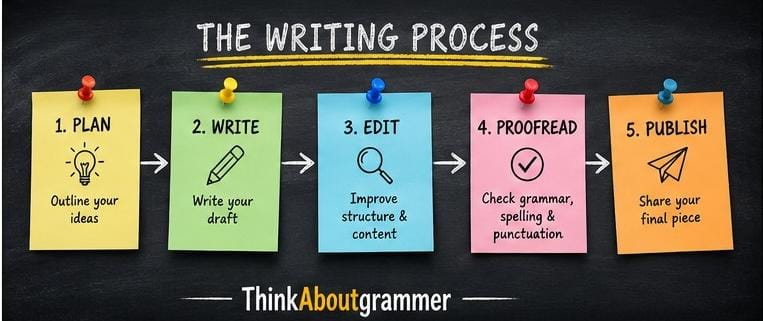
You do not need to fix everything at once. A simple revision process can make improvement much easier.
Step 1: Define Your Main Point
Write your central idea in one sentence.
If you cannot explain what your piece is about in a simple sentence, your draft may need a clearer focus.
Step 2: Create a Basic Outline
List the main points you want to cover.
For example:
- Introduction
- Definition
- Main elements
- Examples
- Common mistakes
- Practical tips
- Conclusion
Step 3: Write the First Draft
Focus on getting your ideas onto the page.
Do not stop every few seconds to find the perfect word.
Step 4: Check Organization
Ask:
- Does each paragraph have a clear purpose?
- Are the ideas in a logical order?
- Does each section connect to the main topic?
Step 5: Edit for Clarity
Look for sentences that are:
- Too long
- Too vague
- Repetitive
- Unnecessarily complicated
Simplify them where possible.
Step 6: Check Grammar
Review:
- Subject-verb agreement
- Verb tense
- Pronouns
- Articles
- Prepositions
- Sentence boundaries
- Punctuation
Step 7: Proofread
Finally, look for spelling, punctuation, capitalization, and typing errors.
Reading your work aloud can also help you notice awkward sentences that may be easy to overlook when reading silently.
A Practical Writing Checklist
Before publishing or submitting your writing, run through this checklist.
Content
- Is the purpose clear?
- Does the content answer the reader’s question?
- Are the important points included?
- Are examples useful and relevant?
Structure
- Does the introduction establish the topic?
- Does each paragraph focus on one main idea?
- Are sections arranged logically?
- Does the conclusion provide a clear takeaway?
Language
- Are sentences easy to understand?
- Are words precise?
- Is the tone appropriate?
- Have unnecessary words been removed?
Grammar
- Are verbs consistent?
- Do subjects and verbs agree?
- Are pronouns clear?
- Is punctuation correct?
- Are sentence fragments and run-on sentences fixed?
Final Review
- Have you proofread the entire piece?
- Have you checked names, facts, and numbers?
- Does the final version sound natural when read aloud?
Why Revision Is One of the Most Important Essentials in Writing
Many writers think writing ends when they reach the final sentence.
It doesn’t.
Revision is where much of the improvement happens.
During revision, you can discover that an introduction is too long, a paragraph contains two unrelated ideas, or a sentence uses unnecessary words.
Consider this example:
First draft:
Due to the fact that the weather conditions were extremely bad, the event was postponed until a later date.
Revised:
Because of the severe weather, the event was postponed.
The revised sentence communicates the same idea more efficiently.
Editing vs. Proofreading
These terms are related but different.
Editing focuses on:
- Clarity
- Structure
- Organization
- Word choice
- Sentence effectiveness
Proofreading focuses mainly on:
- Spelling
- Grammar errors
- Punctuation
- Typographical mistakes
- Formatting inconsistencies
A good writing process includes both.
How Vocabulary and Grammar Work Together
Vocabulary and grammar serve different purposes, but they work together.
Vocabulary gives you the words to express an idea. Grammar determines how those words relate to each other.
For example:
The students completed the assignment.
Changing the vocabulary:
The students finished the assignment.
Changing the grammar:
The assignment was completed by the students.
The meaning remains similar, but the emphasis and structure change.
This is why learning isolated vocabulary words is not enough. Effective writers also need to understand how words function within sentences.
Essentials in Writing for Different Types of Writing
The fundamental principles remain similar, but their application changes according to the writing type.
Academic Writing
Focus on:
- Clear arguments
- Formal tone
- Logical structure
- Evidence
- Accurate citations
- Precise language
When your goal is to explain a topic clearly using facts, examples, and logical organization, expository writing is one of the most useful approaches to understand.
Business Writing
Focus on:
- Clarity
- Conciseness
- Professional tone
- Action-oriented language
- Easy-to-scan formatting
Creative Writing
Focus more heavily on:
- Voice
- Character
- Description
- Narrative structure
- Dialogue
- Pacing
Blog Writing
Focus on:
- Search intent
- Reader needs
- Clear headings
- Scannability
- Helpful examples
- Natural language
- Accurate information
The writing style should change, but clarity remains important across all four.
7 Practical Tips for Better Writing
If you want to improve your writing consistently, start with these habits:
- Read regularly. Pay attention to how strong writers construct sentences and organize ideas.
- Write frequently. Consistent practice helps you recognize your own weaknesses.
- Keep sentences purposeful. Remove words that do not contribute meaning.
- Use examples. Concrete examples often explain concepts better than abstract definitions.
- Read your work aloud. Awkward phrasing becomes easier to notice.
- Revise in stages. Review structure first, then language, grammar, and spelling.
- Learn from corrections. When someone identifies a recurring mistake, understand why it is wrong rather than simply fixing one sentence.
Frequently Asked Questions
What are the main essentials in writing?
The main essentials include a clear purpose, audience awareness, well-developed ideas, logical organization, coherence, effective sentence structure, correct grammar, precise vocabulary, suitable tone, and careful revision.
Why is grammar important in writing?
Grammar helps readers understand how words and ideas relate to one another. Correct grammar reduces ambiguity and makes communication clearer and more professional.
What is the most important element of good writing?
There is no single element that works in every situation, but clarity is fundamental. Even grammatically perfect writing can fail if readers cannot understand its main message.
How can I make my writing clearer?
Use specific words, keep sentences focused, organize ideas logically, remove unnecessary phrases, and explain unfamiliar concepts with simple examples.
Is good vocabulary essential for good writing?
A useful vocabulary helps, but using difficult words is not the same as writing well. The best word is usually the one that communicates the intended meaning accurately and naturally.
How can I avoid grammar mistakes?
Learn the grammar rules that commonly affect your writing, practice applying them, and proofread your work carefully. Reading your writing aloud can also reveal some errors.
What is the difference between editing and proofreading?
Editing improves content, organization, clarity, sentence structure, and word choice. Proofreading is the final check for spelling, grammar, punctuation, and formatting errors.
How do I become a better writer?
Read widely, write consistently, study grammar and sentence structure, seek useful feedback, and revise your work instead of treating the first draft as the final version.
Conclusion
Understanding the essentials in writing gives you a practical foundation for communicating clearly and effectively. Strong writing begins with a clear purpose and audience, then develops through logical organization, focused paragraphs, precise vocabulary, effective sentence structure, appropriate tone, and correct grammar.
But good writing does not happen in a single draft. Revision and proofreading are equally important because they allow you to remove confusion, strengthen weak sentences, and catch errors.
The best approach is simple: know what you want to say, organize it logically, choose clear language, and revise before you publish or submit it. These habits can improve almost any type of writing.